





Defining Annular Eclipses
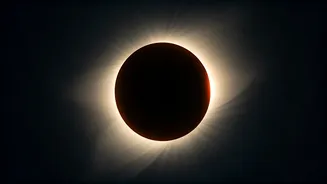
An annular solar eclipse occurs when the Moon passes between the Sun and Earth, but is at or near its farthest point from Earth. Because the Moon appears smaller than the Sun in this alignment, it doesn't
completely cover the solar disk. This leaves a bright ring of sunlight visible around the Moon, creating the captivating 'Ring of Fire' effect. The eclipse's visibility depends on the path of the Moon’s shadow across Earth. Observers within this narrow path will experience the full annular eclipse, while those in a broader surrounding area will see a partial solar eclipse, where the Moon only partially obscures the sun.
Understanding the Science
The science behind an annular solar eclipse relies on the interplay of celestial mechanics. The Moon's orbit around the Earth isn't perfectly circular; it's elliptical. This means the distance between the Earth and Moon varies. When the Moon is at its farthest point from Earth (apogee) during an eclipse, it appears smaller than the Sun. This size difference is what prevents the Moon from completely covering the sun's disc, thus creating the ring-like appearance. The alignment must be precise. The Sun, Moon, and Earth need to be nearly perfectly aligned for the phenomenon to occur and the angle of incidence makes the effect more or less significant depending on the location.
2026 Eclipse Path
The 2026 annular solar eclipse will journey across a vast swath of the globe. The path of annularity will traverse Greenland, Iceland, Spain, and a significant portion of Russia. Prime viewing locations include parts of Spain, offering ideal conditions for observing the 'Ring of Fire.' Detailed predictions provide precise timings for each location, including when the eclipse begins, when annularity (the 'Ring of Fire' phase) starts and ends, and when the eclipse concludes. The exact duration of annularity will differ based on the viewer’s precise location within the path. Factors such as weather conditions will play a significant role in determining how well observers can see the eclipse.
Safe Viewing Practices
It is crucial to prioritize eye safety when viewing any solar eclipse, especially an annular one. The sun's rays can cause severe and permanent damage to the eyes. Never look directly at the sun without proper eye protection. Safe viewing methods include using eclipse glasses that meet the ISO 12312-2 international safety standard. These glasses filter out harmful ultraviolet and infrared radiation. Another safe method is using a solar viewer. You can also use indirect viewing methods, like a pinhole projector, which allows you to project an image of the sun onto a surface. It is vital to supervise children closely to ensure they use these methods correctly. Remember that even brief exposure to the sun without protection can cause eye damage.
Historical Context & Future
Solar eclipses have captivated humanity for centuries, often holding cultural and scientific significance. Historically, eclipses were frequently seen as omens or signs. Today, they serve as remarkable opportunities for scientific study, allowing researchers to gather data about the Sun's corona and the Earth's atmosphere. Looking ahead, eclipses are predictable astronomical events. With accurate calculations and advanced tools, astronomers can precisely forecast the paths and timings of future solar eclipses, allowing for preparations to witness them. Staying informed about upcoming eclipses is a great way to prepare and appreciate these amazing natural occurrences.