





What is the story about?

Mark Zuckerberg's AI Clone: Just a few days after Meta reportedly rolled out Muse Spark, the social media major’s first-ever artificial intelligence model
from one of its highest-paid teams Meta Superintelligence Labs (MSL), the company is now seen ramping up its efforts to develop an AI-first workplace.
Meta building Mark Zuckerberg’s AI clone
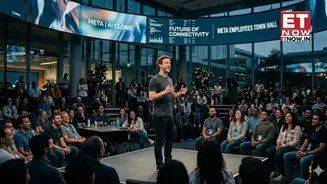
As per Financial Times’ report, the Facebook parent is building a photorealistic, artificial intelligence-powered 3D version of its chief executive, Mark Zuckerberg, that can talk to employees, answer questions and even share feedback.
The AI model mirrors Zuckerberg's mannerisms, voice, tone, publicly available statements, and his recent thinking regarding company strategy. The Meta CEO is said to be personally involved in the training and testing of the animated AI, which can provide conversation and feedback to employees, allowing them to feel more connected to the founder.
Who is behind Meta's Zuckerberg agent?
\Meta’s Superintelligence Labs has reportedly been focusing heavily on creating photorealistic embodiments of virtual AI characters. However, scaling the effort has proven technically difficult since the technology requires large amounts of computing power to achieve realism, while eliminating interaction lag requires massive amounts of computing power.
Meta slashed stock awards by 5%
In February, a Reuter's report, citing the Financial Times, said that Meta reduced its annual distribution of stock options by about 5 per cent for most of its staff, as CEO Mark Zuckerberg ploughs billions of dollars into its artificial intelligence goals.
The social media major said in January that it expected capital expenditure for 2026 to be between USD 115 billion and USD 135 billion, according to Reuters.
Meta has slashed equity-based awards for the bulk of its employees for the second year in a row, the FT report was cited by Reuters.
Last year, the company had cut the stock award by roughly 10 per cent, which shocked some staff at the time, the FT report said.
In January, Meta laid off about 10 per cent of employees within its Reality Labs group, which had about 15,000 workers, as the company redirects resources from some of its virtual reality products to wearables.
Meta’s Indian govt tax bill
Earlier this year, Meta said it had paid USD 652 million, or about Rs 5,993 crore, in income tax to the government in 2025. The company said that the amount was calculated after accounting for the net refunds it received in the country, reported PTI.
The company's regulatory filing showed that it has paid USD 7,578 million for income tax comprising net of refunds, which includes USD 652 million paid in India, according tot PTI. In the regulatory filing, Meta also shared challenges that it is facing in India with respect to investigations by local courts and authorities.
Realising AI's full promise hinges on getting policies right as well as investment, Meta's Chief AI Officer Alexandr Wang has called for bold national strategies and deep public-private collaboration to unlock its full potential, PTI reported.
Addressing the AI Impact Summit this week, Wang underscored the need for the government and industry to work together to deliver the four building blocks of artificial intelligence -- talent, energy, data and compute -- and to design and deploy AI that works for citizens and economies, the PTI report said.
He batted for policies that encourage innovation, "not patchworks of inconsistent regulations that make it harder", the report added.
(With inputs from news agencies)