








What is the story about?
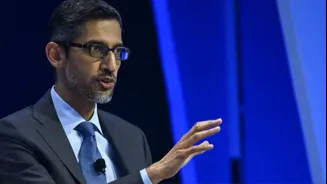
Google CEO Sundar Pichai said that even students who boo artificial intelligence will still help shape its future. He added that young people will adapt to the changes and play a key role in deciding how AI develops in the future.
His remarks come as several tech executives face backlash from students worried that AI could affect jobs and career opportunities.
Speaking on the tech podcast Hard Fork, Pichai w as asked how he plans to handle possible booing when he gives a speech at Stanford University next month. Pichai said he still believes young people will succeed despite fears aroundAI.
"I've always been extraordinarily optimistic about the next generation. AI doesn't change that. My goal would be to share my experiences, and that's what I'm looking to do,” he told the hosts, adding, “These graduates are actually both going to be a big part of driving that progress and also dealing with the impact.”
This comes after former Google CEO Eric Schmidt was booed while speaking at the University of Arizona, discussing the technology. Scott Borchetta also faced backlash at Middle Tennessee State University after talking about how AI could affect music and media jobs.
Students worry about jobs because several companies have already said AI helped them cut costs and reduce staff. Some firms are using AI tools to do work previously handled by employees.
Pichai said people are ‘rightfully’ worried about how AI could change the future, adding that the speed of technological change is difficult for humans to handle. “Humans aren't evolved to process that much change,” he said.
A study, by the Pew Research Center, found that half of Americans feel more worried than excited about AI becoming a bigger part of daily life. At least 12 major companies said they laid off workers this year, partly because AI helped them do tasks faster and with fewer employees, according to Business Insider.
Earlier this month at Carnegie Mellon University, NVIDIA CEO Jensen Huang told students that AI would benefit humanity and create new opportunities for young professionals starting their careers. “Now it's your time to realise your dreams. The timing could not be more perfect,” he said.
His remarks come as several tech executives face backlash from students worried that AI could affect jobs and career opportunities.
Speaking on the tech podcast Hard Fork, Pichai w as asked how he plans to handle possible booing when he gives a speech at Stanford University next month. Pichai said he still believes young people will succeed despite fears aroundAI.
"I've always been extraordinarily optimistic about the next generation. AI doesn't change that. My goal would be to share my experiences, and that's what I'm looking to do,” he told the hosts, adding, “These graduates are actually both going to be a big part of driving that progress and also dealing with the impact.”
This comes after former Google CEO Eric Schmidt was booed while speaking at the University of Arizona, discussing the technology. Scott Borchetta also faced backlash at Middle Tennessee State University after talking about how AI could affect music and media jobs.
Students worry about jobs because several companies have already said AI helped them cut costs and reduce staff. Some firms are using AI tools to do work previously handled by employees.
Pichai said people are ‘rightfully’ worried about how AI could change the future, adding that the speed of technological change is difficult for humans to handle. “Humans aren't evolved to process that much change,” he said.
A study, by the Pew Research Center, found that half of Americans feel more worried than excited about AI becoming a bigger part of daily life. At least 12 major companies said they laid off workers this year, partly because AI helped them do tasks faster and with fewer employees, according to Business Insider.
Earlier this month at Carnegie Mellon University, NVIDIA CEO Jensen Huang told students that AI would benefit humanity and create new opportunities for young professionals starting their careers. “Now it's your time to realise your dreams. The timing could not be more perfect,” he said.