








What is the story about?
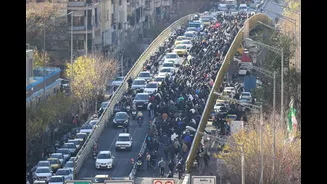
As anti-government protests over a deepening economic crisis enter the third week in Iran, the country has used a ‘kill switch’ approach to jam Elon Musk's Starlink satellite internet service to suppress and control communication flow.
The unrest, which began a few days ago over rising prices and economic hardship, has spread across all 31 provinces. Iran first cut off theinternet delivered through cables and mobile networks, which lasted over three and a half days.
As the protests grew, they are now targeting Starlink, which many protesters have been using to bypass government controls.
Iran has upgraded its internet crackdown by using military jammers to target Starlink, making it much harder for protesters to stay connected online. Starlink has been a ‘Plan B’ for protesters and activists when regular networks are shut down.
Despite tens of thousands of Starlink units reportedly in use across the country, initial reports indicate about 30% of Starlink traffic was disrupted, quickly rising to over 80%.
According to the reports, the highly expensive jamming equipment was likely supplied by Russia or China.
Starlink, which operates via a network of low-Earth orbit satellites about 550 km above the ground terminals, needs GPS signals to know the location of ground stations and maintain satellite connections. Interfering with GPS or jamming signals near the terminal can disrupt service.
The system's design, with antennas that receive signals from a wide angle to track moving satellites, makes it vulnerable to ground-level jamming. Even in Ukraine, Russian forces have struggled to fully block Starlink.
While it's not clear how Starlink's service was being disrupted in Iran, some specialists say it could be the result of jamming of Starlink terminals that would overpower their ability to receive signals from the satellites, according to The Times of Israel.
Arina Moradi, a member of the Hengaw Organisation for Human Rights, said, “We have seen in the past that whenever they shut down [the] internet, it's because they want to use, as much as possible, their violence and their method of controlling people using violence.”
Iran has a history of shutting down the internet during protests. Earlier, it blocked internet access in response to protests in 2019, 2022 and during the July Iran–Israel war in 2025.
"The technology is advancing. A process that was quite manual in 2019 with the step-by-step disconnection of networks... has now been automated," said London-based founder, Alp Toker. Along with the internet, Iran has also restricted phone calls and landline connections.
More than 500 people have been killed and over 10,600 arrested in the ongoing protests. The demonstrations began in December last week as people poured onto the streets against soaring inflation, falling currency and economic crises - all resulting from crippling US sanctions on the Islamic Republic.
The unrest, which began a few days ago over rising prices and economic hardship, has spread across all 31 provinces. Iran first cut off theinternet delivered through cables and mobile networks, which lasted over three and a half days.
As the protests grew, they are now targeting Starlink, which many protesters have been using to bypass government controls.
Iran has upgraded its internet crackdown by using military jammers to target Starlink, making it much harder for protesters to stay connected online. Starlink has been a ‘Plan B’ for protesters and activists when regular networks are shut down.
Despite tens of thousands of Starlink units reportedly in use across the country, initial reports indicate about 30% of Starlink traffic was disrupted, quickly rising to over 80%.
According to the reports, the highly expensive jamming equipment was likely supplied by Russia or China.
Starlink, which operates via a network of low-Earth orbit satellites about 550 km above the ground terminals, needs GPS signals to know the location of ground stations and maintain satellite connections. Interfering with GPS or jamming signals near the terminal can disrupt service.
The system's design, with antennas that receive signals from a wide angle to track moving satellites, makes it vulnerable to ground-level jamming. Even in Ukraine, Russian forces have struggled to fully block Starlink.
While it's not clear how Starlink's service was being disrupted in Iran, some specialists say it could be the result of jamming of Starlink terminals that would overpower their ability to receive signals from the satellites, according to The Times of Israel.
Arina Moradi, a member of the Hengaw Organisation for Human Rights, said, “We have seen in the past that whenever they shut down [the] internet, it's because they want to use, as much as possible, their violence and their method of controlling people using violence.”
Iran has a history of shutting down the internet during protests. Earlier, it blocked internet access in response to protests in 2019, 2022 and during the July Iran–Israel war in 2025.
"The technology is advancing. A process that was quite manual in 2019 with the step-by-step disconnection of networks... has now been automated," said London-based founder, Alp Toker. Along with the internet, Iran has also restricted phone calls and landline connections.
More than 500 people have been killed and over 10,600 arrested in the ongoing protests. The demonstrations began in December last week as people poured onto the streets against soaring inflation, falling currency and economic crises - all resulting from crippling US sanctions on the Islamic Republic.