







India's public systems operate at a massive scale, which includes multiple languages, varied infrastructure, and diverse local realities. Data is often
contextualised for local needs, and connectivity is a “work in progress.”
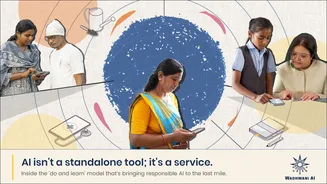
Frontline workers in health, teachers in public schools, and farmers across the country carry heavy workloads and operate far removed from the controlled environments for which most AI systems are designed. Without grounding in these realities, lab-built AI rarely achieves sustainable success, lacking alignment with the systems and people meant to use it.
This was the gap that Wadhwani AI set out to address.
Founded in 2018 by Dr Romesh Wadhwani and Sunil Wadhwani, the Institute was conceived as a non-profit, cross-domain AI organisation working directly with and within public systems. It was inaugurated by the Prime Minister of India in 2018, marking its formal entry into the country’s technology landscape.
The Institute is guided by three core principles: a commitment to responsible and ethical AI, close collaboration with government partners, and an India-first approach. These are represented in its core values—Serve, Care, Learn, Communicate—and reflected in an approach of “do, learn, and keep improving alongside the systems we serve.”
Scaling AI
Scaling AI depends on adoption and sustainability nationwide. Quality requires strong data, talent, and research; adoption necessitates stakeholder alignment, training, and addressing constraints like language diversity, limited connectivity, and frontline realities.
Wadhwani AI designs for both constraint and capability. Solutions run on basic smartphones, function offline or with low connectivity, and support multiple Indian languages via multimodal inputs. Scaled adoption is ensured through policy alignment, updated guidelines, and sustained training embedded in existing workflows, with continuous stakeholder feedback for real-time refinement. Scale is engineered via field-first design, systems integration, and long-term public ownership, merging top-down intent with bottom-up execution.
This approach expanded the Institute’s impact to over 190 million people: 184 million through healthcare deployments, 7.9 million students in education, and 1 million farmers, supported by 25 solutions (in development and deployment) and several government partnerships at the national and state levels.
Why building for India helps build for everyone
India is one of the most demanding environments for deploying AI at scale. Public systems must function across extraordinary diversity in language, geography, infrastructure, and lived experience, shaped as much by human judgment as by policy.
Wadhwani AI builds solutions in this context, prioritising usability compatible with basic devices, which operate in local languages, and seamlessly integrate with existing digital public infrastructure.
Designing with these constraints in mind produces a unique type of robustness; systems that can handle noise, variability, and real-world decision-making. AI serves as an integrated element of a broader service ecosystem rather than a standalone tool.
This is where India’s relevance extends globally. Many public systems across the Global South face similar constraints at a different scale. AI solutions that work in India may be easy to adapt because they were designed to endure uncertainty and complexity.
The road ahead
The past few years have reinforced a simple truth: deploying AI in public systems is a long-term commitment, driven by iterative cycles of doing and learning. Across health, education, and agriculture, Wadhwani AI’s impact is a consequence of sustained engagement.
As India’s digital public infrastructure continues to expand, the institute will deepen its role by strengthening what already works, at a scale that is responsible, resilient, and firmly grounded in real-world use.