








What is the story about?
Microsoft researchers have trained a new multimodal artificial intelligence capable of converting routine pathology slides into spatial proteomics data, CEO Satya Nadella announced.
The breakthrough could significantly reduce the time and cost required to analyse cancer tissues, potentially expanding global access to advanced cancer diagnostics and treatment research.
Sharing the update on X,Nadella highlighted that the technology can transform standard pathology images into complex protein-mapping data that typically requires expensive laboratory procedures. The approach could help researchers and clinicians better understand cancer biology while making cutting-edge analysis more widely available.
A video accompanying theannouncement emphasised the growing promise of immunotherapy in cancer treatment. Immunotherapy, which uses the body’s immune system to fight cancer, is widely considered one of the most promising approaches to controlling the disease. However, scientists continue to face a major challenge in identifying which patients will respond positively to such treatments.
Dr Carlo Bifulco, chief medical officer of Providence Genomics and medical director at the Providence Cancer Institute, noted that understanding patient response remains one of the biggest hurdles in the field.
“The big challenge that we have in the field right now is to understand which patients will respond,” he said.
Spatial proteomics technology can measure multiple proteins simultaneously and generate multiplex immunofluorescent images, helping researchers determine whether a patient is likely to benefit from immunotherapy. However, producing these images typically takes several days and can cost thousands of dollars.
To address this challenge, researchers from Providence Health & Services and the University of Washington collaborated with Microsoft to develop a multimodal AI model called GigaTIME. The system is designed to generate spatial proteomics data at scale.
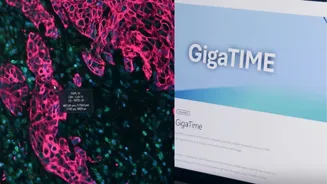
According to Sheng Wang, assistant professor at the University of Washington, the model was trained using large-scale datasets containing millions of cells. While the input image provides limited information about protein activity, GigaTIME can convert these images into colourful multiplex immunofluorescent images, where the colour represents protein activation.
These protein patterns play a critical role in disease progression, particularly in cancer, and can help predict how patients might respond to specific drugs.
In a research paper published in the journal Cell on December 9, 2025, scientists detailed how GigaTIME was trained on a dataset containing 40 million cells with paired H&E and mIF images across 21 protein channels.
The model was then applied to data from more than 14,000 cancer patients across 51 hospitals and over 1,000 clinics within the Providence system.
The study generated a large virtual dataset of around 3,00,000 multiplex immunofluorescent images covering 24 types of cancer and more than 300 cancer subtypes.
Researchers identified over 1,200 statistically significant associations between protein activation patterns and clinical factors such as biomarkers, cancer stage and patient survival.
Researchers say the technology represents the first population-scale study of the tumour immune microenvironment based on spatial proteomics, something that was previously difficult due to limited mIF data availability.
“By translating readily available H&E pathology slides into high-resolution virtual mIF data, GigaTIME provides a novel research framework for exploring precision immuno-oncology through population-scale TIME analysis and discovery,” the paper added.
The GigaTIME model has now been made publicly available at Microsoft Foundry and on Hugging Face to help accelerate clinical research in precision oncology.
Scientists involved in the project hope it will enable hospitals and research centres to conduct advanced cancer research and accelerate the development of next-generation immunotherapies that could improve patient outcomes globally.
The breakthrough could significantly reduce the time and cost required to analyse cancer tissues, potentially expanding global access to advanced cancer diagnostics and treatment research.
Sharing the update on X,Nadella highlighted that the technology can transform standard pathology images into complex protein-mapping data that typically requires expensive laboratory procedures. The approach could help researchers and clinicians better understand cancer biology while making cutting-edge analysis more widely available.
We’ve trained a multimodal AI model to turn routine pathology slides into spatial proteomics, with the potential to reduce time and cost while expanding
access to cancer care. pic.twitter.com/OCptXdsUm1
— Satya Nadella (@satyanadella) March 15, 2026
A video accompanying theannouncement emphasised the growing promise of immunotherapy in cancer treatment. Immunotherapy, which uses the body’s immune system to fight cancer, is widely considered one of the most promising approaches to controlling the disease. However, scientists continue to face a major challenge in identifying which patients will respond positively to such treatments.
Dr Carlo Bifulco, chief medical officer of Providence Genomics and medical director at the Providence Cancer Institute, noted that understanding patient response remains one of the biggest hurdles in the field.
“The big challenge that we have in the field right now is to understand which patients will respond,” he said.
Spatial proteomics technology can measure multiple proteins simultaneously and generate multiplex immunofluorescent images, helping researchers determine whether a patient is likely to benefit from immunotherapy. However, producing these images typically takes several days and can cost thousands of dollars.
To address this challenge, researchers from Providence Health & Services and the University of Washington collaborated with Microsoft to develop a multimodal AI model called GigaTIME. The system is designed to generate spatial proteomics data at scale.
According to Sheng Wang, assistant professor at the University of Washington, the model was trained using large-scale datasets containing millions of cells. While the input image provides limited information about protein activity, GigaTIME can convert these images into colourful multiplex immunofluorescent images, where the colour represents protein activation.
These protein patterns play a critical role in disease progression, particularly in cancer, and can help predict how patients might respond to specific drugs.
In a research paper published in the journal Cell on December 9, 2025, scientists detailed how GigaTIME was trained on a dataset containing 40 million cells with paired H&E and mIF images across 21 protein channels.
The model was then applied to data from more than 14,000 cancer patients across 51 hospitals and over 1,000 clinics within the Providence system.
The study generated a large virtual dataset of around 3,00,000 multiplex immunofluorescent images covering 24 types of cancer and more than 300 cancer subtypes.
Researchers identified over 1,200 statistically significant associations between protein activation patterns and clinical factors such as biomarkers, cancer stage and patient survival.
Researchers say the technology represents the first population-scale study of the tumour immune microenvironment based on spatial proteomics, something that was previously difficult due to limited mIF data availability.
“By translating readily available H&E pathology slides into high-resolution virtual mIF data, GigaTIME provides a novel research framework for exploring precision immuno-oncology through population-scale TIME analysis and discovery,” the paper added.
The GigaTIME model has now been made publicly available at Microsoft Foundry and on Hugging Face to help accelerate clinical research in precision oncology.
Scientists involved in the project hope it will enable hospitals and research centres to conduct advanced cancer research and accelerate the development of next-generation immunotherapies that could improve patient outcomes globally.