




What is the story about?
As concerns mount over artificial intelligence reshaping the employment landscape, technology leaders at the AI Impact Summit 2026 urged professionals to remain composed and prioritise skill development, stressing that adaptability will be key to long-term job security.
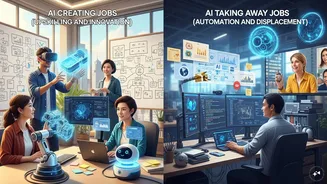
Speaking at a session on “The Future of Employability in the Age of AI”, industry experts said that while certain roles may become obsolete, AI will simultaneously generate new opportunities.
Sanjeev Bikhchandani, founder of Info Edge, which owns Naukri.com, drew parallels with the introduction of computers in banking. "Nobody lost their job and instead productivity went up," he said, as per news agency PTI.
He advised young professionals to focus on personal readiness rather than policy debates while addressing fears around job losses. "Don't worry about policy. Just think what should you do so that AI does not make you lose your job and instead help you get a job," he remarked.
"AI is happening, it is relentless, if you don't do AI, AI will be done to you... Set a personal target of learning how to use three AI platforms within the next three months. The more you do that the more your job is safe," he added.
Read more: Bill Gates meets Andhra CM Naidu in Amaravati ahead of AI Impact Summit; discusses health, agri, and tech
Sateesh Seetharamiah, CEO of EdgeVerve, a subsidiary of Infosys, described AI as a "faster capability multiplier" and emphasised that lifelong learning would remain essential. He noted that while AI boosts productivity, human accountability will still be necessary, adding that jobs would evolve rather than disappear.
"AI has generated more productivity to businesses... Ultimately there has to be a human being to take accountability of the jobs getting done," he said, as per PTI.
Reskilling and new sectors may drive job creation
Sampark Foundation founder chairman and former CEO of HCL Technologies Vineet Nayar said AI could eliminate half of existing jobs but create an equivalent number of new roles requiring specialised skills.
"AI offers us a scope to reskill ourselves. But what skills are required (in respective professions) that we need to figure out," he said.
Nayar also cautioned that India must think strategically about data ownership and domestic AI development to maintain competitiveness in the coming decade.
Co-Chairman of the CII National AI Forum and CEO of Industry.AI, Tejpreet Singh Chopra, said that AI is going to make people more productive.
Read more: India AI Impact Summit 2026: Job losses, harmful bots among key issues on agenda
"I don't think AI is going to take away jobs. I think what AI is going to do is make people more productive... We're going to come into an age where humans are going to be thinking, and computers are going to be doing," he said, as per news agency ANI.
Co-founders of AI4India, Shashi Shekhar Vempati and Alok Agrawal, highlighted India’s growing AI profile and the need for focused upskilling.
"AI is here to stay, and the most important thing is to upskill, focusing on AI... There is significant awareness of AI and what people can do with it," Alok Agrawal said, as per ANI.
"The key takeaway is that jobs will not go, but their nature will change, for which people will have to re-skill," Vempati noted.
AI can create jobs in healthcare
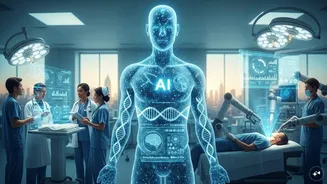
Anurag Mairal, Adjunct Professor at Stanford University School of Medicine, said that AI can create add jobs in the Indian healthcare sector.
"I just spoke on employability in the age of AI... The risks to jobs from AI are more routine and mundane tasks. I think India has the opportunity to create 10 million jobs that would be healthcare professionals. In my opinion, it will create more jobs in healthcare," Mairal said, as per ANI.
"I like the name of the summit - AI Impact summit, it is all about using AI to do something for people. There is no better place to be than India," he added.
Read more: AI Impact Summit: AI-led road safety, V2V communication, emission control and school curriculum under study
Speaking at a session on “The Future of Employability in the Age of AI”, industry experts said that while certain roles may become obsolete, AI will simultaneously generate new opportunities.
Sanjeev Bikhchandani, founder of Info Edge, which owns Naukri.com, drew parallels with the introduction of computers in banking. "Nobody lost their job and instead productivity went up," he said, as per news agency PTI.
He advised young professionals to focus on personal readiness rather than policy debates while addressing fears around job losses. "Don't worry about policy. Just think what should you do so that AI does not make you lose your job and instead help you get a job," he remarked.
"AI is happening, it is relentless, if you don't do AI, AI will be done to you... Set a personal target of learning how to use three AI platforms within the next three months. The more you do that the more your job is safe," he added.
Read more: Bill Gates meets Andhra CM Naidu in Amaravati ahead of AI Impact Summit; discusses health, agri, and tech
Sateesh Seetharamiah, CEO of EdgeVerve, a subsidiary of Infosys, described AI as a "faster capability multiplier" and emphasised that lifelong learning would remain essential. He noted that while AI boosts productivity, human accountability will still be necessary, adding that jobs would evolve rather than disappear.
"AI has generated more productivity to businesses... Ultimately there has to be a human being to take accountability of the jobs getting done," he said, as per PTI.
Reskilling and new sectors may drive job creation
Sampark Foundation founder chairman and former CEO of HCL Technologies Vineet Nayar said AI could eliminate half of existing jobs but create an equivalent number of new roles requiring specialised skills.
"AI offers us a scope to reskill ourselves. But what skills are required (in respective professions) that we need to figure out," he said.
Nayar also cautioned that India must think strategically about data ownership and domestic AI development to maintain competitiveness in the coming decade.
Co-Chairman of the CII National AI Forum and CEO of Industry.AI, Tejpreet Singh Chopra, said that AI is going to make people more productive.
Read more: India AI Impact Summit 2026: Job losses, harmful bots among key issues on agenda
"I don't think AI is going to take away jobs. I think what AI is going to do is make people more productive... We're going to come into an age where humans are going to be thinking, and computers are going to be doing," he said, as per news agency ANI.
Co-founders of AI4India, Shashi Shekhar Vempati and Alok Agrawal, highlighted India’s growing AI profile and the need for focused upskilling.
"AI is here to stay, and the most important thing is to upskill, focusing on AI... There is significant awareness of AI and what people can do with it," Alok Agrawal said, as per ANI.
"The key takeaway is that jobs will not go, but their nature will change, for which people will have to re-skill," Vempati noted.
AI can create jobs in healthcare
Anurag Mairal, Adjunct Professor at Stanford University School of Medicine, said that AI can create add jobs in the Indian healthcare sector.
"I just spoke on employability in the age of AI... The risks to jobs from AI are more routine and mundane tasks. I think India has the opportunity to create 10 million jobs that would be healthcare professionals. In my opinion, it will create more jobs in healthcare," Mairal said, as per ANI.
"I like the name of the summit - AI Impact summit, it is all about using AI to do something for people. There is no better place to be than India," he added.
Read more: AI Impact Summit: AI-led road safety, V2V communication, emission control and school curriculum under study