







What is the story about?
Artificial intelligence is no longer a distant concept for the accounting profession. It is already changing how audits are conducted, how tax work is delivered, and how advisory teams create value for clients. For students preparing to enter the profession, and for firms hiring the next generation of talent, the question is no longer if AI will matter, but how prepared accountants are to work with it.
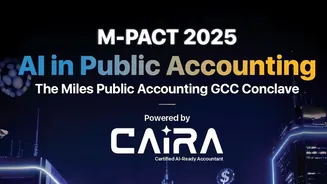
These questions took center stage at M-PACT 2025 - AI in Public Accounting, the Miles Public Accounting GCC Conclave. Hosted by Miles Education in partnership with Christ University, the conclave brought together leaders from public accounting firms, Global Capability Centers (GCCs), and academia to discuss how AI is reshaping the role of the CPA and what that means for careers, education, and the future of the profession.
Rather than focusing on tools or hype, the conversations stayed grounded in a simple reality: accounting is evolving from a largely compliance-driven function into one that demands stronger judgement, deeper business understanding, and the ability to work confidently alongside intelligent systems.
From manual testing to tech-enabled trust
One of the clearest themes that emerged during the conclave was the changing nature of trust in public accounting. Traditionally, trust was built through manual processes, detailed testing, and extensive documentation. With AI-enabled analytics and automation becoming more common, that model is shifting.
Speakers emphasised that while AI can process data faster and identify patterns at scale, it does not replace professional judgement. In fact, it raises the bar. Clients increasingly have access to the same data and tools as firms. What they rely on accountants for is interpretation, context, and the confidence to decide what can and cannot be trusted.
For students, this reframes what success in accounting looks like. Technical accuracy remains essential, but it is no longer sufficient on its own. Data literacy, ethical reasoning, and the ability to explain insights clearly are becoming core skills, not optional add-ons.
The CPA as an advisor, not just a scorekeeper
Another recurring idea was the shift in the CPA's role from historical reporting to forward-looking advisory. As routine tasks become automated, accountants are expected to spend more time helping clients anticipate risks, plan for growth, and make better decisions.
AI enables predictive analysis and more personalised insights, but speakers were clear that technology only creates value when paired with human understanding. Tools can generate dashboards and forecasts, but it is the accountant who must ask the right questions, challenge assumptions, and tailor advice to each client's context.
For young professionals, this points to a career path that is broader than many expect. Accounting is no longer about staying behind spreadsheets. It is about becoming a strategic partner to businesses, supported by technology rather than replaced by it.
Bridging the gap between education and practice
The conclave also highlighted a long-standing challenge: the gap between what students learn in classrooms and what firms expect in practice. Industry leaders noted that while foundational concepts remain critical, curricula often struggle to keep pace with technological change.
Discussions around academia-industry partnerships focused on experiential learning, internships, and exposure to real-world workflows. Learning, as several panelists noted, does not end with a degree or certification. It is a continuous process, shaped heavily by on-the-job experience.
This perspective is particularly relevant for students who assume that earning a qualification marks the finish line. In reality, it marks the starting point of a career that will require constant upskilling and adaptability.
Introducing AI fluency into accounting careers
It was in this context that CAIRA - the Certified AI-Ready Accountant credential was introduced during M-PACT 2025. Positioned as a complement to existing qualifications such as CA, CPA, or CMA, CAIRA aims to address a question many students and professionals are asking: Where do you begin when it comes to learning AI for accounting?
The program is structured to move from foundational understanding to functional application and, eventually, strategic leadership. Rather than focusing only on tools, it emphasises mindset, responsible use, and the ability to apply AI meaningfully across audit, tax, and finance roles.
Speakers described this kind of structured learning as increasingly necessary. While information about AI is widely available online, knowing how to apply it responsibly within the constraints of regulation, ethics, and client expectations is far more complex.
GCCs and the future of global accounting work
The final set of conversations focused on the evolution of Global Capability Centres. Once viewed largely as cost-saving back offices, GCCs are increasingly taking on complex, high-impact work and, in some cases, shaping global strategy.
AI is accelerating this shift, but it also brings challenges around data privacy, governance, and talent readiness. Leaders stressed that success depends not just on access to technology, but on building teams with strong fundamentals and the confidence to question outputs rather than accept them blindly.
A profession in transition
M-PACT 2025 closed with a clear message: public accounting is in transition, not disruption. The fundamentals of trust, ethics, and professional responsibility remain unchanged. What is changing is how those fundamentals are delivered.
For students, this is both a challenge and an opportunity. Those who build strong core skills and pair them with AI fluency will be well-positioned for the next phase of the profession.
To hear these conversations directly from industry leaders and see how the day unfolded, watch the M-PACT 2025 highlights episode here:
These questions took center stage at M-PACT 2025 - AI in Public Accounting, the Miles Public Accounting GCC Conclave. Hosted by Miles Education in partnership with Christ University, the conclave brought together leaders from public accounting firms, Global Capability Centers (GCCs), and academia to discuss how AI is reshaping the role of the CPA and what that means for careers, education, and the future of the profession.
Rather than focusing on tools or hype, the conversations stayed grounded in a simple reality: accounting is evolving from a largely compliance-driven function into one that demands stronger judgement, deeper business understanding, and the ability to work confidently alongside intelligent systems.
From manual testing to tech-enabled trust
One of the clearest themes that emerged during the conclave was the changing nature of trust in public accounting. Traditionally, trust was built through manual processes, detailed testing, and extensive documentation. With AI-enabled analytics and automation becoming more common, that model is shifting.
Speakers emphasised that while AI can process data faster and identify patterns at scale, it does not replace professional judgement. In fact, it raises the bar. Clients increasingly have access to the same data and tools as firms. What they rely on accountants for is interpretation, context, and the confidence to decide what can and cannot be trusted.
For students, this reframes what success in accounting looks like. Technical accuracy remains essential, but it is no longer sufficient on its own. Data literacy, ethical reasoning, and the ability to explain insights clearly are becoming core skills, not optional add-ons.
The CPA as an advisor, not just a scorekeeper
Another recurring idea was the shift in the CPA's role from historical reporting to forward-looking advisory. As routine tasks become automated, accountants are expected to spend more time helping clients anticipate risks, plan for growth, and make better decisions.
AI enables predictive analysis and more personalised insights, but speakers were clear that technology only creates value when paired with human understanding. Tools can generate dashboards and forecasts, but it is the accountant who must ask the right questions, challenge assumptions, and tailor advice to each client's context.
For young professionals, this points to a career path that is broader than many expect. Accounting is no longer about staying behind spreadsheets. It is about becoming a strategic partner to businesses, supported by technology rather than replaced by it.
Bridging the gap between education and practice
The conclave also highlighted a long-standing challenge: the gap between what students learn in classrooms and what firms expect in practice. Industry leaders noted that while foundational concepts remain critical, curricula often struggle to keep pace with technological change.
Discussions around academia-industry partnerships focused on experiential learning, internships, and exposure to real-world workflows. Learning, as several panelists noted, does not end with a degree or certification. It is a continuous process, shaped heavily by on-the-job experience.
This perspective is particularly relevant for students who assume that earning a qualification marks the finish line. In reality, it marks the starting point of a career that will require constant upskilling and adaptability.
Introducing AI fluency into accounting careers
It was in this context that CAIRA - the Certified AI-Ready Accountant credential was introduced during M-PACT 2025. Positioned as a complement to existing qualifications such as CA, CPA, or CMA, CAIRA aims to address a question many students and professionals are asking: Where do you begin when it comes to learning AI for accounting?
The program is structured to move from foundational understanding to functional application and, eventually, strategic leadership. Rather than focusing only on tools, it emphasises mindset, responsible use, and the ability to apply AI meaningfully across audit, tax, and finance roles.
Speakers described this kind of structured learning as increasingly necessary. While information about AI is widely available online, knowing how to apply it responsibly within the constraints of regulation, ethics, and client expectations is far more complex.
GCCs and the future of global accounting work
The final set of conversations focused on the evolution of Global Capability Centres. Once viewed largely as cost-saving back offices, GCCs are increasingly taking on complex, high-impact work and, in some cases, shaping global strategy.
AI is accelerating this shift, but it also brings challenges around data privacy, governance, and talent readiness. Leaders stressed that success depends not just on access to technology, but on building teams with strong fundamentals and the confidence to question outputs rather than accept them blindly.
A profession in transition
M-PACT 2025 closed with a clear message: public accounting is in transition, not disruption. The fundamentals of trust, ethics, and professional responsibility remain unchanged. What is changing is how those fundamentals are delivered.
For students, this is both a challenge and an opportunity. Those who build strong core skills and pair them with AI fluency will be well-positioned for the next phase of the profession.
To hear these conversations directly from industry leaders and see how the day unfolded, watch the M-PACT 2025 highlights episode here: