
This period coincided with the AI-fueled stock market boom in the US. At least five of the ‘Magnificent Seven’ giants in the US – Nvidia, Microsoft, Meta, Alphabet and Amazon – invested over $400 billionin building AI infrastructure. This translated to a 27.5% gain for ‘Magnificent Seven’ stocks last year.
| Company | Mkt Cap Added In 2025 | Promoter Stake |
| Nvidia | $1.25 trillion | ~3.5% ($150 bn) |
| Microsoft | $446 billion | ~1.13% ($40 bn) |
| Meta | $190 billion | ~13-14% ($215-230 bn) |
| Alphabet | $1.45 trillion | Brin & Page: 87.4% of all Class-B shares ($500 bn+ combined) |
| Amazon | $140 billion | ~8-9% (~$230 bn) |
| $3.47 trillion (Combined) |
The AI-led boom has also led to the rise of AI billionaires. According to Crunchbase, AI startups received $100 billion in venture capital funding in 2025, leading to the creation of at least 50 new billionaires. Surge AI’s founder Edwin Chen became the newest ‘AI billionaire’, with a net worth of $18 billion.
Out of the top 10 richest people in Forbes Billionaires List, at least four of them actively run ‘Big Tech’ firms. Mark Zuckerberg of Meta was the second richest man in 2025, with a net worth of $216 billion. However, the biggest AI-led gainers were the founders of Alphabet – Larry Page and Sergey Brin. As Alphabet (Google) crossed $3 trillion in valuation last year, the founders saw their wealth rise by at least $100 billion.
While the net worth of the 10 richest billionaires touched $2.4 trillion last year, Oxfam noted that their wealth was greater than that of the poorest half, about 4 billion people, of humanity. “Corporate empires are adding trillions to the wealth of their owners. Extreme wealth accumulation is occurring particularly in the tech sector, where huge amounts of natural resources are being exploited,” read Oxfam’s report published on the eve of the World Economic Forum in Davos.
The report added that the rising wealth gap can trigger political inequality across the world, arguing that more unequal countries are more likely to experience democratic erosion than more equal countries. In 2025, Gen Z erupted in protests over rising economic inequality and political repression, exposing the fragile political economies of countries like Iran, Nepal, Bangladesh and Indonesia.
However, the spectre of political inequality will rise in the long-run. According to Oxfam, billionaires are over 4,000 times more likely to hold political office than ordinary people. US President Donald Trump’s economic policies, the report noted, led to the sharpest growth in the fortunes of US billionaires last year. Moreover, Trump’s wealth tripled to $7.3 billion by September 2025, as per a Nasdaq report.
“Data from 136 countries confirms that as economic resources become more unequally distributed, so too does political power. This leads to policy outcomes that reflect the preferences of upper-income groups more than those of lower-income groups,” the report noted.
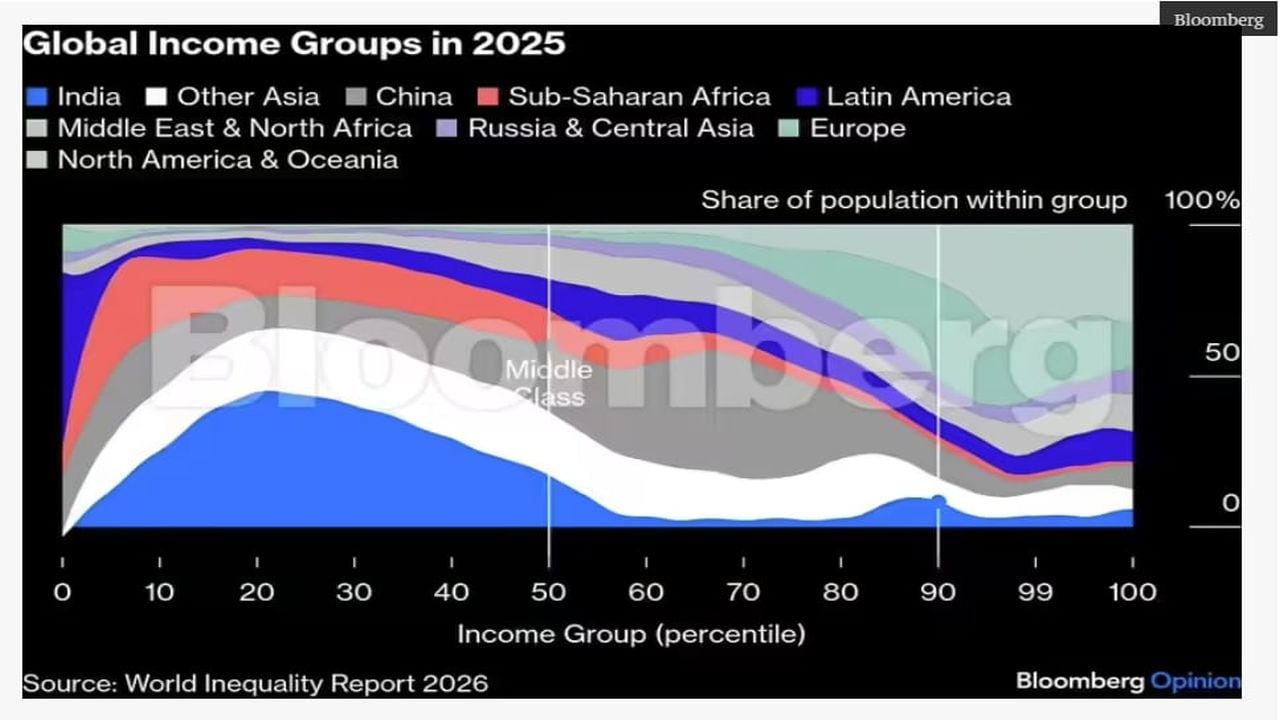
Amid the widening gap between the rich and the poor, the middle class is shrinking around the world. According to the 2026 World Inequality Report, the global middle-class incomes have grown slowly over the last four decades.
While the bottom half has enjoyed relatively robust growth since 1980, the middle 40% experienced stagnation, with some groups growing at less than 1% per year. However, the report noted that the top 1% has gained the most in the same period.
The weakening of the middle class has been more visible in India than anywhere else. According to the report, in 1980, a larger part of India’s population was in the middle 40%, but today almost all are in the bottom 50%.