



A Flyby That Changed Everything
For decades, Pluto was just a faint dot of light, a mysterious object at the edge of our solar system. Scientists assumed its extreme distance from the Sun and frigid surface temperatures—colder than -360 degrees Fahrenheit—meant it was geologically dead.
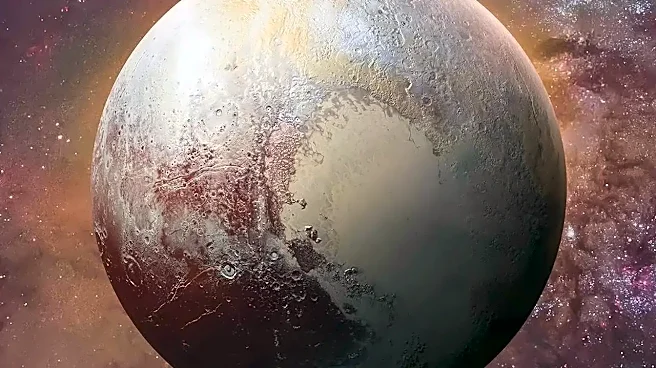
But in 2015, NASA's New Horizons spacecraft flew past Pluto, and the images it sent back were revolutionary. Instead of a static, cratered world, New Horizons revealed towering mountains of water ice, vast, smooth plains of frozen nitrogen, and shockingly few impact craters in certain areas. The lack of craters, particularly on the massive heart-shaped glacier named Sputnik Planitia, was a dead giveaway: the surface was young and being actively renewed, a process that hinted at an active interior.
The Case for a Hidden Ocean
The most tantalizing possibility is that a vast ocean of liquid water exists beneath Pluto’s thick ice shell, which could be 25 to 50 miles thick. Several lines of evidence point to this. The location and mass of Sputnik Planitia suggest something denser than ice is hiding underneath it—and a liquid ocean fits the bill perfectly. Furthermore, large fractures scarring Pluto's crust are consistent with the expansion that would occur if a subsurface ocean slowly froze over billions of years. But how could an ocean stay liquid in such a cold place? The leading theory is that heat from the decay of radioactive elements in Pluto's rocky core provides just enough warmth. This effect could be enhanced by an insulating layer of gassy ice, called clathrates, beneath the crust, essentially acting like a blanket to trap heat.
Ammonia 'Antifreeze' and Ice Volcanoes
The water in Pluto’s potential ocean likely isn't pure. Scientists believe it’s probably mixed with ammonia, which acts as a powerful antifreeze, significantly lowering the water's freezing point. This ammonia-rich slush provides another key piece of evidence. New Horizons detected ammonia on the surface near cracks and features that look remarkably like volcanoes. But instead of spewing molten rock, these cryovolcanoes would erupt a viscous, slushy mixture of water, ice, and ammonia from the interior. Since ammonia breaks down relatively quickly when exposed to solar radiation, finding it on the surface suggests these eruptions happened in the geologically recent past, pointing to an ongoing connection between the surface and a liquid interior.
Flowing Liquid Nitrogen on the Surface?
While a subsurface water ocean is one thing, recent studies from August 2026 suggest liquid might be flowing on Pluto's surface right now. But it's not water. The target is Sputnik Planitia, a glacier larger than Texas made of frozen nitrogen. Computer models and comparisons to features on Greenland's ice sheet suggest that liquid nitrogen may be welling up from beneath the glacier and flowing across the surface before freezing again. The immense pressure at the base of the kilometers-deep nitrogen glacier, combined with modest heat from below, could be enough to melt the nitrogen. Because liquid nitrogen is less dense than solid nitrogen, it would float upward through cracks, creating the dark, wetted features seen in the New Horizons images. This would make Pluto one of the few bodies in our solar system with currently active liquid flows on its surface.