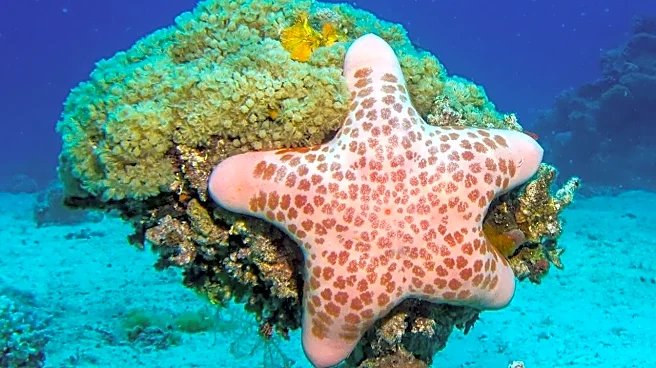








Mention the crown-of-thorns starfish, and most people picture a spiky villain mowing down entire coral reefs. For decades, that’s been the story. But new science offers a surprising twist, suggesting this infamous predator has a secret, helpful side.
The Villain of the Great Barrier Reef
For anyone familiar with the plight of the world’s coral reefs, the crown-of-thorns starfish, or COTS, is public enemy number one. This large, multi-armed echinoderm, covered in venomous spines, has a voracious appetite for live coral. It feeds by pushing its stomach out of its mouth and onto a coral colony, releasing digestive enzymes that liquefy the coral polyps, leaving behind nothing but a white skeleton. When their populations explode in what are known as outbreaks, they can decimate vast stretches of reef, with a single starfish capable of consuming up to 10 square meters of coral per year. These outbreaks have been a major cause of coral loss on the Great Barrier Reef and in other parts of the Indo-Pacific.
A Surprising Twist in the Tale
Despite its well-earned reputation for destruction, recent research from the University of Sydney adds a crucial layer of complexity to the COTS narrative. A study published in the journal 'Ecology and Evolution' found that when these starfish exist in low, natural numbers, they may actually benefit the reef ecosystem. The research was conducted in a protected area of the Great Barrier Reef where healthy fish populations keep the starfish in check, preventing the massive outbreaks seen elsewhere. What the scientists observed there challenges the simple 'good vs. bad' story we thought we knew.
The Unlikely Gardener
The secret to their helpfulness lies in their eating habits when they aren't part of a swarming plague. In these low-density environments, scientists found that starfish rarely destroyed an entire coral colony. In fact, after nearly 75% of feeding events, living coral tissue remained. The starfish would consume a patch and move on. More importantly, they showed a preference for the fastest-growing and most dominant coral species, like Acropora. By 'pruning' these fast-growing corals, the starfish create physical space on the reef, acting like accidental gardeners. This prevents the dominant species from monopolizing all the resources and allows slower-growing, more resilient corals, such as Porites and Montipora, a chance to thrive.
It's All About Balance
This discovery doesn't mean crown-of_thorns starfish are suddenly harmless heroes. The researchers are clear: massive outbreaks are still catastrophic for coral reefs. The key is population density. In a balanced ecosystem with enough natural predators like the giant triton snail and certain species of fish, starfish numbers stay low. It's only when these predator populations decline—often due to human activity like overfishing—that COTS populations can explode with devastating consequences. The study highlights the difference between an animal performing its natural role and an animal in a system thrown out of balance. The goal isn't to eradicate every starfish, but to restore the ecological checks that prevent them from becoming a plague.
This nuanced understanding could have significant implications for coral reef conservation. For years, the primary strategy during an outbreak has been direct culling of the starfish by divers. While this remains essential for controlling major outbreaks, the new findings suggest that in areas with low starfish numbers, complete removal might not be the best strategy. Instead, the focus could shift towards a more holistic approach: protecting the starfish's natural predators and maintaining the overall health of the reef ecosystem so it can regulate itself. By understanding the complex role the starfish plays, we can develop smarter, more effective strategies to protect these vital underwater worlds for the long term.