



What's Happening?
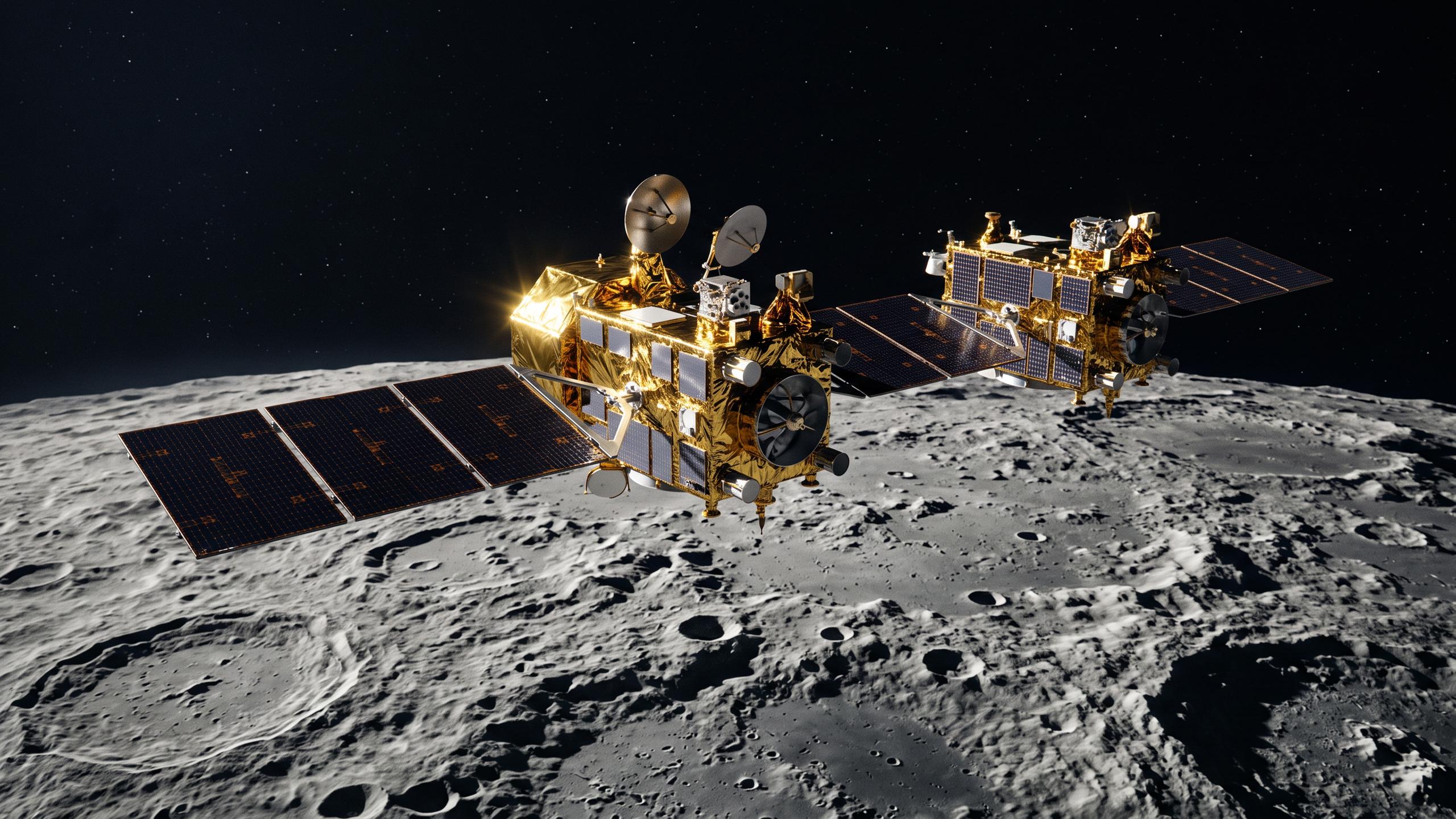
The Gravity Recovery And Interior Laboratory (GRAIL) mission, a dual spacecraft effort by NASA, successfully completed its primary objective of mapping the structure of the lunar interior. Launched on September
10, 2011, GRAIL-A and GRAIL-B embarked on a 3.5-month low-energy trans-lunar cruise before entering lunar orbit in late December 2011 and early January 2012, respectively. The spacecraft then settled into tandem 50 km, 113-minute near-circular lunar polar orbits, separated by 175-225 km. Over a 90-day science phase, divided into three 27.3-day cycles, the GRAIL mission used a Ka-band payload, the Lunar Gravity Ranging System (LGRS), to make high-precision range-rate measurements between the two spacecraft. This data was crucial for determining the Moon's gravitational field and, consequently, its internal structure. The mission concluded with a planned decommissioning phase and lunar surface impacts on December 17, 2012.
Why It's Important?
The GRAIL mission provided unprecedented insights into the Moon's internal structure, which is vital for understanding its formation and thermal evolution. By mapping the crust and lithosphere, the mission helped scientists understand the Moon's asymmetric thermal evolution and the subsurface structure of impact basins, including the origin of mascons (mass concentrations). This data also constrained the deep interior structure from tides and placed limits on the size of the possible inner core. Such detailed information is crucial for refining models of planetary differentiation and evolution, not just for the Moon but for other rocky bodies in our solar system. The mission's findings contribute significantly to the broader field of planetary science, offering a deeper understanding of how celestial bodies form and change over billions of years.
What's Next?
While the GRAIL mission itself concluded with the planned impacts of its spacecraft in 2012, the data collected continues to be analyzed and interpreted by scientists worldwide. The insights gained from GRAIL's gravity maps will inform future lunar missions and research, guiding the selection of landing sites and the design of new instruments. The understanding of the Moon's interior structure is a foundational piece of knowledge for any future human or robotic exploration of the Moon. Furthermore, the techniques and technologies developed for GRAIL, such as the high-precision range-rate measurements, can be applied to future missions aimed at studying the gravitational fields of other planets and moons, thereby extending its scientific legacy beyond the Moon.
Beyond the Headlines
The GRAIL mission exemplifies the power of precision engineering and scientific collaboration in unraveling the mysteries of our solar system. The deliberate impact of the spacecraft at the mission's end, while seemingly destructive, was a carefully planned maneuver to ensure no space debris was left in orbit and to gather final scientific data. This approach highlights the responsible conduct of space exploration. The mission's success in mapping the lunar interior also underscores the importance of fundamental research in space science, which often yields unexpected discoveries and provides the groundwork for future technological advancements. The data from GRAIL will continue to be a cornerstone for lunar science, influencing textbooks and scientific papers for decades to come, and inspiring new generations of planetary scientists.