
What's Happening?
An international team of scientists, including researchers from the Max Planck Institute for Gravitational Physics (AEI) in Germany, the Weizmann Institute of Science in Israel, and Chalmers University
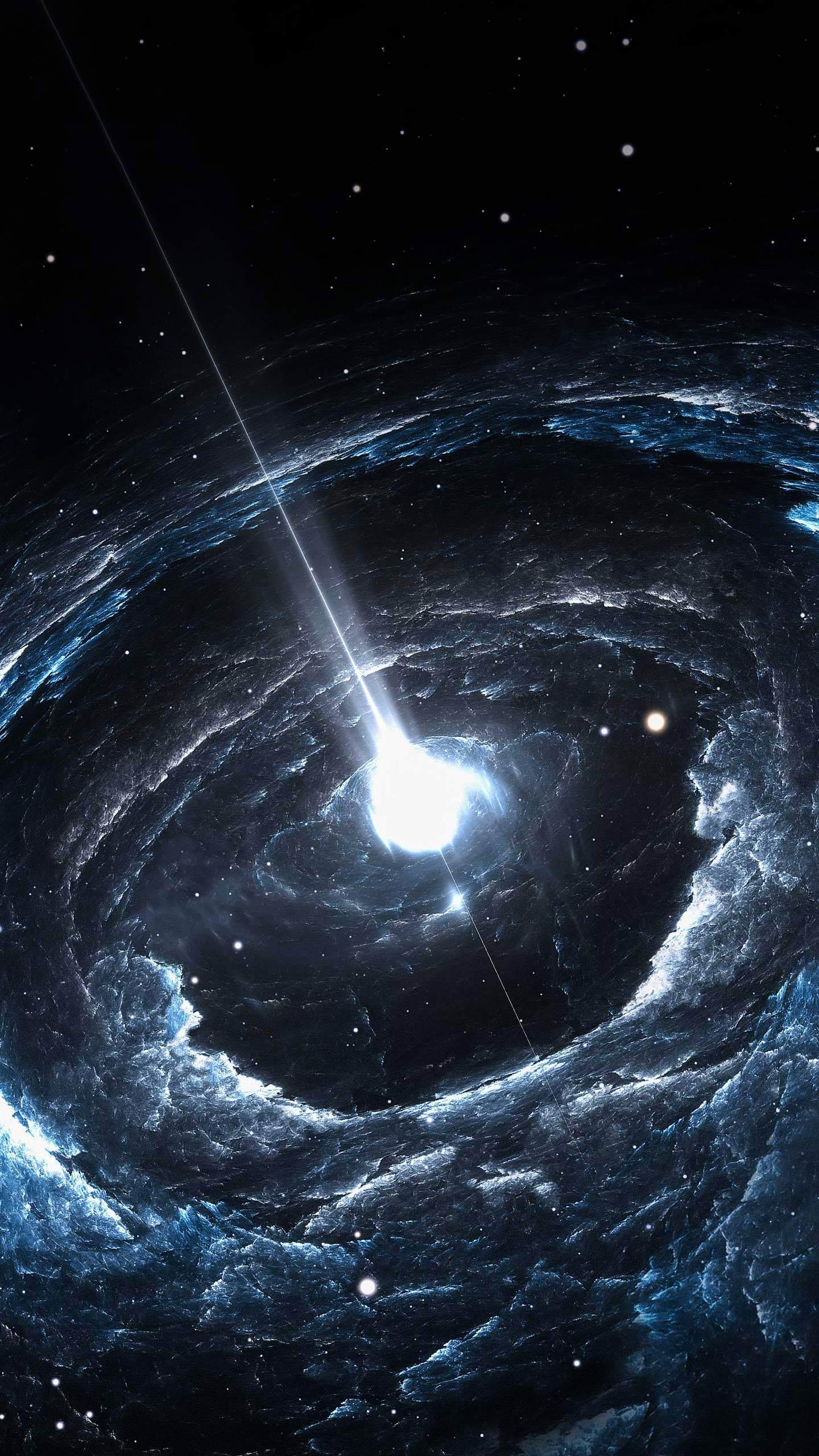
in Sweden, has discovered a new gamma-ray pulsar, PSR J1622-7204, using a novel method that is approximately a million times faster than previous techniques. The findings were published on November 19, 2026, in the journal Physical Review Letters. This new method leverages algorithms originally developed by cryptographers to break encryption systems, particularly those designed to resist future quantum computers. The pulsar, which spins 261 times per second, was identified within 15 years of data from NASA's Fermi Large Area Telescope (LAT). The new approach required only about 10 hours of computing time on a single standard CPU core, a significant improvement over previous state-of-the-art methods that failed to detect this pulsar and would have required 600 years of computing time on a single CPU core for analysis. The challenge in detecting pulsars lies in precisely determining their spin rate, deceleration, and sky location from a tiny fraction of photons buried in background noise.
Why It's Important?
This advancement dramatically accelerates the discovery of gamma-ray pulsars, which are crucial for understanding extreme astrophysical phenomena. Pulsars, rapidly rotating neutron stars, act as cosmic lighthouses, emitting beams of radiation. Detecting them provides valuable data for studying neutron star physics, gravitational waves, and the interstellar medium. The previous computational bottleneck limited the number of pulsars that could be identified, especially those in complex systems like binary stars. By making the search process vastly more efficient, this new method opens the door to discovering many more previously undetectable pulsars. This could lead to a more complete census of these objects in our galaxy and beyond, enhancing our understanding of stellar evolution and high-energy astrophysics. The interdisciplinary application of cryptographic algorithms to astrophysics also highlights the unexpected benefits of cross-field scientific collaboration.
What's Next?
The research team plans to utilize this new method to search the publicly available Fermi LAT data for additional gamma-ray pulsars. A primary goal is to find pulsars in binary star systems, which have been particularly challenging to detect due to signal distortions caused by orbital motion. The scientists anticipate that combining the new algorithm with the distributed volunteer computing project Einstein@Home will enable the discovery of numerous new pulsars that have remained hidden. This expanded search is expected to yield a wealth of new data, potentially revealing new types of pulsars or shedding light on the dynamics of binary star systems. The success of this method could also inspire similar interdisciplinary approaches in other data-intensive scientific fields.
Beyond the Headlines
The deeper implication of this discovery lies in the innovative application of algorithms from cryptography to astrophysics. This cross-disciplinary transfer of knowledge demonstrates how solutions developed for one complex problem can unexpectedly unlock progress in an entirely different scientific domain. It underscores the value of fundamental research in diverse fields, as breakthroughs in one area can have unforeseen ripple effects across the scientific landscape. Furthermore, the reliance on distributed computing projects like Einstein@Home highlights the power of citizen science and collaborative efforts in tackling grand scientific challenges. This approach not only democratizes scientific discovery but also provides immense computational power that would be otherwise unattainable, fostering a global community engaged in cutting-edge research.