


Sama Rice Delight
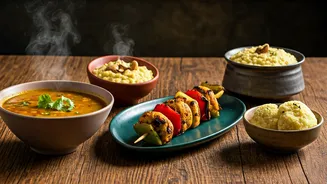
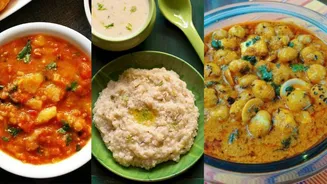
Kick off your Navratri lunch with a wholesome Sama Rice Khichdi. This dish utilizes sama rice, a grain commonly consumed during fasting periods, cooked
with tender pieces of potato. The preparation begins by rinsing and soaking the sama rice for about twenty minutes to achieve a soft texture. Subsequently, a tempering of cumin seeds in ghee is performed, followed by the addition of diced potatoes which are lightly sautéed. Once the potatoes show slight softening, the soaked rice, along with sendha namak (rock salt) and water, is added. The mixture is then cooked until the rice and potatoes are tender and well-combined, forming a comforting and easily digestible meal. Garnished with fresh coriander and best served with a side of cooling curd, this khichdi is a perfect balance of simplicity and nourishment for your vrat days.
Kuttu Poori & Aloo
Indulge in a classic Navratri comfort food: Kuttu Atta Poori paired with a simple Aloo Tamatar Sabzi. The dough for the pooris is made by kneading kuttu flour (buckwheat flour) with lukewarm water and a pinch of sendha namak, creating a pliable mixture. Small portions of the dough are then rolled out and deep-fried in hot ghee until they puff up into golden-brown pooris. Complementing the pooris is the Aloo Tamatar Sabzi, which is prepared by sautéing cumin seeds in ghee, followed by the addition of chopped tomatoes. Mashed boiled potatoes are then incorporated into the tomato base, seasoned with sendha namak, and simmered for a few minutes until the sabzi thickens into a flavourful consistency. This combination offers a satisfying and hearty meal that adheres to fasting principles.
Sabudana Transformation
Another staple during Navratri fasting is Sabudana Khichdi, a light yet filling dish that transforms humble sabudana pearls into a delightful meal. The process involves soaking sabudana for a significant period, typically 3-4 hours, to ensure they become soft and plump. The khichdi is then prepared by heating ghee in a pan and adding cumin seeds for tempering. Diced boiled potatoes and roasted peanuts are introduced next, sautéed to release their flavours. The soaked sabudana is then added to the pan, along with sendha namak, and cooked until the pearls turn translucent and gain a slightly chewy texture. A final flourish of fresh lemon juice and chopped coriander elevates the taste, offering a refreshing and energizing lunch option.
Creamy Paneer Curry
For a touch of richness, try the Vrat Paneer Makhana Curry. This dish features succulent paneer cubes and crunchy makhana (fox nuts) in a creamy gravy. The preparation starts by lightly roasting the makhana in ghee until they become crisp. In the same pan, a paste of ginger and green chilli is sautéed in ghee, followed by the gradual addition of curd, which is cooked on low heat to prevent curdling. Once the gravy thickens slightly, sendha namak is added, along with the paneer cubes and the roasted makhana. The curry is then simmered for about five minutes, allowing the paneer to absorb the flavours and the makhana to soften slightly, resulting in a decadent yet vrat-appropriate curry.
Sweet Potato Patties
Conclude your Navratri lunch exploration with Sweet Potato and Peanut Tikki, a delightful snack that doubles as a light meal. This recipe uses boiled sweet potatoes as its base, mashed thoroughly to create a smooth mixture. To this, peanut powder is added for a nutty flavour and binding texture, along with finely chopped green chilli for a hint of spice and sendha namak for seasoning. Small patties, or tikkis, are then shaped from this mixture and shallow-fried in ghee until they develop a golden-brown crust and are heated through. These delectable tikkis are best served with a cooling dip made from chilled curd blended with fresh mint and coriander, offering a unique and satisfying taste.