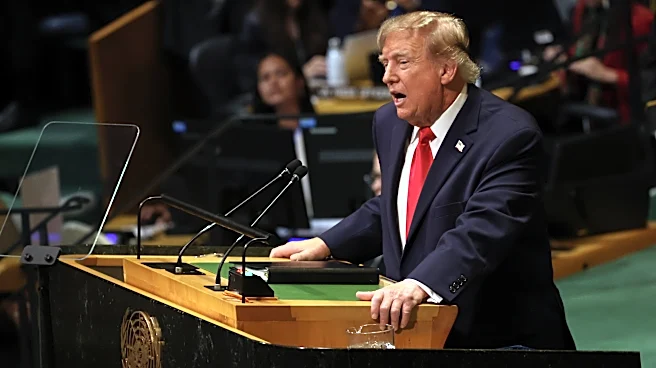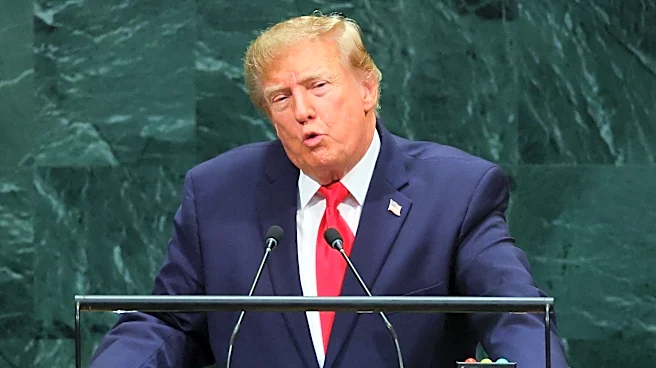








President Donald Trump announced that artificial intelligence will now be referred to as "superintelligence" in United States documents at the United Nations General Assembly in New York City on Tuesday, Sept. 22.
"The use of the word 'artificial' makes intelligence fake," he said. "It makes it sound fake and it is not fake. It’s actually amazing, but we have to be careful. In fact, it is exactly the opposite of what it purports."
Among those working in the AI industry, superintelligence refers to something slightly different than artificial intelligence. It is used to talk about AI that is smarter and more capable than humans across every imaginable skillset.
"It's not like we're coining a term over here. It's like repurposing something that was
already existing," said Juan Londono, a technology policy analyst at the research group Cato Institute.
"Animosity towards AI in general has is pretty high, and therefore, maybe something like superintelligence gets the people more excited," he added.
The term artificial intelligence was first coined by Dartmouth computer science professor John McCarthy in 1955 as part of a project asking how computers can make use of language. Since then, AI has expanded into different categories based on levels of advancement.
Sometimes referred to as ASI, artificial superintelligence is the most advanced category, and it is still considered theoretical by AI researchers and computer scientists. While most AI labs are working toward building superintelligence, many predict it could still be a few years to get there.
In a 2024 blog post, OpenAI CEO Sam Altman wrote, "It is possible that we will have superintelligence in a few thousand days (!); it may take longer, but I’m confident we’ll get there."
A year later, he told Politico that he expected to reach superintelligence by the end of the decade.
"I think in another couple of years, it will become very plausible for AI to make, for example, scientific discoveries that humans cannot make on their own," Altman said. "To me, that’ll start to feel like something we could properly call superintelligence."
The AI that currently exists, sometimes referred to as narrow AI, is thought to be less smart than humans by most researchers. It works on a single set of cognitive abilities and is limited to just that space, such as a text-based conversation. Siri, Alexa and ChatGPT are all considered a form of narrow AI.
Between narrow AI and ASI is artificial general intelligence, or AGI, which is AI that is as smart as humans. There is ongoing debate among experts about whether AGI has already been reached.
Stanford computer scientist Peter Norvig argued in a 2023 essay that AGI exists because large language models like ChatGPT can do things they weren’t trained to do. Others, including a colleague of Norvig's at Stanford, professor James Zou, have said that LLMs aren’t even capable of reaching AGI because language does not account for the majority of thought or human capability.
Londono doesn't expect Trump's choice of word to become too entangled in this debate.
"Terms sometimes have such sticking power, and it happens with other things, right?" Londono said. "Like we saw, for example, the rebranding of of Twitter as X. People still call it Twitter a lot of the time, so I wouldn't be surprised if something similar happens with AI when we reach the point where we say, 'Oh, this is superintelligence.'"
This is not the first time Trump has proposed changing the phrase. Over the weekend, he put a poll on social media asking respondents to vote on a word to replace "artificial," giving the options of "superior," "extreme" or "supreme" intelligence. "Superior intelligence" won.
In his speech to the U.N., Trump also compared use of the phrase artificial intelligence to the use of global warming.
"The very same people who said we’ll all be dead in 12 years because of global warming — a name since reborn to climate change since the planet was cooling, not warming and nobody was dead — these are the same people that are now saying that AI is going to kill us all, that robots are going to attack us and that everything is going to be a total disaster," he said.
Greta Reich covers the artificial intelligence industry for USA TODAY through a fellowship from the Tarbell Center for AI Journalism. Funders do not provide editorial input.
This article originally appeared on USA TODAY: Trump refers to 'AI' as 'superintelligence'. What's the difference?