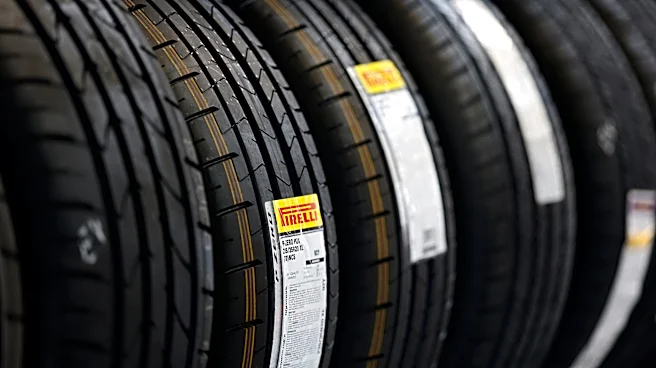








When drivers are shopping for replacement tires, tire efficiency is not normally a priority for many, but that may soon change, as California announced on Aug. 17 that it will implement the nation’s first energy-efficiency standards for replacement tires.
Traditionally, the tires that come on new cars are designed to provide better fuel mileage; however, when it comes time to replace them, consumers tend to choose less efficient tires, resulting in drivers losing significant mileage and range and, in turn, refueling more often, according to the California Energy Commission.
In pursuit of reducing carbon dioxide emissions by about 2 million metric tons and potentially saving California drivers nearly $1 billion per year in gasoline and electricity
costs, the California Energy Commission approved a new tire-efficiency replacement program to address the staggering efficiency gap between new and replacement tires.

“This action will help Californians save approximately $1 billion a year on refueling while reducing pollution and extending the range of vehicles on the road. I would like to thank all the consumer organizations, industry leaders and public health advocates for their support of this important step forward for California," said David Hochschild, Chair of the California Energy Commission.
The commission has been working with stakeholders from Bridgestone and Michelin, as well as researchers, since 2020 to develop these new standards for replacement tires, which are expected to take effect in two phases.
The California Energy Commission will start the first phase of the new standards in 2028, which will limit what tires can be sold in California. Any tires manufactured on or after Jan. 1, 2028, will be required to meet the new efficiency standards for passenger-car or light-duty-truck replacement tires.
The second phase will start on Jan. 1, 2033, with stricter standards.
What are critics saying about California's new tire-efficiency standards?
Not all industry stakeholders support the new regulations.
According to comments submitted during the California Energy Commission's rulemaking process, some tire manufacturers and trade groups have expressed concerns that the standards could increase the upfront cost of replacement tires, reduce the number of tire models available to California consumers and create challenges for manufacturers that sell specialty or performance-focused products.
In August, Pirelli Group, which represents Pirelli Tire, asked the commission to delay the regulation's implementation, highlighting the need to keep standards within the "realm of possibility in terms of achievable rolling resistance."
Additionally, Pirelli Group considered the proposed phase 2 threshold and deadline as "disproportionately stringent compared to other regulations worldwide and fail to take a holistic approach to tire performance."
"The thresholds are set at a level equivalent to the average rolling resistance of (Original Equipment) tires, which exceeds the California Energy Commission's stated objective of aligning replacement tire performance with OE tires," Pirelli Group comments read.
Beyond dissenting companies, some companies in favor of the new regulation also highlighted their concern regarding the state's deadline to meet Phase 2 standards.
Specifically, Discount Tires shared with the commission its concerns that implementing these standards might disproportionately burden low-income consumers.
"If the Phase 2 requirements beginning in 2031 were applied to the tires we sell in California today, roughly 70 percent of currently available options would be removed from the market," Discount Tires' comment reads.
"Critical to the success of this program is the understanding that tires are a non-discretionary purchase— drivers cannot opt out. If highly efficient tires carry significant price premiums or meaningfully narrow the available selection, the burden will fall disproportionately on cost-sensitive consumers."
How does the state determine an efficient tire?
Although the state's announcement did not provide a specific definition or example of what California will consider an efficient tire, documents released in June can provide some insight into the state's methods.
The California Energy Commission determines a tire's efficiency based on its rolling resistance, which measures how much power a tire wastes while traveling and generating heat on the road, according to a presentation onthe replacement tire efficiency program.
"As a tire rolls, it flexes against the road — deforming and rebounding. That process generates heat using some of the energy that would otherwise keep the vehicle in motion. That energy loss is caused by rolling resistance," the presentation reads.
"Lower rolling resistance tires commonly come standard on new vehicles, since they help automakers achieve better fuel economy and range."
The lower the rolling resistance coefficients are, the more energy-efficient a tire is considered by the state, according to the commission.
Starting in 2028, the California Energy Commission expects tire manufacturers to meet a "maximum rolling resistance coefficient" score of 9, and by 2033, the state expects that score to drop to 7.1, according to the presentation.
How does this new standard benefit California drivers?
As manufacturers begin releasing tires meeting the state's standards, consumers will see an increase in the average cost of a new set of tires. Starting in 2033, consumers could see costs increase by $24 per set, but the state believes this increase will be offset by the expected $179 in savings from using more efficient tires.
“[The state] is at the cusp of adopting a program that will deliver real cost savings and environmental benefits to the people of California, allowing you to drive forward energy and climate benefits,” said Karim D. Marshall, Director of Climate and Energy Policy, Consumer Federation of America.
The commission noted that a portion of the current replacement tire market meets the standards and doesn't expect these new standards to affect tire availability, as manufacturers will have years to adjust tire designs to meet the standards.
Beyond standard tires for passenger vehicles and light-duty trucks, the commission provided a list of tires that are exempt from the proposed regulation’s minimum performance standards.
Here is the California Energy Commission's list of exempt tires.
- Space saver tires
- Competition tires designed for motorsports
- Winter-type snow tires
- All-season winter performance tires
- Used and retreaded tires
- Deep tread tires
- Tires designed for ATVs and other off-road vehicles
- Large off-road tires for use up to 99 mph
- Motorcycle tires
- Temporary-use spare tires
- Small tires with ≤13-inch nominal rim diameter
- Limited production tires (<15,000 per year)
- Tires sold for use on an emergency vehicle
- High load index tires (122 or greater)
- Tires not capable of sustaining speeds over 50 mph
Noe Padilla is a Northern California Reporter for USA Today. Contact him at npadilla@usatodayco.com, follow him on X @1NoePadilla or on Bluesky @noepadilla.bsky.social. Sign up for the TODAY Californian newsletter or follow us on Facebook at TODAY Californian.
This article originally appeared on USA TODAY: New program wants California drivers to have fuel-efficient tires