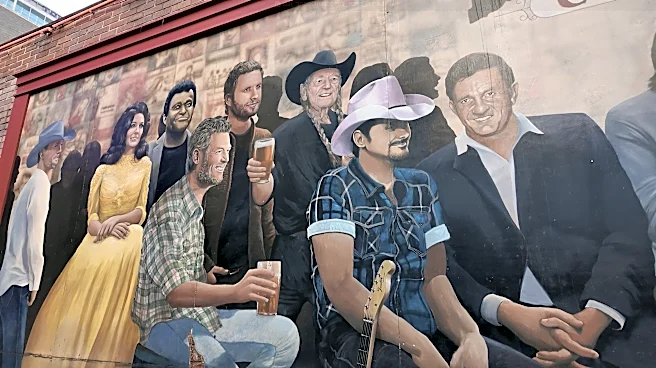

Outside Legends Corner on Nashville's Lower Broadway, tour guide Angela McCluskey often points visitors toward a piece of country music history that's almost impossible to see.
A section of Taylor Swift's
hair remains visible behind Brad Paisley's cowboy hat on the bar's famous mural of country legends.
Swift once had a prominent place in the painting, seated among Willie Nelson, Johnny Cash and other country music greats. But in December 2020, the mural's owners had her replaced with Paisley, a decision that upset Swift's fans.
"Her hair is right there," McCluskey told The Tennessean, pointing to the painting in front of a group of tourists soaking in the Broadway scene. "She should go back on the wall."
The country star who replaced Swift on that Broadway mural has already made his position clear.
"She is first and foremost one of us," Paisley said during her Oct. 26 induction into the Nashville Songwriters Hall of Fame.

The mural captures a debate that has followed Swift since she transitioned from country to pop: Does the world's biggest pop star still belong to the genre that launched her career?
That question is resurfacing ahead of the 60th annual CMA Awards on Nov. 18, when Swift will return to the stage for her first performance at the ceremony in 13 years. Her song "I Knew It, I Knew You," recorded for Disney and Pixar's "Toy Story 5," is nominated for single of the year.
Swift, the Hall of Fame's youngest inductee, spent much of her Oct. 26 acceptance speech revisiting her formative years in Music City.
"I've been very fortunate. I've gotten to genre hop and travel the world and write with so many different people and in so many different ways, and the only reason that I've been able to have that kind of dexterity in my creative process is because of the fundamentals and the foundation that I learned here in Nashville," she said, crediting those Nashville lessons with giving her the freedom to explore other genres, including her full transition to pop with the 2014 album "1989."
Her latest country song nominated for a CMA Award, a piano and harmonica ballad heavily influenced by pop sounds, tests the boundaries of roots music while also leaning into the lyrical tradition of nostalgia. Indeed, the words from the song also echo this moment in her own career. She'll return "wearing that same smile," although "it's been a while." The question is whether CMA voters still see the self-made music billionaire as one of their own.
Taylor Swift's Nashville roots
Swift's country music career began when her family moved from Pennsylvania to the Nashville area so she could pursue songwriting. By 14, she had a publishing deal with Sony and her mother was driving her from Hendersonville High School to Music Row for writing sessions.
She initially signed a development deal with RCA Records, but executives questioned whether a teenager writing about her own experiences could succeed in a country industry dominated by adult men. After leaving RCA, she caught Scott Borchetta's attention at the Bluebird Cafe and became one of the first artists signed to Big Machine Records.
Her self-titled debut arrived Oct. 24, 2006, including songs like "Tim McGraw" and "Teardrops on My Guitar," written with Liz Rose. Swift toured country radio stations, opened for established artists and built a following one handshake at a time.
Paisley was among those artists, bringing Swift on tour when she was 17. Nearly two decades later, he introduced her at the Nashville Songwriters Hall of Fame.
"All of us were like, how is this teenager doing this? How is she so brilliant?" Paisley told the audience.
However, country music fans have since developed conflicting opinions on her relationship to Music City.
During Alan Jackson's June 27 farewell concert at Nissan Stadium, Swift's prerecorded tribute drew both loud boos and cheers when her face appeared on the screens. The boos initially drowned out her message of appreciation for the country legend. The reason for the hostility was unclear, whether it reflected political differences or resentment over her departure from country music.

What makes someone a country artist?
Whether Swift still belongs to country music depends, in part, on how the genre is defined.
Beverly Keel, dean of the Scott Borchetta College of Media and Entertainment at Middle Tennessee State University, favors a "big tent philosophy" that embraces traditional country alongside pop-influenced recordings. For her, Swift never lost her place in the genre.
"I would say she didn't leave country. She just added pop," Keel said. "So country is still a part of who she is. And it made her who she is."
Belmont University professor and country music historian Don Cusic argued that country is more than a musical sound. It is a community whose acceptance depends on audiences, radio programmers and industry relationships.
"Country is basically a culture or subculture," Cusic said. "It's being accepted by the country music audience that defines country." Swift's latest song certainly garnered country radio airplay, thanks in part to a private listening party she hosted for radio professionals at herForrest Hills family home in June.
As for audiences, perspectives on loyalty can make experimenting beyond the genre complicated. Cusic said some fans may view Swift's pop transition as abandoning the community that first supported her.
"She was one of ours and now she's not one of ours," he said, describing that possible reaction.
Nadine Hubbs, a University of Michigan musicologist and country music scholar, believes Swift's enormous popularity gives her more freedom than most artists to move between genres.
"If you want to bring your huge global brand back into town, I think there's a welcome mat when you are someone who has become such a juggernaut as Taylor Swift," Hubbs said.
Along those lines, Swift performed her song "Betty" at the ACM Awards in Nashville in 2020, a tune with pedal steel guitar and harmonica sprinkled throughout. It was popular among country radio listeners yet was never nominated for a genre award like "I Knew It, I Knew You." The CMA Awards next week will show whether Swift can continue to win awards for both pop and country music at the same time. Both her latest pop album, "The Life of a Showgirl," and her newest country single are nominated for upcoming Grammy awards as well.
"It's one thing to boo at her face being projected on the screen," Hubbs said, arguing that a strong song or album could overcome resistance. With Swift confirmed to perform at the CMA Awards, the reception from the country music audience could offer another indication of where she stands with the genre. It's hard to imagine the crowd not singing along to her old country hits like "Tim McGraw" or "Our Song."
The challenges women face in country music
The question of belonging extends beyond Swift. Keel pointed to Shania Twain and Faith Hill as other women who faced criticism for exploring pop music, while male acts such as Florida Georgia Line continued receiving country radio airplay despite crossover success.
"It's a double standard that women have faced in country music forever," Keel said, citing Beyoncé's "Cowboy Carter" as another project that she believed deserved a warmer welcome from country music fans, especially considering how Post Malone was embraced by the Nashville community.
Cusic credited Post Malone's collaborations with established country stars, including Dolly Parton, Blake Shelton, Morgan Wallen and Luke Combs, with helping him gain acceptance and "instant credibility." Likewise, even after she added pop music to her repertoire, Swift has continued to perform and make music with country artists like Chris Stapleton, Kane Brown, Keith Urban, Maren Morris, Lainey Wilson and The Chicks.
Hubbs said that, overall, both country artists and audiences have sometimes felt dismissed by outsiders. This amplifies debates about what the genre is and who belongs to it.
"Country is a huge genre right now, and they have incredible sales and incredible crossover in this moment. But there's always this underdog outlook coming from country because it started as a regionalized genre," she said, adding that some people, especially on the coasts, still "look down their noses" at country music fans.
As Swift marks the 20th anniversary of her self-titled debut album, fans are still waiting for the release of "Taylor Swift (Taylor's Version)," the rerecorded edition of the country album that launched her career. Revisiting those songs could offer the singer an opportunity to change how fans around the world view the genre.
In the meantime, the Nashville-raised songbird has already taken steps to reconnect with country fans, providing prerecorded interviews to radio stations on Sept. 5 to promote "I Knew It, I Knew You."
"She started in Nashville. She learned how to write songs in Nashville. So Nashville is in her DNA," Keel said. "Let's always keep her in the family."
In her last sit-down interview with The Tennessean in 2014, Swift addressed that very distinction as she prepared to release "1989," her first entirely pop album. Speaking with journalist Peter Cooper at the Hutton Hotel, the then-24-year-old singer rejected the idea that changing genres meant abandoning her musical roots.
"To say I 'left' country music sounds very harsh," Swift said. "It's just a change in artistic direction."
She was equally adamant about her relationship with Music City.
"I would never quit Nashville," she said. "I think Nashville has become such a melting pot for different genres, and so many different artists who make different kinds of music move here and call it home. I don't think that because I don't make country music right now that means that I've in any way unleashed some great assault on this city."
That Centennial Park bench and all it represents
When Swift brought her Eras Tour to Nashville for three sold-out nights at Nissan Stadium in May 2023, the city celebrated one of its most successful musical exports by dedicating a bench to her at Centennial Park.
Swift immortalized the afternoons she spent in that park in her song "Invisible String," a folk-pop ballad. During her Nissan Stadium concerts, she acknowledged the bench and remembered spending "many an afternoon sitting in the park performatively journaling."
Today, the bench has become another Music City landmark, drawing fans from around the world. Visitors gathered there offered different answers about whether Swift still belongs to country music.
"I think she started country, but now she's pop. So she had a country era," said visiting fan Lisa Raaf.
Meanwhile, Tiera and James Cates, fans visiting the park from North Carolina, saw no reason to exclude Swift from country music.
"She's a major contributor to country music," James Cates said. "Country pop is still a thing."
For Jaime Gins, visiting from Germany, Swift's connection to Nashville was the reason that Gins decided to vacation in Music City.
"Nashville was like a city that I kind of only knew from the name," Gins said. "Because Taylor was here, that's where she grew her career. I was like, I have to go to Nashville."
For visitors like Gins, becoming the world's biggest pop star hasn't erased Swift's role in the ongoing story of country music.
Gins said that Swift makes a variety of music but is definitely "country," through and through.
Don't miss any Taylor Swift news; sign up for the free, weekly newsletter This Swift Beat.
Follow Taylor Swift reporter Bryan West on Instagram, TikTok and X as @BryanWestTV.
This article originally appeared on Nashville Tennessean: Taylor Swift's CMA return after 13 years sparks debate