



WASHINGTON – The Supreme Court’s upcoming debate over whether Catholic preschools in Colorado must accept children of gay parents if taxpayers are footing the bill may not be the only case involving religion and schools that the justices will decide this term.
The court will hear the preschool dispute Nov. 3. But the justices have plenty more appeals to choose from if they want to further delve into the controversial topic — including those asking the court to revisit decades-old rulings aimed at maintaining a separation of church and state.
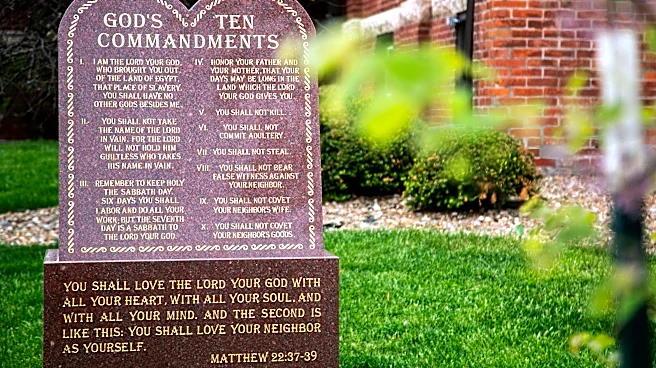
The justices, for example, are expected to tackle whether a Texas law requiring public schools to post the Ten Commandments violates the court’s 1980 ruling striking down a similar requirement in Kentucky.
The court has also been asked to overturn a major 2004 decision allowing states to exclude students studying to become ministers from public scholarship programs.
In addition, Amish schools that want a religious exemption from state vaccination requirements argue the court should consider scrapping a controversial 1990 decision that made it difficult to challenge laws as a burden on religion.
A substitute teacher in Maryland is urging the court to decide whether a school district's rules for what pronouns to use for transgender students and what information should be conveyed to their parents violate her religious and free speech rights.
And parents seeking public funds for religious homeschool curricula are likewise hoping their appeal will grab the justices' attention, as are parents who want state special education services to be delivered at Jewish schools.
The court rejects the vast majority of requests for hearings. In recent years, however, it's been sympathetic to religious liberty claims, including in multiple cases involving public funding and schools. That’s likely encouraged more lawsuits, such as those the justices will be reviewing in the coming weeks and months.
Here’s what they’ll be considering for a hearing or rejection:
Ten Commandments displays in schools
The dispute over religion and schools that the justices are most expected to add to their docket is one that the court weighed in on decades ago.
In 1980, the Supreme Court struck down a Kentucky law that was nearly identical to Texas’ requirement that public schools display the Ten Commandments.
But an appeals court that upheld Texas’ law in April said that the Supreme Court has since jettisoned the legal reasoning behind the 1980 decision. It pointed to the high court's 2022 opinion backing a high school football coach who offered prayers at the 50-yard line after games despite objections from the school district that students felt compelled to take part.
Lawyers for a coalition of multifaith families challenging Texas’ law toldthe justices that they need to get involved to ensure government officials can’t “flood public-school classrooms with an endless array of religious rules, instructions and mandates.”

Public funds for ministerial training
The Supreme Court is also being asked to revisit its 2004 ruling that a state does not have to help pay for instruction in religious ministries, even if it provides public scholarships for majors like math or philosophy.
Chief Justice William Rehnquist wrote in Locke v. Davey that states can make that distinction without it being “evidence of hostility toward religion.”
“Since the founding of our country, there have been popular uprisings against procuring taxpayer funds to support church leaders, which was one of the hallmarks of an 'established’ religion,’” Rehnquist wrote in reference to the Constitution’s prohibition against the establishment of religion.
But the Supreme Court in recent years had put more emphasis on the First Amendment right to freely practice religion, including in a trio of decisions since 2017 about state funds going to schools.
“Locke was wrong when it was decided, and this Court’s subsequent caselaw has further eviscerated its fatally flawed foundation,” lawyers for students at Liberty University who are challenging Virginia’s tuition assistance program told the justices in pending appeals.
The students include one who lost her grant after switching her major from music education to youth ministries, and then to music and worship.

Religious exemption from vaccination rules
Amish schools in New York are upset that the state, in response to measles outbreaks across the country, no longer allows religious exemptions for its school vaccination rules.
“New York has effectively prohibited the practice of the Amish faith within its borders,” lawyers for the schools wrote in their Supreme Court appeal.
They argue that the court should reconsider its 1990 decision upholding laws that affect a religious entity if the rules apply to everyone – religious and secular groups alike.
Religious freedom advocates have been pushing the court to overturn that decision. While the justices have not done that – and specifically declined to consider doing so when they agreed to hear the Colorado preschool case – the court could continue its recent trend of limiting the reach of Employment Division v. Smith.

Public funding of religious homeschooling
The Supreme Court in 2025 deadlocked over whether the Catholic Church in Oklahoma could run a charter school in a case about whether charter schools – which use taxpayer money but have private operators – are public schools.
A group of California parents are raising a similar question about home-based independent study programs available through the state’s charter school system. The parents want to use public funds to purchase faith-based curriculum for independent studies.
But an appeals court said that the independent study programs are still part of the public education system – rather than being pure homeschooling – so California can control what’s taught.

Religious challenge to school's gender identity policy
A substitute teacher in Maryland wants the Supreme Court to decide whether schools can require staff to use a student’s preferred pronouns and to restrict what teachers tell parents about a student’s gender identity at school.
The teacher sued Montgomery County Public Schools in 2024, saying the district’s guidelines for student gender idenity violated her religious and free speech rights.
While her case was being litigated, the Supreme Court said in March that California parents were likely to win their challenge to a similar policy.
In response, the Maryland school district revised its policy on parental notification, it said. The district has also allowed the teacher to use students’ names instead of pronouns.
But the teacher said the district’s parental notification policy is still problematic, and the court needs to settle an issue of “undeniable national importance.”
“Gender identity policies like these, "lawyers for the teacher wrote in their appeal, "threaten to drive traditional religious beliefs about sexuality out of our public schools."

Special ed services at Jewish schools
Parents in Massachusetts whose sons attend Jewish schools are challenging the state’s requirement that special education services be delivered at public schools or another neutral location. That rule, the parents argue, forces them to choose between getting publicly funded help for their sons’ ADHD or getting the education that is best for them.
Lower courts said that while parents have the right to choose a private education, the state isn’t required to change how it delivers services. What the parents object to, at most, is an increased logistical burden of transporting their sons to another location for the extra help, an appeals court said.
The parents told the Supreme Court that traveling between locations is too difficult, as well as stigmatizing and a detraction from the students' religious school education.
Although the case involves religious schools, it does not directly raise a religious rights issue. Instead, the parents’ argument is tied to the court’s 1925 decision striking down an Oregon law that required children to attend public school.
This article originally appeared on USA TODAY: Supreme Court faces wave of appeals about religion and schools