






For decades, scientists have been aware of a massive, strange six-sided formation on Saturn's north pole.
The mystifying hexagon, unlike anything else seen in the solar system, has persisted long enough for four spacecraft to observe it above the gas giant – including theiconic Hubble Space Telescope.
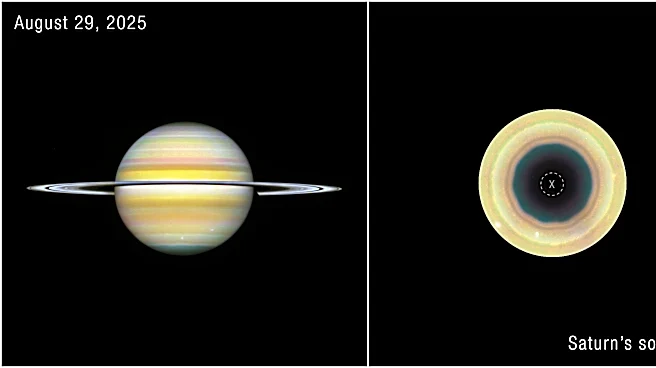
Now, a new enigmatic 10-sided feature known as the decagon has been spotted swirling on the complete opposite side of the ringed planet. The discovery marks the first time that a regular-sided polygonal jet pattern has been observed on Saturn's southern hemisphere.
Here's what to know about Saturn, as well as the mysterious 10-sided pattern discovered over its south pole.
What to know about Saturn, 2nd largest planet in solar system
The sixth planet from the sun, Saturn is of course famed for its rings – composed
of billions of small chunks of ice and rock coated in cosmic dust.
While four robotic spacecraft have explored Saturn, it wasn't until the Cassini probe arrived in 2004 that our understanding of the gas giant – the second largest in our solar system behind Jupiter – began to take shape. After more than a decade of studying Saturn's complex system of rings and moons in unprecedented detail, Cassini was deliberately plunged into Saturn's atmosphere in 2017, ending its mission.
Saturn's system is also positively teeming with moons. In fact, a whopping 128 of its 274 observed moons were just discovered in March 2025.
The moons range from planet-size Titan to smaller oddities, some of which are strangely shaped like potatoes or ravioli. And at least two of them, Mimas and Enceladus, have recently been in the news as potential harborers of water – a sign that the worlds could be habitable.
NASA's Hubble spots strange shape on Saturn's south pole

Saturn is also home to a newly discovered phenomenon: a giant, 10-sided enigmatic pattern around its south pole.
The formation was first spotted in 2023 by the Hubble Space Telescope, according to a Sept. 2 press release from NASA. Data, though, suggested the strange feature may have first formed earlier and didn't become visible until Saturn's southern hemisphere tilted back into Earth's view.
Observations have shown the pattern has only become more distinct since it's discovery three years ago. That suggests scientists may be witnessing a new phenomenon develop, according to a study published Sept. 2 in the journal Science Advances led by Agustín Sánchez-Lavega, a researcher at the University of the Basque Country in Spain.
“We’ve never seen anything quite like this in Saturn’s southern hemisphere,” study co-author Amy Simon of NASA’s Goddard Space Flight Center in Maryland said in a statement.
What is the decagon over Saturn?
The feature, known as a decagon, is a weather phenomenon that NASA described as an atmospheric wave. Sitting within one of Saturn's powerful jet streams, the decagon is what the agency says is "the first large, persistent, regular-sided pattern observed at Saturn’s southern hemisphere."
Because it extends through multiple layers of the gas giant's atmosphere, the decagon is far from simply a cloud-level feature. It's also massive, with each of its 10 sides measuring more than 10,000 miles long, according to the study.
Decagon is bigger than what twin Voyagers observed on north pole

The decagon has already drawn comparisons to another famous geometric feature observed for more than 40 years on the other side of Saturn.
Saturn's hexagon – a cloud pattern about 20,000 miles wide – was first discovered on the planet's north pole using data from flybys conducted by NASA's twin Voyager probes in 1980 and 1981. Later observations from NASA's robotic Cassini spacecraft between 2004-2017 unveiled the jet streams on the six-sided hexagon spanned 20,000 miles across.
Hubble has also captured the strange feature, suggesting that it has remained stable for at least four decades.
Additional study of the hexagon and now a decagon could help astronomers compare formations on the opposite ends of Saturn and learn more about a gas giant's weather patterns, according to NASA. Further observations from Hubble and the James Webb Space Telescope could also help scientists understand how the decagon formed and how long it will last.
"The northern hexagon has been there every time we’ve looked for more than 40 years," Simon said in her statement. "This feature is different – it appears to be strengthening, giving us the rare opportunity to watch a giant atmospheric pattern develop.”
Eric Lagatta is the Space Connect reporter for the USA TODAY Network. Reach him at elagatta@usatodayco.com
This article originally appeared on USA TODAY: This newly discovered decagon above Saturn leaves scientists perplexed