



For those of you who read my columns regularly (thank you), you're aware I usually stick to politics.
I'm going to shift gears for this one. Literally.
I recently came across this headline in The Washington Post: “The death of the stick shift is almost here.” It wasn't completely news. I've noticed the dearth of manual transmissions
in newer vehicles for years. But I'd hoped there was enough demand left that it wouldn't disappear.I was wrong.
According to a 2025 Environmental Protection Agency report on automotive trends, less than 1% of new vehicles made for the U.S. market are manual transmissions. In 1980, roughly 35% were. Europeans remain more attached to the stick shift, but even there, demand is fading.
Stick shifts are dying. And I don't
think it's just electric vehicles or autonomous features driving this. It's that more of us have started treating driving as an interruption, something that happens between checks of our phones, rather than an experience in its own right.
I learned how to drive on a stick. I've loved them ever since.

Thirty years ago, when I learned to drive at 16, it was in our family's 1971 mustard-yellow Volvo station wagon. It definitely had a stick shift, one with a mind of its own. It wasn't always easy, but what my dad told me turned out to be true: "If you can drive this, you can drive anything."
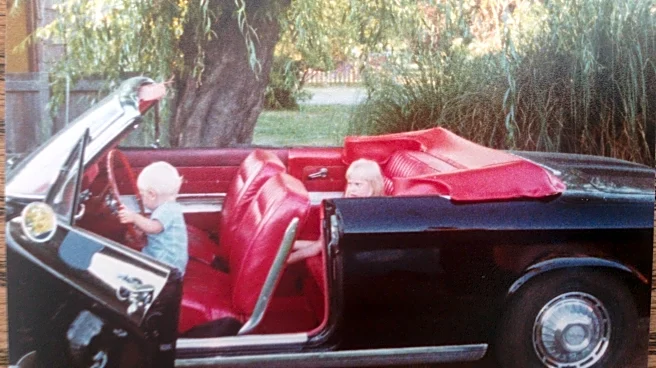
We also had a 1962 Corvair convertible growing up, which my brother and I both drove around town.
We learned all kinds of tricks that only come with a manual transmission. If your car doesn't start – and given the age of ours, that was a fairly common occurrence – you can pop the clutch: Find a small hill, shift into second and let gravity do the work.
It worked on several occasions.
The first new car I bought was a 2002 Honda Civic, shortly after I graduated college. And guess what? It had a stick.
Driving a stick shift is like a dance with your car
Maybe I've reached the age when the old days start seeming rosier than they were. But I think what I feel about the stick shift is more than nostalgia.
It's fun. And when you're shifting gears yourself, you feel connected to the car and the road in a way that's just not possible in an automatic. Pushing a button to start the engine and turning a knob to “shift” isn't the same thing.
If you've never driven a stick, imagine it as a dance with your car. As the RPMs climb, the car is telling you when it's ready to step into a higher gear. Coming into a turn, you downshift instead of hitting the brake.
Adding a third pedal – the clutch – to the mix takes some getting used to, especially if you learned on an automatic. I recall stalling the Volvo more times than I'd like to admit (OK, a lot of times) while my mom coached me through it in a high school parking lot back in 1995.
It's intuitive once it clicks, though. And like riding a bike, you never really lose it.
These days I don't get to drive a stick often. My car is a 2008 Jeep Grand Cherokee – automatic – which comes in handy during Michigan winters but is comparatively boring to drive. Whenever I visit my parents, though, I make a point of taking their 2015 Honda Accord (a stick, of course) out on Oregon's back roads.
There’s really no better way to hit the open road. I'm going to keep doing it as long as I can find one to drive.
Ingrid Jacques is a columnist at USA TODAY. Contact her at ijacques@usatoday.com or on X: @Ingrid_Jacques.
This article originally appeared on USA TODAY: I'll drive a manual car wherever I find one. Here's why. | Opinion