






There's nothing like exploring the great outdoors, but it's not always easy or possible for travelers with disabilities. Now, one of America's most popular parks, Zion, has expanded its accessibility.
"We’re excited to announce the launch of a new all-terrain wheelchair lending program
designed to expand trail access for visitors with disabilities, mobility challenges, or injuries," the Utah park recently posted on Instagram.More than a quarter of U.S. adults have some type of disability, according to the Centers for Disease Control and Prevention.
Here's what visitors should know about Zion's new program and others across the National Park System.

Wheelchair rental at Zion National Park
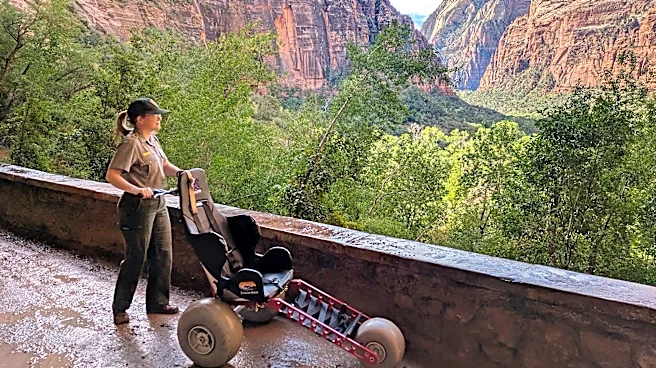
Zion's new Extreme Motus all-terrain wheelchair
can be checked out free of charge, thanks to the support of the park's nonprofit partner, the Zion Forever Project.
There is just one wheelchair available for now, but the Zion Forever Project told USA TODAY it plans to expand similar devices and systems for checkout in other parks that it serves.
The wheelchair is available on a first-come, first-served basis at the Zion Canyon Visitor Center. Reservations are not available, and only single-day rental is allowed.
Prospective users should note that an assistant is required to push the wheelchair, and both the user and assistant must complete a waiver and undergo a short training. Proof of identification and insurance is also required from either the user or assistant.
It's also worth noting that the wheelchair is too big for Zion's shuttle buses, so users will be given an accessibility pass to park along Zion Canyon Scenic Drive during shuttle season.
Where the wheelchair may be used

- Cable Mountain Trail via Stave Spring
- Chinle Trail
- Coalpits Wash Trail
- Deer Trap Trail via Stave Spring
- East Rim Trail
- Grotto Trail
- Hop Valley Trail
- Lower Emerald Pools Trail
- Middle Emerald Pools Trail
- Observation Point Trail via East Mesa
- Pa’rus Trail
- Riverside Walk Trail
- Taylor Creek Trail
- Weeping Rock Trail
- West Rim Trail
- Wildcat Trail to Hop Valley
Where the wheelchair can't be used
- Angels Landing
- Canyon Overlook
- Upper Emerald Pools
- Zion Narrows
- Connection between Lower Emerald Pools and Middle Emerald Pools
- Connection between Kayenta Trail and Middle Emerald Pools Trail
Additionally, Zion's website notes: "You may wish to have additional assistants on trails like Weeping Rock, West Rim, Middle Emerald Pools, and the Watchman due to the steepness and/or rugged nature of those trails."
Mobility devices at other national parks
The National Park Service has prioritized making parks accessible for visitors of all abilities.
"Nearly 30 parks within the National Park Service – including Zion National Park – make mobility devices available for visitors, either as a direct loan from the park or through a partnership with other organizations," Jeremy Buzzell, manager of Park Accessibility for Visitors and Employee, told USA TODAY by email.
Offerings are listed by state on the Park Service's website, along with links to more information. Other types of accommodations vary across the system, with details on each park's website.
Buzzell notes NPS has implemented the EXPLORE Act, which aims to expand public land and outdoor recreation access for people with disabilities. "The Act prioritizes providing accurate trail information on park websites to help ensure that users of mobility devices know what to expect on each trail, allowing them to plan their visits with confidence," he said.
Additionally, free park entry is available for Americans with permanent disabilities.
Zion entry typically costs $20 to $35 for U.S. residents. Non-residents over 15 must pay an additional $100 per-person fee.
This story was updated with new information.
This article originally appeared on USA TODAY: The new way Zion visitors can explore rugged trails