



The nation’s blood centers have long relied on high school and university blood drives not only as a dependable and sizable donation source, but as an introduction to young people about the importance of donating.
The COVID-19 pandemic of 2020 brought it all to a halt.
Blood donation professionals say the effect was more than temporary. With such campaigns slow to return to campuses, advocates suspected millions of high school and college students would miss out on learning the importance of blood donation.
A closer look at the data confirmed their fears: Post-pandemic blood donation levels have rebounded among all age groups – except for the youngest generations. The number of donors aged 16 to 24 plummeted by more than a third while those aged 25
to 34 fell by more than fifth, despite the rebound among older people.
“How do you rebound from that to have a sustainable blood supply?” said Jennifer Kapral, vice president of enterprise data strategy and management for Blood Centers of America, a national network of blood supply centers that conducted the analysis. “How do you engage with people when you’ve lost that first entry point?”
She and other industry leaders worry the generational gap could mean future blood shortages if something isn’t done to revive donation habits among the young. National blood supplies have flirted with precipitously low levels, and this summer, the American Red Cross declared its second-ever national blood crisis as donation levels fell to a four-year low.
“There’s a lot of concern over the aging of our donor base,” said Kate Fry, CEO of America’s Blood Centers, a separate national network of nonprofit community-based blood centers. “We’re starting to see that silver tsunami, where a lot of our donors are going to become the patients.”
Blood collection experts say reconnecting with young people is crucial as traditional donors age out.
“For decades, we’ve been able to rely on the generosity of the Baby Boomers generation,” said Armando Romero, associate director of transfusion medicine at Cedars-Sinai Health System in Los Angeles. “The numbers show they’ve made it a habit even when there’s not an emergency; they just happened to be at church or at their kid’s soccer game and saw a bloodmobile.”

For now, the Red Cross said the national supply has stabilized. But as older generations produce the next group of blood product consumers, their absence as donors threatens to further deplete reserves.
“We need to replace them with this next wave,” Romero said. “There’s a lot of urgency of making this a lifelong habit in those early years. Part of our backbone is the Baby Boomer generation, and now we’re scrambling to make sure we have an adequate replacement.”
In July, an article co-authored by Kapral for the Association for the Advancement of Blood & Biotherapies spelled out the situation and its implications.
“This isn’t purely a pandemic effect,” the authors wrote. “It’s a generational fracture.”
Blood donation 'a learned behavior'
The Blood Centers of America based its analysis on a database of donor demographics and donation frequency that the organization launched in 2018, with more than 25 million donor records tallying 126 million donation records dating to 2010.

The organization compared numbers from 2017 through 2019, just before the 2020 pandemic, with those from 2022 to 2024. The number of donors aged 16 to 24 dropped 37%, while those aged 25 to 34 fell 22%.
Meanwhile, the number of donors aged 35 to 54 inched up 5%, with increases successively higher with older age groups – 15% among those aged 55 to 64, 50% among those 64 to 73 and 72% among those 73 and older.
It’s worth noting that despite the decline, the 16-to-24 cohort still represented the largest donor group at 1.7 million, compared with 2.7 million before the pandemic.
Campus blood drives typically beef up those numbers.
“High school blood donations are often people’s first introduction to the process,” Romero said. “For a lot of them, there’s this peer factor. We don’t know if it’s that they want to save lives or if they just want to get out of third period, but it reduces fears about getting a needle in their arm if their friends are there.”
In a matter of six hours, a high school blood drive can collect 150 to 200 units of blood, he said.

The pandemic’s effects weren’t limited to one year, Romero said. Many campuses were slow to invite blood drives back, and often in a smaller capacity.
“Donating blood is a learned behavior,” he said, recalling drives at which 16-year-old first-time donors, nervous about being pricked by a needle, might ask a friend whether it hurts. “Then their friend says, ‘it doesn’t, you should go ahead and do it.’ It really is a learned behavior. But we missed out on three-plus years of people learning that.”
It’s not that young people aren’t altruistic, Romero said; they volunteer plenty. But while a Gen X adult might see a workplace bloodmobile and recall previous donating experience, “when you have an entire generation of young donors who’ve never had that exposure, who may see a blood drive and feel angst about needles, they’re much less likely to adapt.”
Rebuilding donation habits among younger people, Romero said, is “a real slow crawl. And the demand has not diminished, even though our donor base was interrupted.”
'We can't use the same tactics'
Fry said the issue isn’t about shaming younger generations. The 19 to 35 age group has always been challenging, she said, which is why workplace-based blood drives are so important.
“People are busy, starting careers and having kids,” she said. “What we saw is that when companies go remote, with flexible schedules, there’s not as many drives happening overall. It takes extra motivation and time to seek them out.”

Additionally, she said, the pandemic accelerated migration patterns that frayed community ties as jobs were lost and people began working remotely, reducing community foundations that encouraged such giving.
Meanwhile, the pandemic hiatus gave blood collection professionals an opportunity to reevaluate their messaging. Among their conclusions: Outreach methods that motivated previous generations may not connect in the same way with Gen Z and younger Millennials.
According to the Blood Centers of America analysis, Boomers (aged 62 to 80) are likelier to equate service with citizenship, a mindset instilled by their Greatest Generation parents that responds to calls to “do one’s part” for society. Generation X (aged 46 to 61), meanwhile, took on that duty but less intrinsically; they’ll respond if they know there’s a need.
More than half of all blood donations still come from those two groups, the organization said.
Kapral said while every individual who donates is differently motivated, younger people are more likely to respond to transparency about the donation process and its impact, as well as peer-to-peer, social-media-driven efforts – such as the ALS Ice Bucket Challenge – originating from or encouraged within their community networks.

While blood collection campaigns once relied on mailers, phone calls and emails, Romero said it’s now necessary to adapt to new methods.
“We already know young folks are on their phones, so if we can appear on their feed that would be a helpful reminder,” he said. “We’re trying to meet donors where they’re at.”
Rather than waiting for a crisis, Kapral said, blood collection centers might find better results with more positive messaging – explaining to people what happens with their blood, how it specifically helps cancer patients or car accident victims.
“We’ve learned we can’t use the same tactics we used with older generations,” she said.
Some donations programs finding success
Kapral cited the We Give Blood campaign launched in 2024 as one model finding success among younger people. The campaign, a collaboration between Abbott Laboratories and the Big 10 Conference, encourages friendly donation competition among universities, promoted on social media “in a more joyful, fun, competitive way,” she said. “It’s spreading the message differently, speaking to a new audience in a positive way.”
Fry said centers are also doing more to let donors know how their blood is used. In some cases, donors might get a text letting them know their blood has shipped to a hospital, while another program encourages blood recipients to write thank-you letters anonymously shared with their donors.

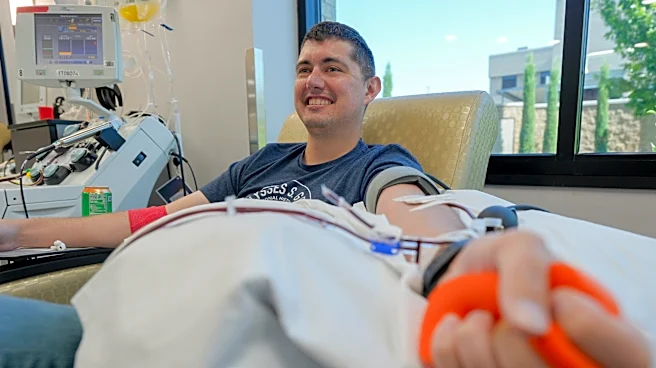
Another strategy finding success, Romero said, is centers offering virtual-reality headsets to donors that they can wear while their blood is drawn, especially those with an aversion to needles.
“It’s a good way to engage young donors,” he said. “Even if it’s only for 10 minutes, they can watch YouTube videos or stream social media.”
While America’s Blood Centers doesn’t impose a formal age cap, Fry said, donors are more likely to be deferred as they age because of a medical condition or a medication they’re taking.
The larger issue, she said, is that fewer Americans are giving blood overall.
“It’s not just young donors,” she said. “Only 3% of Americans donate blood each year. If we had even 5%, our need to worry about blood shortages would decrease significantly.”
In other words, participation across all age groups could go a long way to fending off crisis situations.
“We take for granted that if we need therapy or that if major trauma occurs that hospitals will be able to support us.," Krapal said. "But it’s a volunteer base, and blood is something you can’t manufacture. You rely on your neighbor and your community to donate.”
This article originally appeared on USA TODAY: Blood centers have lost young donors. What can they do?