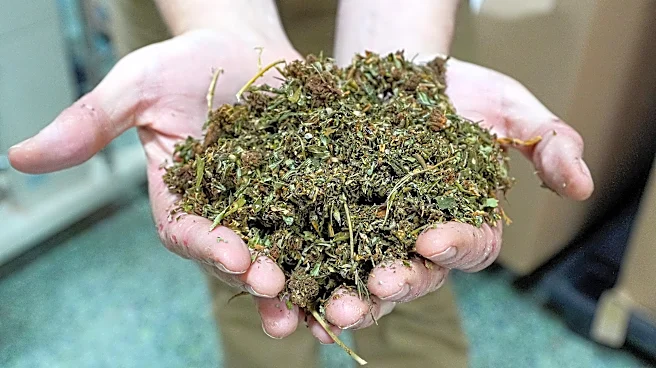








A new Medicare pilot program covers hemp-derived cannabidiol (CBD) products to treat certain patients, even as Congress is moving forward with a law that will effectively wipe those same products off the market.
The resulting policy quagmire threatens patient access, undermines the work of entrepreneurs and highlights a deeper truth: Hemp already plays a role in American health care
, whether federal lawmakers are ready to acknowledge it or not.Millions of Americans across the country are using full-spectrum CBD products not for recreation, but for relief. A recent policy explainer from Pacific Legal Foundation shows that CBD use spans every region and demographic group, with Americans turning to it to manage pain, anxiety, sleep disorders and other
conditions.
For those managing chronic conditions, CBD can offer a lower-risk alternative to more intensive interventions. In fact, some survey data suggests a majority of adults have tried CBD, and many report using it specifically to address medical ailments and eliminate their dependence on over-the-counter or prescription drugs.
CBD use for health care purposes is not a fringe movement. It is a nationwide phenomenon of informed adults seeking more choice in health care.
Medicare recognized CBD's benefits. And then ...

Older Americans, including many Medicare enrollees, make up a substantial share of CBD consumers.
These are regular Americans navigating real health challenges, often after exhausting conventional treatments. That reality makes the emerging Medicare pilot program unsurprising, as policymakers are beginning to recognize that CBD products are filling gaps in the system.
At the same time Washington takes steps to advance hemp’s medical applications, however, it is moving to restrict its use. Recent federal legislation, set to take effect later this year, could eliminate nearly all hemp-derived cannabinoid products in the United States by redefining what counts as legal hemp.
Under current law, CBD products are legal if they contain no more than 0.3% tetrahydrocannabinol, or THC, the primary compound in cannabis and hemp responsible for intoxicating effects. While the law is specific to the intoxicating compound delta-9 THC, lawmakers have argued that this narrow focus created a loophole for other THC compounds to enter the market as CBD products.
The new law will broaden the restrictions to measure total THC, including the compound THCA, which is not intoxicating on its own but turns into THC if it’s heated through smoking, vaping or baking.
This change effectively criminalizes the raw material used to make CBD products, even though the CBD or other hemp-derived products a consumer buys or consumes contain no detectable THC at all. For instance, topical CBD creams or a CBD gummy with 0.0 mg of detectable THC would still be illegal to manufacture because the plant material contained THC in its raw form.
The new law will also prohibit CBD products with more than 0.4 milligrams of THC per container. This change will cause further challenges for CBD manufacturers – because containers generally contain multiple servings and each serving contains anywhere from a few fractions of a milligram of THC to a few milligrams, depending on the product.
Federal policies are tripping all over themselves
The contradiction is mind-boggling. On the one hand, the federal government is exploring ways to facilitate CBD access through Medicare. On the other hand, it is preparing to make that access functionally impossible.
More than just policy incoherence, these contradicting efforts threaten patient autonomy and access to alternative health care solutions.
State laws have largely respected patient autonomy, allowing regulated markets for hemp-derived products to emerge. Rather than waiting for a federal permission slip, Americans are making decisions based on their own knowledge and experiences, often in consultation with their providers.
Federal overreach now threatens to stymie that momentum.
There's still time to fix this
Since this ban was put in place in November, advocates have been working with their allies in Congress to avert its worst impacts. To date, they have been unsuccessful. They are running out of options – and the clock is ticking.
In June, the House Rules Committee denied amendments that would have fixed the hemp problem. Two days later, the White House responded in a statement of administration policy that said, in part, “at a minimum, (Congress should) update the statutory definition of final hemp-derived cannabinoid products to allow Americans to benefit from access to appropriate full-spectrum CBD products.”
Congress should listen to the White House in this instance. If there isn’t time to pass meaningful legislation regulating the hemp industry and sidelining its bad actors before a Dec. 11 deadline, then Congress should pass an extension to pause implementation of the new hemp restrictions and evaluate the role hemp already plays in America today.
At a minimum, federal policy should align with itself. If Medicare is going to facilitate access to CBD products with up to 3 milligrams of THC per serving, those products must remain available. Otherwise, a promising innovation will sink into a bureaucratic morass.
Washington can either catch up to the reality of CBD’s role in American life or stand in the way of the medical freedom of millions of American voters.
Maddie Salamone is a federal policy counsel for Pacific Legal Foundation. Caitlin Styrsky is a strategic research manager at Pacific Legal Foundation, specializing in equality and opportunity.
This article originally appeared on USA TODAY: Medicare now covers CBD, but Congress wants to ban it | Opinion