


Did loyalists to the English crown think that George Washington, John Adams and Ben Franklin were a bunch of snollygosters and belswaggers brabbling as they droiled and desudated in the July heat?
Did their hearts ake, missing the wimmin and dawters they left at home as they fought for what they beleev?
Confused? If a 21st century American heard the way people spoke during the Revolutionary period, they'd hear a lot of words and phrases that sounded familiar, since the former British subjects spoke English. But the English they spoke was different from our modern day diction, from varying accents to unfamiliar words and phrases and even spelling that would make a present-day teacher wear out their red pen.

But how do we know what people in 18th
century America sounded like? There are no recordings from the time, of course, so we're left to try and glean information from contemporary journals, letters and diaries, said Esteban Touma, a linguistics expert with Babbel, the online language learning platform.
"Wouldn’t it be fascinating to have recordings?" Touma mused. "But we can surmise. We have reports about people visiting (America) and writing back to Europe about the differences and similarities in how people sounded."
Perhaps surprisingly, the early colonists would not sound very similar to the formal British accent we think of today. That posh accent is a relatively modern invention, linguist John McWhorter wrote earlier this year in the New York Times.
"The hallmark of the British accent," wrote McWhorter, an author and professor at Columbia University, "developed only at the end of the 18th century."
A 2018 BBC article cites several linguists who say that modern Americans in many cases sound more like 18th century Brits. The article notes the ways in which we (and those long-ago colonizers) pronounce words like "path" ‒ with the "a" sounding like "aa" and not like modern Brits' "pah-th," and Americans' saying "fire" "fi-er" as opposed to today's Britons' "fi-yah."
Mixing sounds and cultures
Language, Touma said, "tends to move in patterns," especially in cities like Boston, New York and Philadelphia which were busy ports where people from all over Europe, the Caribbean and the colonies landed, traded, lived and worked.
Boston welcomed more people from England than other colonial-era ports, so Touma said the sound of New Englanders' speech was closer to that of the mother country. Virginia, too, seemed to have a distinctive accent as early as the 18th century. "Speech would mix with later waves of immigrants, so I would speculate that there was a difference in the accents, and they could tell people from different regions" by the way they spoke, he added.
He pointed to the 2008 HBO miniseries "John Adams," about the Founding Father and second U.S. president; the filmmakers hired a dialect coach to make actor Paul Giamatti sound as historically accurate as possible.
Did Betsy Ross have a Philadelphia accent?
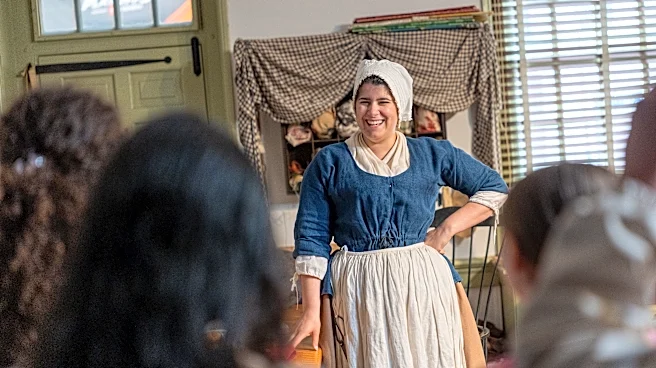
Samantha Ricchiuti is an actor and historic interpreter for Historic Philadelphia, Inc. who portrays two very different but important women of the American Revolution: Betsy Ross, credited with sewing the first American flag; and Julia Stockton Rush, wife of Dr. Benjamin Rush (a signer of the Declaration of Independence) who was highly educated and well-read in her own right.

The two women came from very different backgrounds: Ross was a working-class woman who was raised as a Quaker, and she used the sect's "plain speech" throughout her life, Ricchiuti said. Stockton Rush was born into a wealthy family; her mother was one of the first female poets published in America and her father's family had donated the land for Princeton University, where he was a trustee.
Touma said that, not unlike today, access to education and wealth often affected one's diction and vocabulary.
Books were expensive and rare in Colonial America, and Touma said, people with more money and social standing were able to read more, write more and connect more easily to England and Europe. People from lower social classes might also live in more isolated areas, limiting the languages and words to which they might be exposed.
Regional variations also existed, then as now, he added: A poor laborer in Massachusetts would sound more like a wealthy person from the same area than they would to a poor person from, say, Virginia. And yes, people then code-switched at times, such as the way enslaved people spoke amongst themselves, often using vernacular derived from the West African languages, versus the way they spoke in the company of their enslavers.

"When I am Betsy, people tell me they like my accent and I joke, what accent?" Ricchiuti said. A native Philadelphian, she explained that in character, she rounds out her vowels, articulates consonants more clearly and enunciating more than we do today. As Ross, she says "thee," "thou" and "ye" in keeping with the Quaker speech of the time, but she also says that the seamstress was "very much amongst the people" of Philadelphia: people from England, yes, but also Ireland, Scotland, Wales, Germany, the Caribbean and France. "The way she spoke would have been influenced by the people around her."
Stockton Rush would likely have been more soft-spoken, "a woman of her class and her time," Ricchiuti said, "who was also not afraid to call out the men. She's a lot less fiery than Abigail Adams," but from the correspondence between her and her husband that survives, it's clear Benjamin Rush respected her as his intellectual equal, writing to her about books they could read and discuss together and taking her advice to heart.
Weird words, weirder spellings
Babbel's linguists compiled a list of several words that existed at the time of America's founding that we've largely abandoned, for better or worse. Among them: "Snollygoster," which describes an unscrupulous politician; "brabble," to argue loudly about something unimportant; "belswagger," or a lewd or swaggering man; and "desudation," to sweat profusely.
Noah Webster, who was born in Connecticut in 1758, wrote the "American Spelling Book" in 1783 and the American Dictionary of the English Language in 1828, and, Britannica writes, "was instrumental in giving American English a dignity and vitality of its own."
He was also, Babbel said in a release, a proponent of spelling reform who wanted to democratize language. He "waged a linguistic revolution against what he saw as British spelling tyranny, driven by a belief that the English language had been corrupted by British aristocracy." His own form of rebellion was to create a new system of spelling, one that was based in phonetics: "ake" for "ache"; "beleev" for "believe"; "wimmin" for "women"; and "dawter" for "daughter."
Those spellings, much to the chagrin of students for the last couple-hundred years, did not catch on.
Phaedra Trethan is a national correspondent for USA TODAY, writing about history and Americana. Contact her by email at ptrethan@usatoday.com, on X @wordsbyphaedra, on BlueSky @byphaedra, or on Threads @by_phaedra.
This article originally appeared on USA TODAY: What did the Founding Fathers sound like? The surprising answer