







Keeping Pittsburgh International Airport up and running during a winter snowstorm is a little like a ballet.
That's how both Jim Moorhead, vice president of airport operations, and Will Riordan, director of field maintenance, described it.
"Every piece is choreographed," Moorhead said.
Often enduring whiteout conditions during winter storms, the airport's snow fighters man dozens of multi-ton vehicles, clearing runways with few breaks so the airport can stay open and be a hub for flights diverted from the East Coast.
Here's how they do it.

How Pittsburgh International Airport stays open during winter storms
When winter storms hit at Pittsburgh International Airport, it's all hands on deck — sometimes without any breaks.
"You're going to be here 24 hours, you're going to be here 36 hours, you're going to be here 48
hours without giving up," Moorhead said.
Cleaning up snow and ice isn't as simple as putting down salt. Salt can harm aircraft engines, and while sodium acetate can be put down if necessary, it's extremely expensive, and it must be completely removed before airplanes can use the runways safely.
Instead, the airport's snow fighters combat the snow and ice. Using vehicles equipped with plows, blowers, brooms and substances to help aid in both the removal of snow and prevention of more ice forming, the airport's snow fighters form a "conga line" on the runways.
"Everything has to be synchronized so that driver operator knows what the next driver's doing," Moorhead said.
Riordan echoed the sentiment.
"It's kind of a orchestrated ballet, if you will, when we're out there," he said.
And sometimes, that "ballet" takes place in conditions with next to no visibility brought on by bad weather and snow kicked up by their equipment, something Riordan witnessed firsthand as he rode along with a broom operator during Winter Storm Fern in January.
"You put these brooms down, and it just — everything disappears because ... all you see is white," he said. "It's like you're kind of driving by feel a little bit."
The drivers communicate over radios as they work to clear the runways, moving with the wind to push the snow out of the path of airplanes. And once they're in line, they can't stop without risking an accident, Moorhead said.
"It's a domino effect," he said. "If one stops, they're going to wreck into each other and go down."
The exact process of clearing a runway depends on the storm and whether or not it's bringing freezing rain or wet or dry snow. It also depends on the rate of snowfall. During times of rapid snowfall, like in Winter Storm Fern, which brought more than one inch per hour of snowfall to the airport, the airport has the ability to move a fuel tanker outside so vehicles can quickly refuel and get back to work immediately.
"(During Fern) we lined them up like Daytona, Pit Road, and our laborers went right down the tanks, filling the tanks, gave the guys a sandwich," Moorhead said. "Get back on the machines, get going, or else we're closing."
But for more than 30 years, they've kept at least one runway open. Even during Fern, despite assuming they'd have to reduce operations to only one runway, they managed to keep the others open, Moorhead said.

Logistics of keeping Pittsburgh International Airport open during winter storms
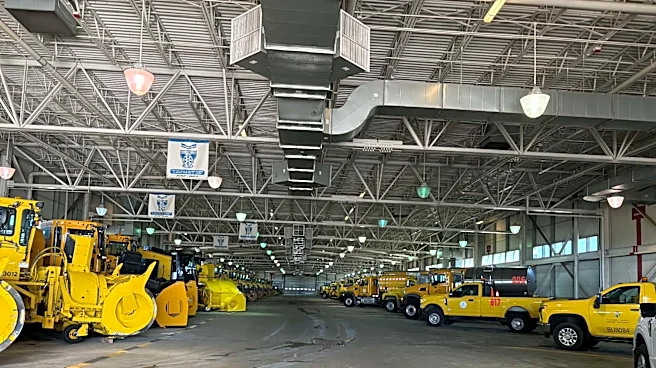
Pittsburgh International Airport has 10 snow blowers, 10 front-mounted brooms, 10 deicers, 10 spreader trucks with the ability to lay down sand (or sodium acetate) on the runway and 10 multifunction vehicles. They also have loaders with attachable 24-foot push boxes for pushing snow across surfaces, as well as auxiliary machines. These are manned by numerous snow fighters who, during bad weather, work around the clock to help keep the airport up and running.
They can also use vehicles to spread materials like potassium acetate, sodium acetate and sand. Potassium acetate is effective as both a deicer and anti-icer, meaning it can both break down ice and prevent it in the first place, while sodium acetate pellets give off heat. The sand helps with traction when conditions are icy.
It's imperative for Pittsburgh International Airport to remain open not only for its own flights, but also for other planes that may get diverted there. The airport is a preferred FAA location for diverted flights when East Coast airports are snowed in. In 2025, the airport handled 463 diverted flights, and this year, they've already surpassed that, Moorhead said.
"When we get a winter storm, my expectations are we're going to keep moving aircraft and we're going to do it safely," he said. "If they need to divert into Pittsburgh, they know there's always going to be a light on in Pittsburgh, and they do it all the time."
How does Pittsburgh International Airport prepare for winter storms?
Each year, Pittsburgh International Airport holds a winter operation drill to prepare for seasonal storms during the autumn. Preparation includes reviewing Allegheny County Airport Authority's Snow and Ice Control Plan, reacting to a simulated winter storm, examining early winter weather forecasts, practicing runway snow removal operations and more.
They also perform maintenance on snow vehicles months in advance. Preventative maintenance starts in July, with things like filter and fluid changes, replacing sections of plows and re-coring brooms. Everything should be ready to go by late October to mid November, Riordan said.
The airport's preparation and its payoff has earned it six Balchen/Post Awards for excellence in snow and ice control over the years.
For Riordan and his team of snow fighters, the honor brings them a lot of pride. But that's just a small part of why they show up every day, he said.
"It's not just about winning the trophies, it's about keeping everybody safe who's flying in and out of here, and that goes a long way with these guys," he said. "I'm pretty blessed to have the opportunity to lead these people."
Finch Walker is the Pittsburgh Connect Reporter for the USA TODAY Network. Contact Walker at FWalker@usatodayco.com. Instagram: @finchwalker_. X: @_finchwalker.
This article originally appeared on USA TODAY: Even in winter storms, Pittsburgh International Airport stays open