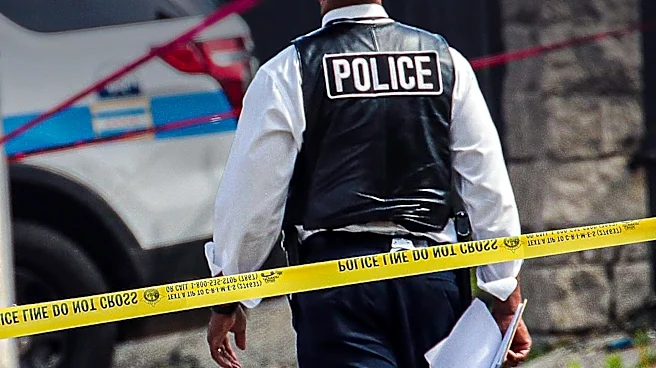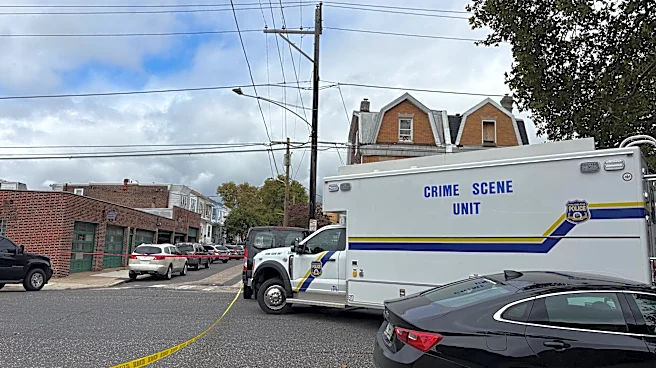





A Philadelphia home is at the heart of a sprawling homicide investigation that police say involves a trove of unsettling evidence, including thousands of photos and videos — some of which police say show five women unconscious and possibly dead.
No bodies have been found in the home, police said on Sept. 16. The city's police commissioner called it "a disturbing case" in September, and experts say the investigation will be challenging.
The case, which involves local and federal authorities, including the FBI and Drug Enforcement Administration, centers around a home in the city's Olney neighborhood owned by Eugene Horsch, 44. His father, notorious pornographer Raymond Horsch, also lived in the house before he died in 2025.
The investigation kicked
off when Eugene Horsch was arrested by National Park Service police on drug and firearm charges, court papers reviewed by USA TODAY show. Eugene Horsch has not been charged with any crime related to the women, some of whom have not yet been identified and some who have been missing for years.
Finding physical forensic evidence connecting the women to the home and confirming whether they are dead is the next major hurdle police must clear, according to retired FBI agent J.J. Klaver, who previously worked in the bureau’s Philadelphia division.
“And that is, I think, a daunting challenge at this point for investigators,” Klaver said.

Traffic stop leads to ‘Herculean’ search effort
The monthslong investigation began with a traffic stop. Eugene Horsch was arrested on June 19 by NPS police on drug and firearm charges, court papers reviewed by USA TODAY show.
According to criminal complaint documents, a park ranger saw Eugene Horsch parked near Independence National Historical Park without a necessary police placard and next to a fire hydrant. While approaching the vehicle, the ranger heard a female passenger say something to the effect of, "you're going to hurt me."
The ranger noticed sores, behaviors and paraphernalia associated with drug use in the vehicle and asked Horsch and the woman for IDs. The name on the female passenger's identification, however, belonged to a local missing person.
A search of Horsch’s car uncovered suspected narcotics, two firearms and fraudulent DEA credentials. He is due in court on Nov. 3 for a hearing on the drug and firearm charges, online court records show. An attorney listed for Horsch declined to comment.
His arrest led to a search of the home. During the initial search, investigators discovered chemicals in a “homemade laboratory of some kind in the basement area,” five urns believed to contain human ashes and a “large amount of digital evidence,” Frank Vanore, Philadelphia police deputy commissioner of investigations, said at a September news conference. Vanore said police believe the urns contain the ashes of Raymond Horsch, his sister, a friend and two other people who have not yet been identified. Some evidence from the home has been sent for testing at a lab in Chicago, according to police.
“The evidence is voluminous and I don’t think it can be overstated what a, I’ll use the term Herculean job it is to go into a crime scene like this and attempt to retrieve as much physical evidence as you can,” said Mary Ellen O’Toole, a former FBI profiler and director of the forensic science program at George Mason University.
Women linked to the case slowly identified
Over 1 million digital images were recovered from the hard drives, flash drives and other items found in the home and about 30% of that material has been reviewed, Wayne Jacobs, FBI special agent in charge of the Philadelphia office, said Sept. 16.
As officials previously stated, some images showed two women, Maribel Fresses and Gabrielle Amarando, who have been missing for years and appeared to be injured and unconscious, Vanore said. These images came from a computer hard drive and had metadata dated 2017, he said.
Other images show a 25-year-old woman, who police did not name, and another woman, who police have not identified, in similar states, Vanore said. A confiscated video, which also has 2017 metadata, appears to show Raymond Horsch handcuffing another woman to a bed and then using a zip tie to render her unconscious.
"So that's five altogether that we've had in this house that we're concerned about," Vanore said.
Authorities have previously identified two other missing women linked to the case as Blair Tonzelli, who disappeared in 2023, and Amy McHale, who disappeared in 2016 and was married to Raymond Horsch. Jonathan Halloran-Koren previously told USA TODAYthat his cousin, Nicole Amanda Fusaro, 27, who disappeared in July 2018, was last seen in the city's Kensington neighborhood and has also been tied to the case. Philadelphia police did not respond to questions from USA TODAY about the women linked to the case.
Vanore said police have identified 58 people total in the images, ten of whom overdosed after they were recorded and were found at another residence. Sixteen of the people who have been interviewed were "not very cooperative," he said. Police are scheduling interviews with 25 people and the remaining three have refused to talk with law enforcement, Vanore said.
On Sept. 28, crime scene investigators returned to the home. Police at the scene explained that this part of the investigation would occur in phases.
Phase one was expected to focus on cleaning out the home and continuing to take photographs. The investigation was expected to pick up again on Oct. 5, and last about two weeks as officials continue to move through and catalog the scene.
Though searches for forensic evidence of this kind are immensely challenging, O’Toole said if multiple homicides were committed in the home, it is highly likely investigators will find some trace of the crimes.
“If in fact he was involved in these severe crimes, evidence is left behind,” she said. “No matter how purposeful they might have been to destroy it.”
Who is Raymond Horsch?
Further complicating the investigation is Raymond Horsch’s work as an artist known for erotic materials that push the genre of pornography and sado-masochism.
A look into his body of work shows erotic photography, adult films and various writings according to a web-archived biography on what claims to be his website, Eroto. The site is no longer active and, as of Sept. 1, the web archive of the site did not appear to be functioning. The site described Raymond Horsch as a "fugitive, sociopath, ex-convict and all-out villain."
Books published in Raymond Horsch's name have cover art images of women in restraints and in a cage. Another, "Empathy: The Memoir of an Empathetic Serial Killer," was published in 2014.
Jacobs said at the September news conference that Raymond Horsch’s work makes it “incredibly difficult” to definitively determine whether the women were actually harmed. Investigators may also have to make similar determinations about whether Horsch's writings are fantasy or connected to actual crimes, O’Toole said.
“People can write some pretty horrible things,” she said. “They’re awful, but whether or not they actually acted out on them, that’s a whole different story.”
What’s next in Philadelphia homicide investigation?
CBS reported that a Philadelphia police K-9 was brought in to search for more electronics on Oct. 9, and detectives plan to look for blood in the house and bring in heavy equipment to dig up parts of the property on Oct. 12 and 13.
Shawn Ritchie, a spokesperson for the Philadelphia Police Department, declined to confirm these are the next steps in the search but said “the investigation remains active and ongoing.” Tanya Little, another spokesperson for Philadelphia police, said parking restrictions remain in place in the surrounding area.
“Additional information will be released as it becomes available and is appropriate for public release,” Ritchie said.
Klaver said investigations into complex cases like this can take months or even years. But he said time can become a serious challenge for investigators as people connected to the case die, memories fade and forensic evidence degrades.
“It may be unfortunately that the fate of some or all of the women who have been identified as missing with a connection to this property, that mystery may never be solved if the only person who has firsthand knowledge of it is no longer alive,” said Klaver.
This article originally appeared on USA TODAY: 'Disturbing' search for missing women started with a traffic stop