


With Thanksgiving approaching, Americans are thinking about what they’ll be cooking and whether everything will be ready on time. For the chefs who have worked in the White House kitchen, those challenges are familiar – although the guest lists, menus and occasional presidential requests have sometimes been anything but ordinary.
Over the years, White House cooks have prepared everything from French banquets to Southern barbecue, navigated the preferences of presidents and their guests, and created culinary traditions that continue today.
A new digital exhibition, "Culinary Diplomats: The Gastronomic Legacy of White House Executive Chefs," takes readers into the White House kitchen and introduces some of the chefs who have worked there.
How free and enslaved Black women, European immigrants and Filipino Navy stewards serve the White House

Some Americans
may be surprised to learn how much French cooking has influenced White House menus over the years. That influence dates back at least to our third president, Thomas Jefferson, who developed a love of French cuisine while serving as the young nation’s minister to France.
As president, he employed a French chef named Honoré Julien, who not only cooked but also taught new techniques to enslaved kitchen workers, including Ursula Granger Hughes, Edith Hern Fossett and Frances Gillette Hern, whose stories are among more than a thousand White House nonpolitical staffers documented in the White House Workers History Project.
Other White House kitchens were also staffed by free and enslaved Black women, European immigrants and Filipino Navy stewards. Throughout the 1950s, U.S. Navy chefs prepared meals for White House celebrations and diplomatic events.
First lady Jacqueline Kennedy created role of White House executive chef
When Jacqueline Kennedy arrived at the White House in 1961, the first lady brought a new emphasis on elegant entertaining and fine dining, establishing the formal position of White House executive chef. She hired René Verdon, a French-born chef known for serving celebrities and dignitaries at New York’s Carlyle Hotel.
In the 65 years since, just seven individuals have held the position.
Verdon’s French flair did not sit well, though, with President Lyndon Johnson, who preferred simpler Southern cooking and valued frugality. Verdon ultimately resigned after being told to use canned garbanzo beans to make a purée.
Johnson also brought to the White House a longtime family cook whose influence extended well beyond the kitchen. Zephyr Wright, a Black woman who had worked for the Johnson family for decades, prepared the Southern dishes the president loved, including fried chicken and biscuits.

She spoke candidly with him about the racial discrimination she experienced while traveling with the family, when she was denied service at restaurants and other facilities available to White Americans. Johnson later cited Wright's experiences as examples of injustices the landmark Civil Rights Act of 1964 was designed to address. He gave Wright a pen he used to sign the law.
From French feasts to barbecues to holiday gingerbread house
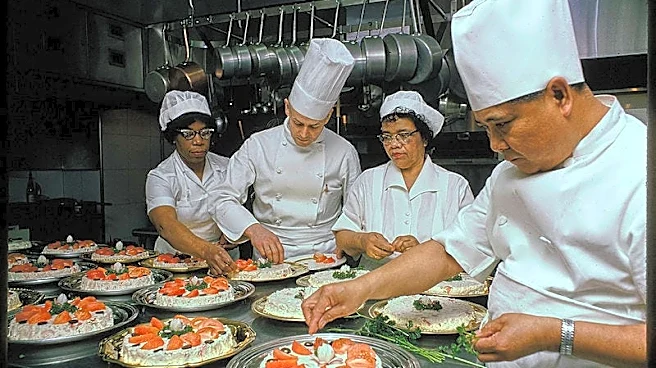
White House chefs have also played an important role in entertaining world leaders. For major state dinners, the kitchen staff can swell to 25 chefs, all working to accommodate guests’ tastes and dietary needs while getting every dish to the table on time.
When President Jimmy Carter, who grew up on a farm in Georgia, hosted the Japanese prime minister in 1979, he was determined to deliver on his guest’s request to experience authentic American barbecue. The White House prepared six suckling pigs, and Carter’s special trade representative, Robert Strauss, even made the barbecue sauce himself. Carter and Swiss-born executive chef Henry Haller personally inspected the pigs as preparations got underway.
Haller, who served five presidents over 21 years, was accustomed to demanding assignments. For his first six months on the job, he worked such long hours that he lived on the White House’s third floor. During the nation’s bicentennial in 1976, the White House hosted at least two state dinners each month.

When the Clintons arrived at the White House, they wanted a different approach to cooking. In 1994, they hired Walter Scheib, who had worked at several prestigious American hotels and resorts, to shift White House cuisine away from its traditional French emphasis – including its generous use of butter.
Scheib embraced contemporary American cooking, combining regional ingredients with flavors and techniques from around the world. He remained executive chef for 11 years, serving both the Clinton and George W. Bush administrations.
In 1994, while preparing a state dinner for South African President Nelson Mandela, Scheib needed extra help in the kitchen. He brought in Cristeta Comerford, a Filipino-born chef working at a Washington hotel known for serving international guests. Impressed by her skills, Scheib hired her permanently.
A decade later, Comerford helped create a menu for Indian Prime Minister Manmohan Singh that paired American ingredients with Indian flavors. Her work caught the attention of first lady Laura Bush, who appointed her White House executive chef in 2005, making her the first woman and first person of color to hold the position.
Over the next 19 years, Comerford continued to expand White House menus, incorporating ingredients from her native Philippines and culinary traditions from around the world.

While White House chefs have prepared countless elaborate dinners for visiting dignitaries, some of their most memorable creations were for holidays.
In 1969, first lady Pat Nixon asked assistant chef Hans Raffert – who later returned as White House executive chef – to create a gingerbread house for the family’s first White House Christmas. Drawing on a holiday tradition from his native Germany, Raffert built a 40-pound, A-frame gingerbread house and launched a tradition that continues today.

The following Christmas, President Richard Nixon reportedly tried to break off a piece to eat, only to be scolded by his wife. Raffert’s creations grew more elaborate over the years, including one during Ronald Reagan’s presidency with a walkway made of the president’s favorite jelly beans.
The new digital exhibition offers a chance to recognize the people behind those meals and celebrations, whose work is rarely seen by the public.
And so, as Americans gather around their own tables this Thanksgiving, a tip of the "toque blanche" – the chef’s tall white hat – to the White House cooks and chefs across the centuries, and to everyone preparing a holiday meal for family and friends.
Stewart D. McLaurin is president of the White House Historical Association, a private nonprofit, nonpartisan organization founded by first lady Jacqueline Kennedy in 1961, and is director of The People’s House: A White House Experience multimedia educational center and museum.
This article originally appeared on USA TODAY: White House chefs serve history as culinary diplomats | Opinion