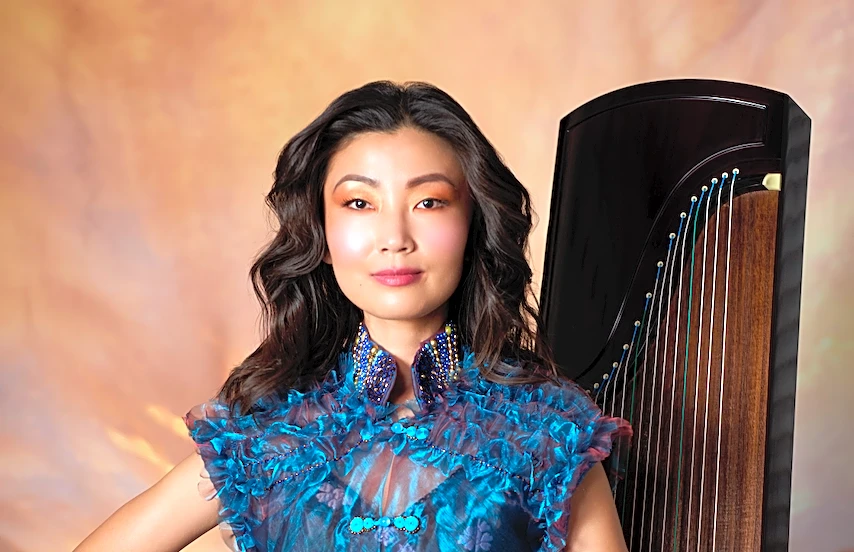










For more than two decades, guzheng performer, composer, and recording artist Bei Bei has been sharing the sound of the traditional Chinese instrument with audiences across Southern California.
Musician Beibei Monter, known professionally as Bei Bei, first began playing the guzheng when she was nearly 7, after hearing a friend perform a piece on it.
"I fell in love with this instrument instantaneously," she said. "I wanted to learn it."
The guzheng has more than 2,500 years of history and originated in China. The instrument was once smaller and had fewer strings before evolving into the standard 21-stringed Chinese zither. People play it widely throughout China and around the world.
About 23 years ago, Bei Bei moved to Southern California and brought
the guzheng with her. She began performing in Old Pasadena as a street performer outside Barnes & Noble, where she says her professional career began.
Over the years, Bei Bei has recorded for productions including "Mulan" (2020), "Kung Fu Panda 4", "Turning Red", and Season 2 of Netflix's "Avatar: The Last Airbender". She has also performed with the Pacific Symphony, UC Irvine Symphony Orchestra, and the UCLA Game Music Ensemble.
In addition to performing, Bei Bei teaches the guzheng. Her students range in age from 6 to 70 and come from a variety of backgrounds.
"I feel I have a responsibility here in California to help people continue to discover this music and help them learn if they want to," she said.
Released Feb. 20, "Two Moons" features seven original tracks composed by Bei Bei and collaborator Paul Elliott. Bei Bei described the project as a contemporary instrumental album that blends traditional instruments with modern electronic production.
The album's title track drew inspiration from the Mid-Autumn Festival. Bei Bei said she improvised the piece during the celebration, then noticed what appeared to be two moons in a window: The moon itself and its reflection. She photographed the image and later used it as the album cover.
"The two moons became the central symbol of the album," she said, representing "tradition and innovation, East and West, as well as the physical selves and our spiritual selves."
One of the album's standout tracks, "Midnight Bizarre", draws on Chinese folklore and supernatural stories, particularly "Strange Tales from a Chinese Studio", a 17th-century collection featuring ghosts, demons, fox spirits and other supernatural beings.
"I decided to write a piece to reflect that kind of energy," Bei Bei said. "That's how 'Midnight Bizarre' came."
Bei Bei created the piece through improvisation over an electronic soundscape Elliott produced. Bei Bei said the stories left a lasting impression on her after she read the book as a child and later watched film and television adaptations.
"Nobody has ever done that with this instrument," she said. "Most times people play pretty music, beautiful music with this instrument. So this is actually a very cool experimentation."
"Midnight Bizarre" went on to win a 2026 Intercontinental Music Award in the Contemporary Instrumental category.
This article originally appeared on USA TODAY: Guzheng musician shares Chinese folklore in Southern California