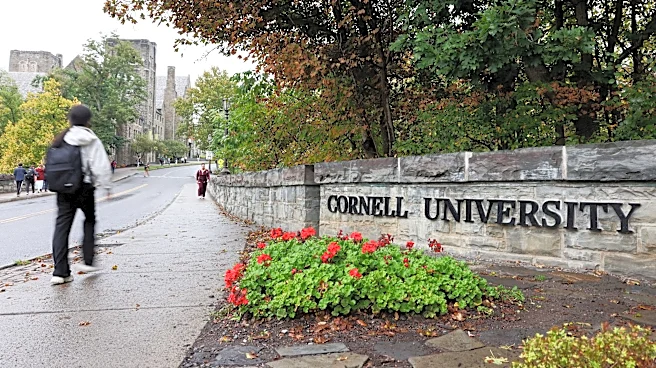







Netflix on Oct. 29 released a short documentary about the Cornell University gang rape case amid building pressure against the school’s administrators over their handling of Jane Doe’s 2024 allegations.
The 36-minute documentary, “Jane Doe V. Cornell,” is the fifth installment of what the streamer calls “Instadocs,” quickly produced, narrative nonfiction stories that dive into the latest headlines.
It dropped less than two months after Doe, a former Cornell student, filed a civil lawsuit alleging she was drugged and raped at the Chi Phi Fraternity house in October 2024.
The release comes as a growing group of faculty members mount efforts to oust Cornell President Michael Kotlikoff and other leaders, whom they say have inadequately responded to the “ongoing
crisis of sexual assault” on campus.
The Cornell Faculty Senate began voting Oct. 29 on a symbolic no confidence resolution in university administrators, while the school’s American Association of University Professors chapter formally called on the president to resign.
When Netflix announced plans to release the documentary, some on social media were quick to question whether it was “unethical” for the entertainment platform to release the show while Doe’s case is ongoing.
Criminal justice and media experts told USA TODAY the film's rapid release isn’t a new phenomenon. It follows in the mold of news magazine programs, they said, including "Dateline" and "48 Hours".
“It's just a continuation of what we've been seeing, which is more and more immediacy and more and more people trying to put the story out there quickly in order to get the viewers,” said Danielle Slakoff, an associate professor of criminal justice at California State University, Sacramento.
“The fact that this is being packaged alongside entertainment and comedy and live podcasts – it just feels a little bit different in that sense.”
Is it too soon for a true crime documentary?
Slakoff and other experts said documentaries produced during ongoing news events, such as Netflix’s short film on the Cornell case, aren’t necessarily salacious, as some Reddit users suggested, and in some cases, serve a public good. It comes down to the documentary’s framing, Slakoff said.
Over multiple weeks, the team behind “Jane Doe V. Cornell,” interviewed the key figures at the center of the case, including editors at the student newspaper, The Cornell Daily Sun; New York Gov. Kathy Hochul; Jane Doe’s attorney; a former Cornell fraternity president and a Title IX expert.
The documentary examined how Cornell and other universities handle sexual assault allegations and Title IX reports.
“It seems to be framed around institutional harms, and I think, on its face, that sounds great,” Slakoff said before viewing the film.
Slakoff said she understands viewers' concerns about quick-turn documentaries that premiere before the story comes to a resolution. But, she said, these films also have the “advantage” of helping inform the public more quickly.

At one point in the film, Amanda Walsh, a former Brown University Title IX program officer and deputy director at the Victim Rights Law Center, said Cornell appeared to follow Title IX procedures. The problem, she suggested, is that the federal Title IX law is imperfect.
The Netflix release followed another true crime documentary about the case published Oct. 9 on Hulu by Impact x Nightline, a news magazine and documentary series from ABC News.
Patricia Aufderheide, a communications professor at American University who has written about documentary ethics, said the “instadoc phenomenon” puts streamers, such as Netflix and Hulu, in the category of news providers.
“The norms of journalism apply,” she said in an email.

Pressure mounts against Cornell leaders
The night before the documentary was released, hundreds of Cornell faculty packed into a lecture-style auditorium to debate whether they had enough evidence to prove university administrators failed in their handling of Doe’s 2024 case.
They discussed a resolution Labor History Professor Paul Ortiz introduced earlier in the month for a vote of no confidence in the school’s leadership. More than a dozen Faculty Senate members co-sponsored the resolution and more than 160 faculty across the university expressed support.
But ahead of the Oct. 28 meeting, divisions among faculty were evident. Twenty female science and engineering professors wrote a letter to Cornell’s Board of Trustees on Oct. 27, calling on Kotlikoff to resign.

Meanwhile, three professors in the Department of Chemistry and Chemical Biology penned a letter to the student newspaper, The Cornell Daily Sun, arguing that ousting Kotlikoff would “undermine” the school’s ability to address sexual assault on campus.
At the Oct. 28 meeting, Ortiz argued Cornell administrators built and defended a system that put the universities' reputation over victim interests, according to written opening remarks sent to USA TODAY. He described campus police investigations into sexual assault allegations as inadequate and cited USA TODAY reporting showing Cornell rarely suspended or expelled students in sexual assault cases.
Opponents of the resolution said the Faculty Senate did not have enough information to judge the university’s response to Doe’s case and other cases of sexual assault, Cornell professors told USA TODAY. They motioned to table the resolution until the conclusion of an ongoing independent investigation into its sexual assault procedures led by former acting U.S. attorney general Sally Yates. That motion failed.
Faculty senators have until Nov. 6 to vote on whether they have confidence in Kotlikoff and other administrators.
Although largely symbolic, supporters of the no confidence vote believe it could influence the school’s Board of Trustees, who oversee the appointment of university leaders.
This article originally appeared on USA TODAY: Netflix drops Cornell documentary as school leaders face scrutiny