





Could one single router have been the cause of the nationwide ground stop that halted over 10,000 flights?
That's the culprit identified Nov. 14 by Transportation Secretary Sean Duffy, who said aerospace and defense technology company L3Harris was conducting routine maintenance to switch telecommunication lines from old copper wire to fiber in at least one remote location.
Officials told Reuters there may have been problems with routers installed in both Arkansas and Texas.
The work involved replacing aging copper wire with fiber, a process that had been ongoing throughout the system over decades, Duffy said. The updated router starting flooding others on the air traffic control system causing communication issues and disruption in radar feeds,
he said.
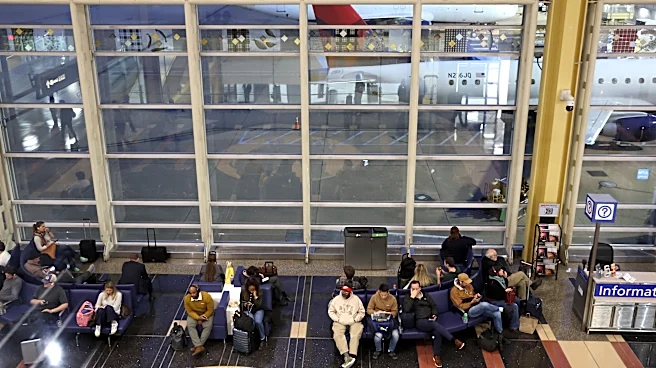
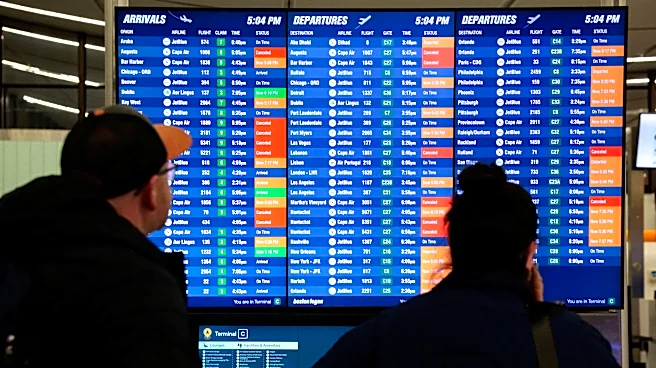
As a result, the FAA issued a nationwide five-hour ground stop that led to the cancellation of nearly 10,000 flights and delays of more than 7,000 others in one of the nation's worst-ever travel disruptions.
The ground stop was lifted at around 8:15 p.m. Friday. "We are back at full operations," Duffy said Saturday.
However, officials and experts warned disruptions caused by the stoppage could linger for days.
Officials are still working to determine whether the problem was due to an error in the installation or a faulty router, Duffy said.
What is L3Harris?
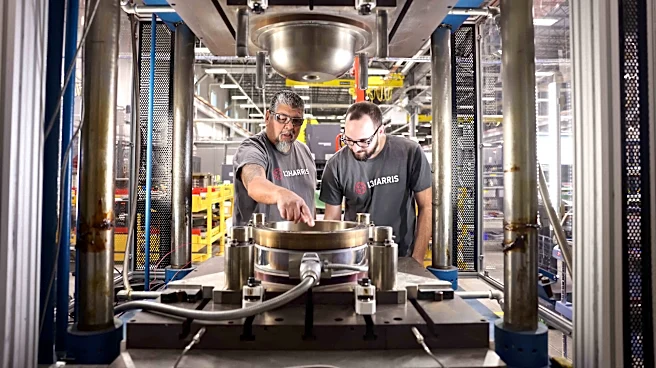
The router work was being done by contractor L3Harris Technologies, which is headquartered in Melbourne, Florida, Duffy said.
L3Harris manages the FAA Telecommunications Infrastructure, supporting about 45,000 daily U.S. flights, connecting more than 4,400 facilities, according to the company's website.
Among its tasks: converting decades-old copper wire connections with modern high-speed networks.
"L3Harris has been modernizing the communications infrastructure supporting the National Airspace System in close coordination with the FAA. With safety and reliability as our highest priorities, L3Harris, together with its telco partners and the FAA, has completed more than 70% of the planned airspace communications conversion from legacy copper wires to a fiber optic system," the company said in a statement Saturday, Nov. 14.
"We are supporting the FAA in its investigation to understand the conditions that led to the Nov. 13 ground stop of our nation’s air travel. L3Harris takes the nationwide ground stop and its impact on travelers, airlines and air traffic operations seriously."

An aerospace and defense technology company, L3Harris Technologies was created in June 2019 by the $43 billion merger of the space and aviation company Harris Corporation of Rochester, New York, and L3 Technologies, a Melbourne, Florida-based military and homeland security communications tech provider, CNBC reported.
The merger created the nation's sixth-largest defense tech firm, behind Raytheon, Washington Technology reported at the time.
Friday's replacement of copper to fiber was being handled by L3Harris at an as-yet-unnamed FAA remote location, Duffy said. "We're working to determine was whether we had incompetence, meaning was it user error or installer error from L3Harris, or did they install a faulty router? We haven't determined what the fault was," he said.The issue led to data overloading other communications centers.
"We had over 1,000 connection attempts every four to five seconds, and what that did was gave us issues with our communication with airplanes, and it also caused some disruption with our radar," Duffy added.
"We were able to deploy fixes to reduce the overloading on our switches, that we're able to bring the networks back online and our (air traffic control facilities) and our centers back online," he said.
Duffy described the problem as involving "legacy network" equipment, maintenance on which continues as the FAA is in the midst of an air traffic control modernization program. "By the way, all of the new equipment that we put in, none of that went down. This is all old legacy equipment that's existed forever," he said.
"We need L3Harris or whoever provided that router to us to do a better job," Duffy said, noting that "virtually every single institution in America has gone from copper to fiber, from analog to digital."

The nation's aging air traffic control system has been a hindrance for years, as it relies on outdated telecom systems, including decades-old Compaq computers and replacement parts bought on eBay, Reuters reported. FAA Administrator Bryan Bedford has said outdated telecom copper wires should be completely replaced by September 2027.
Congress approved $12.5 billion to modernize air traffic control systems in 2025, but in September, Duffy asked for an additional $30 billion to complete upgrades and fix facilities.
He upped that request Friday to $50 billion in funding to upgrade air traffic control systems. "This is an emergency," he said
The FAA said it was doing additional testing with L3Harris to see if there are any additional risks, Reuters reported.
The FAA is also moving to a cloud-based SMART (Strategic Management of Airspace, Routes, and Trajectories) system for managing air traffic. Coincidentally, the FAA said on Friday it was expanding the SMART system across the United States after initially rollout in the National Capital Region in September.
Air Space Intelligence, the company behind the FAA's SMART airspace planning system, denied its technology had any affect on Friday’s nationwide ground stop.
Contributing: N'dea Yancey-Bragg, Joey Garrison, Sarah D. Wire, Josh Rivera and Zac Anderson
Mike Snider is a national trending news reporter for USA TODAY. You can follow him on Threads (mikegsnider), Bluesky (@mikegsnider.bsky.social), X (@mikesnider) and email him msnider@usatoday.com.
This article originally appeared on USA TODAY: FAA contractor, router focus of investigation into air traffic halt