




Somehow the song “Baby Beluga” always soothes my 7-month-old daughter. When she cries on car trips. When she’s getting a diaper change. When she was kicking in the womb.
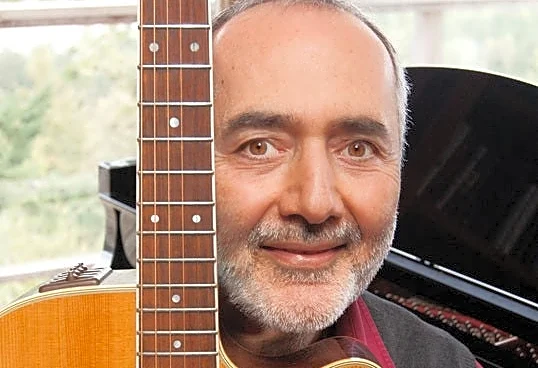
“It's magic,” says the children’s singer Raffi, of his song inspired by a whale at the Vancouver Aquarium
. “I wish I had another answer for you, but that song has a way of comforting children … in a way that I could never have imagined.”He muses on the secret behind the magic. It’s the bouncy melody. The gentle repetition. It’s because it’s about a baby – “young children love babies.” Or it’s the comforting, encouraging lyrics: "Is the water warm, is your mama home," yet you "swim so wild and you swim so free." Eventually he gives up and simply concludes: “Alliteration, yes!”
It’s the most well-known song in a career that began 50 years ago with the album “Singable Songs for the Very Young,” which is getting an anniversary rerelease Nov. 13 on an eco-friendly vinyl alternative. It includes classics like “I Wonder If I’m Growing,” which last month got a book adaptation in collaboration with the celebrated illustrator Jon Klassen. And Raffi just released a new album, “Love Is Everywhere,” featuring the song “ABC Democracy,” on the importance of voting.
Profiles have been written over the years about the complicated Raffi – the one who got divorced, who could become depressed about global warming, who worried he became a self-centered celebrity, who took breaks from kids music, who never had kids himself. But now, at 78, he seems content with where he is and the nearly 20 million albums he’s sold – and how he’ll be remembered.
To a generation of “Beluga grads,” as he calls his grown-up fans, he epitomized children’s music. “The Simpsons” featured a character called Roofi, while a “Portlandia” sketch saw a group of parents rebel against typical kids songs by creating a band called Defiance of Anthropomorphic Sea Mammals. Yet he once aspired to be a singer for adults – so the real anniversary celebration is marking 50 years of making peace with the path that the world opened up for him.
“With children's music, I could present songs in a number of different musical styles and that was fine because the variety was actually a strength,” he recalls. “So because I knew that my children's songs weren't dependent on radio airplay, that gave me a freedom to kind of do what I chose to do."
Like “Sesame Street” and “Mister Rogers' Neighborhood,” which both began several years before “Singable Songs,” he brought together countercultural thinking with new ideas about attending to children’s emotional needs – but he merged them with the folk music of his idols.
Rachel Accurso, known as children’s entertainer Ms. Rachel, says she grew up trimming the tree while Raffi’s Christmas album played in the background, and now she does the same with her children. "His songs also have themes of giving and love and caring for each other that really resonate with my spirit and our family and my heart, you know?" she says. "I like that the kids sing with him."
She says if she had to pick a tune by anyone that she could have written, it would be "Baby Beluga." "Sometimes we hear a song and just know it’s beautiful."
Raffi’s beginnings as 'melancholy child'
Raffi Cavoukian takes our video interview from his home on Salt Spring Island in British Columbia, in front of a couple gold albums, his fifth honorary degree and a citation naming him a Companion of the Order of Canada, roughly equivalent to a knighthood.
He was born to an Armenian family in Cairo before they moved to Toronto when he was 10. He was a “melancholy child, and said to have the oversensitivity of a poet,” he writes in his memoir, "The Life of a Children's Troubadour."
“My childhood often felt like a great bewilderment,” he says. “The saving grace was that I knew that I was loved. Thank goodness. But if I was loved, why was I at times being hit by my parents? Why was I at times being mocked and humiliated? So yes, I was loved, but did I feel respected for who I felt I was as a child? No, I didn't feel that.”
He sang in the church choir and made a fake guitar with a cardboard tissue box and elastic bands, before buying his first real one at age 16 for $24. He idolized Pete Seeger, Bob Dylan and James Taylor, and during college performed his songs in Toronto coffee houses.
Then one day his mother-in-law invited him to play for a dozen kids at the nursery school where she worked. He had to learn “Twinkle, Twinkle, Little Star” and “Baa, Baa, Black Sheep,” since they were not part of his childhood. He kept being invited to play for kids – and things seemed to click.
Bert Simpson, a friend who was then an elementary school teacher and is now senior associate at Raffi’s record label, recalls, “You had to watch him sit down with a bunch of 3- and 4-year olds and start singing with them – as soon as you saw that, you could see something different was happening.”
Raffi's landmark album that's 'simple and genuine'
Raffi's folk-singing career was a struggle, and he considered quitting to become a carpenter, before his mother-in-law suggested he create a children’s album. Kids music back then consisted of Disney movie soundtracks or “so-called educational records that were either dry and instructional, or syrupy sweet and condescending,” Raffi writes in his memoir.
Ken Whiteley, who co-produced several Raffi albums, says that his secret is that “he is able to embody these bigger concepts and express them in a way that is simple and genuine.”
On “Singable Songs,” they wanted a vibe that was “both positive and yet still kind of low-key,” Whiteley recalls. “Don’t take the tempos too fast. Keep the tempos so it’s kind of relaxed, so the kid will respond to it over and over again, so it doesn’t wear them out.”
They made sure to inject musical variety, helped by Whiteley’s ability to play 20 instruments, and the engineering contributions of Daniel Lanois, who went on to co-produce U2’s “The Joshua Tree” and “Achtung Baby.” Whiteley says that Raffi “was always aware of the fact that if you’re making an album for children it has to be listenable for parents, or they’re going to hide the album: ‘Oh I don’t know where that is.’”
Simpson, who advised Raffi on "Singable Songs," remembers the two of them hustling to drop off copies at bookstores, and even leaving a cheap record player so the store could play it – and a day later, the store would call to request more albums.
“It was very different than what passed for children’s music at the time," Simpson says. "It wasn’t commercial, it wasn’t brash, it didn’t talk down to the children, it wasn’t cutesy."
When Raffi started doing concerts, he’d spend an hour greeting kids in the lobby afterwards.
“He has like a built-in empathy with young children,” Simpson adds. “They sense in him someone they can trust and connect with, even from the back of the auditorium and through a record player.”
Even former Canadian prime minister Justin Trudeau has a kinship with Raffi. “Some of my earliest, happiest childhood memories are set against the tune of ‘Down by the Bay’ and ‘Peanut Butter Sandwich,’” Trudeau writes via email of two of the songs on Raffi's album. “It’s always special to see a beloved Canadian artist grow and gain international recognition, especially when they use their voice and influence to better the world.”
Raffi has a philosophy of 'child-honoring'
Raffi tells the story of bolting upright from sleep one Sunday morning in the late '90s and seeing a vision of two words in the air: “child honoring,” which became the driving idea behind his foundation. "Respect for the child as a whole person," he explains.
He’s sticks to his ideals: When he put out his environmental advocacy album “Evergreen Everblue,” he refused to put the CDs in wasteful long-box packaging. And he’s turned down offers to put his songs in ads.
Kids are “not old enough to be able to appraise the sales pitch – they're impressionable. It's not fair,” Raffi says. “And also, I didn't want my music, which was already becoming well-loved, I didn't want it associated with some soup company or a diaper company.”
Accurso says that one lesson she’s learned from Raffi is “not being afraid to go beyond the music, and be an advocate for children, to make sure as grown-ups that we are standing up for kids when what’s happening to them is wrong. That’s something that’s not separate from the career – it makes sense that it’s a part of it.”
Accurso has faced criticism for advocating for Palestinian children, and Raffi has voiced his encouragement. “It’s just so validating,” she says. “On the internet those voices can be so loud, so when someone like Raffi supports you, you can say wow, I’m so lucky.”
Raffi speaks in high-minded, universal concepts, but he does care about earthly things. He roots for the Vancouver Canucks and cheered on the blue wave in the U.S. elections. He's delighted that his song "Bananaphone" became a TikTok meme.
And he has a basic answer to why he stuck with kids music for these past 50 years: "I was having so much fun with it.”
This article originally appeared on USA TODAY: Why is 'Baby Beluga' singer Raffi so great? Just ask Ms. Rachel and Justin Trudeau