




The biotech company that brought us the dire wolves has a new project: breeding and cloning elite dogs for the U.S. military, law enforcement and first responders.
New defense-tech startup Warhound, launched by Ben Lamm, George Church and Palmer Luckey, announced Thursday, Oct. 22, it had received $200 million in funding for its ambitious goal: rebuild America's domestic supply of military working dogs using cloning, genetic screening and battlefield technology.
The company says the effort could reduce U.S. reliance on imported dogs while improving training success rates. According to Warhound, more than 80% of U.S. military working dogs are acquired from Europe.
To accomplish that, Warhound will license Colossal Laboratories & Biosciences' biogenetics
and animal-cloning technology alongside Anduril Industries' defense systems "to fundamentally change how America produces, trains and protects its military working dogs," the company said in a news release.
The company argues that supply has dwindled because of growing international competition for top working dogs and a growing rift between America and the European Union, which currently supplies most of the animals used by the U.S. military. "There's supply chain issues. A lot of the best dogs have been purchased. There's a dwindling supply (and) we compete with our adversaries," Ben Lamm told USA TODAY
Why the U.S. military's dog supply has become a concern
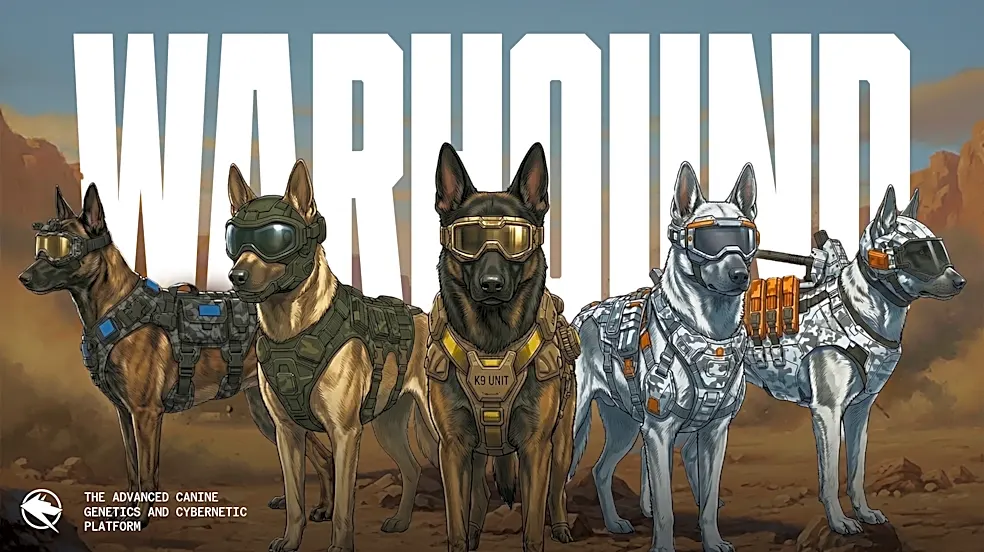
Among the breeds Warhound expects to raise for the military, police, and rescue services are Belgian Malinois, German Shepherds and Labrador Retrievers, Lamm said.
Optimizing the dogs' genetics can deliver animals more suited to warfighting. Currently, it's typical for half of the dogs brought into training to not make it through.
"If you can standardize the training and you know the genetic disposition and performance capabilities, we think that we can we can lower (the failure percent) to 10% washout or less," Lamm said. "Let's vertically integrate everything so that we can clone and deploy the top dogs. You're not worried what you're going to get."
In addition to "domesticating that supply chain (and) enhancing the dogs genetically we will also be further enhancing them," Lamm said. Deployed dogs may get protective body armor, ear and eye coverings, and integration with military technology such as like EagleEye, Anduril's in-development artificial intelligence-powered military helmet and high-res 3D heads-up display. Anduril is also developing, with Meta, battlefield augmented reality glasses.

Warhound hopes to have its first puppies born in the first quarter of 2027 and will likely have some demonstrations next year of Anduril's potential technology applications for the working dogs. “Man’s best friend deserves man’s best tech,” Luckey said in a statement.
Lamm and Luckey came up with the idea for Warhound at a Moonshots Summit event hosted by entrepreneur Peter Diamandis, founder and chairman of the XPRIZE Foundation.
Luckey, Lamm said, "kept talking about working dogs and all these ideas. we came up with this idea of (if) we can support the working dogs, which helps firefighters and first responders and police departments and war fighters (and) our military."
Luckey is among the co-directors – along with SpaceX CEO Elon Musk and former House Speaker Newt Gingrich – of "Project Meridian," an effort to study technological capabilities needed for the future of warfare, announced by Defense Secretary Pete Hegseth last month.
Musk and Luckey's roles could raise conflict-of-interest concerns as both own stakes in companies that do business with the Defense Department. Luckey does not have an equity share in Warhound, the company said. Lamm, who does, will serve on the company's board.

Funding a fighting dog program
Amid its $200 million seed funding round, Warhound is backed by In-Q-Tel, Sequoia Capital, ARK Invest, Franklin Templeton, Bob Nelsen, Breyer Capital, CAZ Investments, USIT, Neogenesis, Builders VC, Lux Capital and others.
“Our long-term goal is simple: healthier dogs, better-prepared teams, and more service members and first responders coming home safely," said Warhound CEO David Spirk in a statement. Spirk served as the chief data officer for U.S. Special Operations Command and, subsequently, the Defense Department before joining Palantir Technologies in July 2022 as a senior counselor.
"Leading Warhound, and strengthening America’s working-dog capabilities, is an opportunity to apply my experience to a mission I care deeply about: protecting people and helping the animals who support them," he said.
The American Humane Society, which has previously monitored the process used to produce the dire wolves, will also certify Warhound's training programs and support the reunification of retired military working dogs with their former handlers and adoption protocols, the company said.
"What excites me about Warhound is the opportunity to make health, welfare, and exceptional care fundamental to a working-dog program from the very beginning," said Robin Ganzert, president and CEO of American Humane Society, in a statement. “We owe these dogs a commitment to their well-being that matches their service to us. Success means helping these dogs thrive throughout their lives – from training and active service to the loving, dignified retirement every canine hero deserves.”

Contributing: Miles J. Herszenhorn
Mike Snider is a national trending news reporter for USA TODAY. You can follow him on Threads, Bluesky, X and email him at mikegsnider & @mikegsnider.bsky.social & @mikesnider & msnider@usatoday.com.
This article originally appeared on USA TODAY: Warhound plans high-tech future for military dogs