




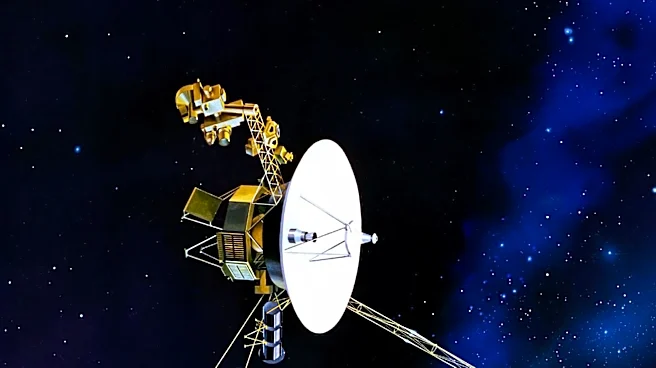
First human-made object to reach the space between the stars. Farthest spacecraft from Earth. And now, first to reach one light-day from our planet.
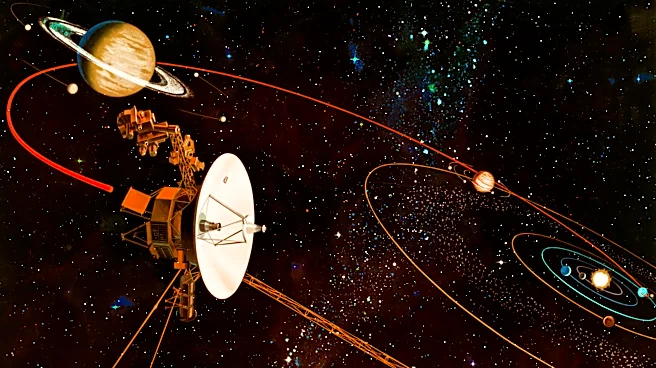
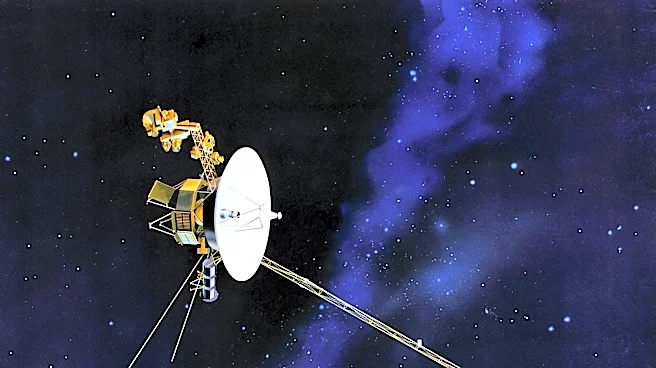
Those are the laurels of Voyager 1, one of two iconic NASA probes launched nearly half-a-century ago that has explored the depths of our solar system – and now beyond.
Voyager 1 was expected to reach its latest milestone this morning, Wednesday, Nov. 18, as it cruises through space at speeds of nearly 38,000 mph. That's fast by Earth standards, but a slog in cosmic terms.
For instance, the light-day landmark means Voyager 1 has crossed a swath of the universe so vast as to be incomprehensible to most of us. But within the larger context accounting for the grand scale of the stars, the intrepid vehicle
has barely scratched the astral surface.
That's not to minimize its historic feat, which marks a major accomplishment for NASA and humanity at large, science educator Bill Nye said in a statement, lauding the missions as having "changed the way all of us feel about outer space and our home world."
"The majority of people on Earth today were not alive when Voyager 1 and 2 were launched," Nye said. "But all of us – everyone on Earth – have been touched by these missions."
Here's everything to know about Voyager 1 and its light-day milestone.
What is NASA's Voyager program?
Both Voyager probes have spent nearly five decades traveling billions of miles away from Earth to explore the outer solar system and beyond.
The Voyager program's main mission was originally to investigate all the giant planets of our outer solar system ‒ Jupiter, Saturn, Uranus and Neptune ‒ as well as the planets' magnetic fields and a combined 48 of their moons, NASA says. The probes completed that portion of their respective journeys by 1989, after which NASA retooled their mission as an interstellar expedition – meaning one journeying beyond our solar system into the region between stars, farther into the Milky Way.
Each probe also carries the famous "golden record," functioning both as a time capsule showcasing Earth's various cultures, languages and more, as well as a friendly Earthling greeting should either vehicle encounter extraterrestrials.
Voyager 1 reaches light-day from Earth
Voyager 1 already has long had the distinction of being the farthest human-made object from Earth – a record it has maintained since 1998 when it bypassed NASA's Jupiter-exploring Pioneer 10 probe.
In 2012, Voyager 1 became the first spacecraft to reach interstellar space, followed in 2018 by Voyager 2, according to NASA. To this day, the probes are the only spacecraft in history to operate outside of the heliosphere – the protective bubble of particles and magnetic fields generated by the sun.
Now, on Wednesday, Nov. 18, Voyager 1 has reached a new milestone: becoming the first human-made object to reach one light-day away from Earth.
What is a light-day?
A measurement of distance rather than time, a light-day indicates the distance light will travel in the span of 24 hours. That means the light from Voyager 1, which was expected to reach the milestone at 5:16 a.m. ET, will now take a full day to reach us here on Earth.
Nothing moves faster through space than light, according to NASA, which said it travels at a speed of about 186,000 miles per second. For an idea of how fast that is, light could traverse the roughly 240,000 miles between Earth and the moon in about 1.3 seconds – a distance it took the Artemis II astronauts three days to cover in April.
"Before you get too excited by this, the nearest stars to the sun are light **years** away," astrophysicist Neil deGrasse Tyson cautioned in a post on Facebook.
That's right, the closest neighboring solar system to ours is about 4.24 light-years away, while the next closest galaxy to our Milky Way, Andromeda, is about 2.5 million light-years away, according to NASA.
When did Voyager 1, 2 launch?
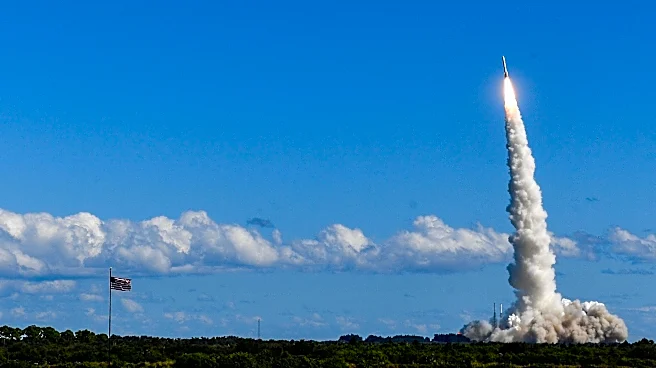
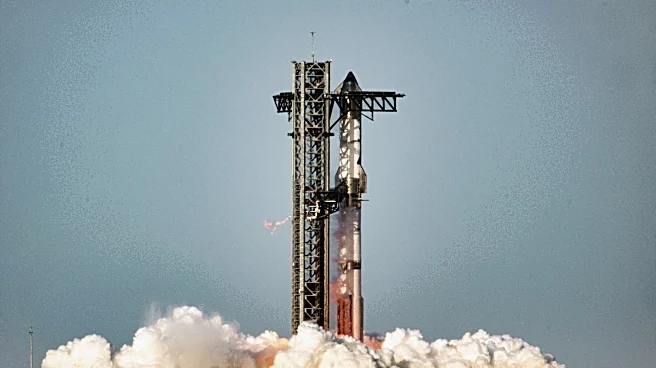
The twin Voyager probes were launched on separate dates in 1977 from Florida from what is now the Cape Canaveral Space Force Station atop a Titan-Centaur rocket.
Contrary to its name, Voyager 2 was the first of the vehicles launched into space on Aug. 20, 1977, followed by its twin probe, Voyager 1, then launched Sept. 5. But because it was on a faster route, Voyager 1 quickly made up ground on its twin, whizzing beyond the asteroid belt between Mars and Jupiter and passing Voyager 2 by December of that year.
NASA Voyager tracker: Where are the probes now?
Voyager 1 is more than 16 billion miles away from Earth, traveling through the cosmos at more than 37,800 mph, according to NASA. Voyager 2, meanwhile, is whizzing at about 34,000 mph while 13.4 billion miles away.
The space agency provides an interactive three-dimensional diagram tracking both Voyager probes' positions outside the solar system.
Where is Voyager 1 going?
Voyager 1 is headed in the direction of a star (AC +79 3888) more than 17 light-years away from Earth, also known as Gliese 445 in the constellation Ursa Minor. If Voyager 1 keeps trucking along, it could pass within 1.7 light-years of the star – in 40,000 years, according to NASA.
Eric Lagatta is the Space Connect reporter for the USA TODAY Network. Reach him at elagatta@usatodayco.com
This article originally appeared on USA TODAY: NASA's Voyager 1 is now a light-day away from Earth. What that means