





You might not be accused of committing a crime, but a coast-to-coast network of cameras is still trying to track your vehicle’s movements.
It’s a high-tech attempt at deterring crime and catching criminals, championed by its creators and some local law enforcement, who say license plate readers are a big part of the future of policing.
But the technology is also a snowballing privacy nightmare, according to critics who are fighting back with protests, legislation and websites dedicated to tracking the trackers.
Frustration has boiled over into vandalism in some locations.
License plate readers have been shot at in Tennessee, hit with a truck in California, beat with a baseball bat in Virginia, cut down with a saw in Texas and splattered with paint
in New York. They've also been regularly blocked by a lone protester in Florida.
Notably, the criticism of the technology has been strikingly bipartisan in a nation where it’s often tough to find political common ground.
Chad Marlow, senior policy counsel at the American Civil Liberties Union who focuses on privacy, surveillance and technology issues, said the technology triggers concerns about government overreach on the right and worries about who is being targeted on the left.
"For people in the center or the non politically engaged are even like 'I don't want to be tracked everywhere I go,'" he said. "And so there's different reasons, but everyone is arriving at the same position, which is mass government surveillance in this country has gotten completely out of control and needs to be reined in immediately."
Now the concerns about privacy, misuse, mistakes and even road safety are popping up in city council meetings, lawsuits and even a planned national week of action in late August.
Flock cameras aim to help crime-fighting
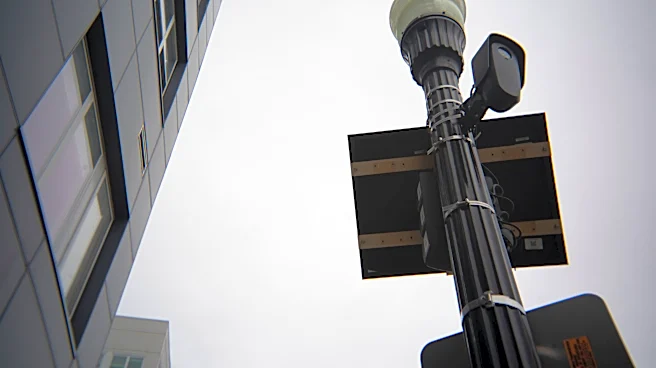
Though multiple companies sell the devices (sometimes called Automated License Plate Readers or ALPRs), much of the public ire has been directed at Flock Safety, which boasts a network of more than 120,000 cameras across 49 states that capture a vehicle’s license plate, make, model and color. Flock’s system can provide law enforcement access to a searchable, nationwide database that the company and its supporters say it has helped police locate missing people, recover stolen vehicles and track down suspects including in high profile crimes like the 2025 mass shooting at Brown University.
In New Jersey, investigators used license plate reader data to help solve an armed robbery. Police in Wisconsin said Flock cameras helped identify suspects in a string of recent vandalisms. Since installing Flock cameras in an Ohio parks district, the rate of thefts from vehicles parked in its lots has plummeted approximately 80% since 2024, a parks spokeswoman said.
As debate raged about the technology in Tiverton, Rhode Island, Town Council President John Edwards said his decision to approve the addition of more Flock cameras came down to one question: "Do I trust the sworn officers who are here to protect this community? And from my perspective, if the chief says, 'Hey, this has helped us solve crimes,' and can run a laundry list down, I’d like to be able to continue to solve crimes."
While cities like Tiverton have kept their contracts and others have looked for alternatives to Flock, nearly 100 other localities have ended their use of the cameras, according to DeFlock. The company has continued to push back on criticism by offering law enforcement advice on how to counter public pressure at city council meetings, noted Torin Monahan, a professor at the University of North Carolina at Chapel Hill.
"The fact that they're in full damage control and circulating these guides in their interests and are trying to forestall the negative city council outcomes, I think all that shows that the opposition is having an effect," he said.
How citizens are fighting back
Concerned residents nationwide have also found other ways to push back.
Websites like DeFlock and Eyes on Flock use crowdsourced data to map out where Flock cameras are located and shed more light on which departments have access to the information, while another, Have I Been Flocked, allows users to check if their license plate is among those searched by law enforcement using audit logs obtained through public record requests.
"There have been lots of pushback efforts, but I think they’re just getting started," said Marlow.
St. Petersburg, Florida resident Carl Gunn, 77, stands sentinel in front of local license plate readers blocking them with a sign on a 10-foot pool skimmer pole that reads: "Down with Flock cameras." Gunn, a registered Republican, is particularly irked that the city installed the cameras in front of homes and private property.
"I was just very disappointed they would put these things up without our knowledge," he told Florida Today, part of the USA TODAY Network.
Critics have formed anti-Flock advocacy groups and planned a national week of action to urge local governments to end their contracts with Flock. Ed Vogel, a member of DeFlock, said more than 20,000 people have registered and over 300 events have been planned, which could range from presentations on surveillance technology to guided tours of the cameras' locations called "Flock Walks."
"We want this week to be a week where the thousands of people across the country who are challenging the use of automated license plate readers can mobilize, can do something in their community," said Vogel, who said he will be involved in multiple events across the South.
The Guardian identified at least 33 cases of people vandalizing and destroying Flock cameras. While some advocates have discouraged such vigilantism, thousands of dollars have been donated to online campaigns to fund legal defenses for some of the accused vandals.
Paris Lewbel, a spokesperson for Flock, said in a statement to USA TODAY the company "strongly condemn[s] this type of behavior."
"People have every right to make their voices heard, but criminal acts should never be part of that process," Lewbel said. "Damaging public safety equipment ultimately hurts the very communities this technology is there to help protect."

License plate reader legal backlash has been brewing
The backlash to license plate readers began growing several years ago as advocacy organizations like the ACLU raised the alarm about the massive amount of information the devices collect, according to Marlow. "The single biggest problem is that they are basically creating a movement dossier on every single person in the country," he said.
Lawsuits have been filed arguing this level of surveillance violates drivers' Fourth Amendment rights in Virginia and California and challenging the deployment of this technology in New York, South Carolina and West Virginia. Though a federal judge recently sided with the city of Norfolk, Virginia, in one of these cases, Marlow and other legal experts have said a recent Supreme Court decision on police access of cellphone location data may indicate the tides are turning.
"I think courts and people generally are starting to appreciate what a profound invasion of privacy these tools, including license plate readers, enable," said Michael Soyfer, an attorney with the Institute for Justice, which filed the lawsuits in Virginia and California.
Meanwhile, instances of alleged misuse have brought wider public criticism, including 2025 reports that a Texas law enforcement officer had conducted a nationwide search of more than 83,000 Flock cameras for a woman who’d had an abortion. The company and the sheriff pushed back on those reports, saying the woman was not being searched for as a criminal suspect but because law enforcement were concerned about her wellbeing.
Reports that federal immigration enforcement agencies have accessed Flock data, dozens of officers have abused the system to stalk women, and police have logged hundreds of searches related to protest activity sparked successive waves of backlash. Misreads of license plates leading to innocent people being held at gunpoint and in one case attacked by a K-9 stirred up further concern, said Max Isaacs, director of law and policy at the New York University Policing Project.
"When these tools were brought into people’s communities, they were sold as tools to solve the most serious crimes, to help solve murders and sexual assaults…For these tools to be turned around and used in ways that people have deep reservations about, I think that is really what’s driving a lot of the discomfort around ALPRs now," Isaacs said.
Flock has said it added features that flag impermissible searches and help agencies identify unusual usage patterns. The company has also said it does not work directly with U.S. Immigration and Customs Enforcement and that each local law enforcement agency is responsible for deciding whether to share data with federal and out-of-state agencies.
After five officers in Georgia were charged with accessing Flock data for personal use, the company issued a statement saying the case proves their system works to hold law enforcement accountable. "Technology doesn't create misconduct. People do," Paige Todd, Co-Founder of Flock Safety, said in the statement.
Despite these efforts, Democratic Sen. Ron Wyden has said abuses of Flock’s technology "are not only likely but inevitable, and that Flock is unable and uninterested in preventing them." Republican Reps. Tim Burchett and Thomas Massie have introduced or called for legislation to bar the federal funding of the surveillance technology, with Burchett calling it "draconian."
I’ll soon be sponsoring a bill to withhold federal money from municipalities and police departments that deploy Flock (and other style) cameras to surveil law abiding citizens. pic.twitter.com/FGzE69psxS
— Thomas Massie (@RepThomasMassie) July 25, 2026
Some states have imposed stronger restrictions including mandating auditing and transparency measures, and one lawmaker in Louisiana is working on legislation to ban the devices altogether. But half of states don’t have any laws on the books related to license plate readers, according to a scorecard developed by The Policing Project.
"I think Flock can do a lot and probably should be doing more to mitigate the harms," said Isaacs. "But ultimately the responsibility lies with lawmakers, and we think they haven’t been doing a good job of bringing ALPR use in line."
Contributing: John Pacenti, USA Today Network-Florida; Nick Rommel, The Herald News; Derek Kreider, Akron Beacon Journal; Manahil Ahmad, NorthJersey.com; Irene Wright, USA TODAY
This article originally appeared on USA TODAY: Flock cameras attract critics and vandals. What's going on?