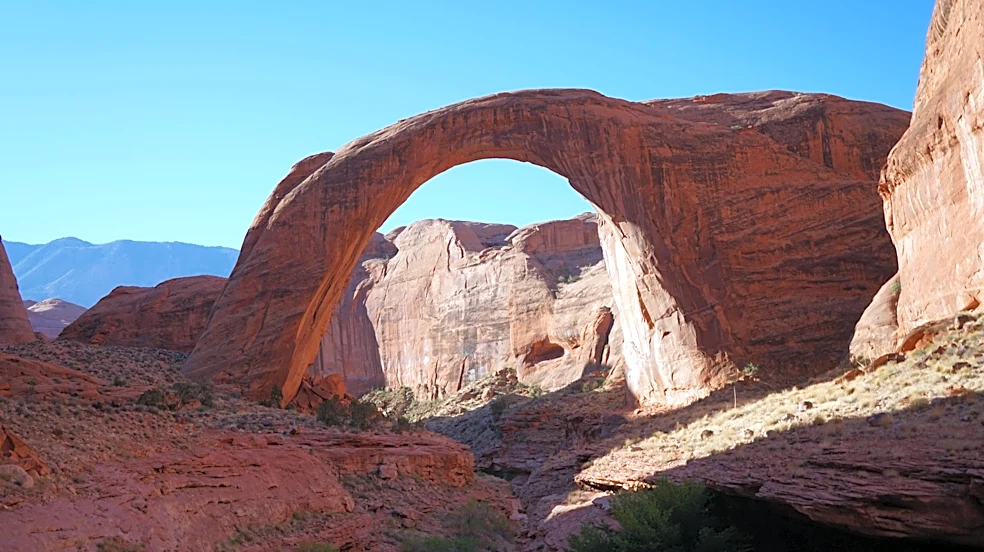









PAGE, Arizona ‒ Tucked deep in a breathtaking canyon about 50 miles from the nearest town sits a towering red rock bridge nearly as tall as the Statue of Liberty.
Soaring 290 feet, Rainbow Bridge has been sacred for generations of Native Americans, including Navajo and Hopi people.
So awe-inspiring that it was made a national monument in 1910, the bridge attracted Theodore Roosevelt shortly after he left the White House. So remote that it's internationally recognized for its dark night-sky viewing, the bridge site once drew more than 300,000 visitors annually.
And today, almost no one can get there.

Drastically low water levels in Lake Powell have effectively halted most public access to Rainbow Bridge National Monument this year. National Park
Service officials have removed the floating docks that once permitted easy boat access for tourists. And what was once a short walk from the water's edge is now a 2-mile uphill hike that starts with a jump off a private boat into waist-deep mucky water and a wade through quicksand.
The only other option is a 14-mile hike across Navajo Nation land requiring tribal permission. Last year, 11,404 people visited the bridge, most of them before officials removed the dock. In 1995, the peak visitation year, more than 346,000 people visited the site, according to the park service.
"Today, to get to Rainbow Bridge you have to have an adventure. But it's truly something to behold when you're there," said Page-area resident Adrian Augustine, 45, a member of the Navajo Nation.
Augustine first visited the bridge as a child and marveled at how it frames the sky deep within Forbidding Canyon.
As water levels in Lake Powell hit about 22% full as of Oct. 16, new areas of the submerged Glen Canyon have remerged. Plants and grasses are growing in cracks that were once more than 100 feet underwater, and lizards scamper across the still-drying red sandstone. Another natural bridge completely submerged by the lake, Gregory Bridge, is now visible, as is the rock amphitheater known as Cathedral in the Desert.
But the low water levels have also affected visitors' ability to use the area, from rock hazards in the lake to the loss of giant bays for fishing and houseboat adventures. Additionally, the shallower water has made it harder to launch boats – even though most of the ramps have been repeatedly extended – and forced people to take longer, slower routes to reach beaches and fishing spots.
The changes have injected fresh urgency into long-running debates about the future of the nation's second-largest reservoir, which when full stretched 186 miles from the Glen Canyon Dam in Page north to Hite, Utah. Straddling the Utah-Arizona border, Lake Powell stores drinking and irrigation water for tens of millions of Americans. The dam also generates carbon-free hydroelectricity for states.
The Glen Canyon National Recreation Area is a powerful tourist attraction. Millions of dollars worth of houseboats float on its waters. Last year, 3.7 million tourists visited the area, nearly the same number as visited Grand Teton National Park, according to park service statistics.
Many visitors develop a strong emotional attachment to the area, especially those who fondly remember boat trips and canyon adventures. The rugged red rock, breathtaking sunrises and sunsets, and often-clear skies draw many to return or relocate there, local residents told USA TODAY.

The reservoir was conceived to store excess spring runoff from the Colorado River during wet years and provide a bank to draw from during dry ones. But long-term shifts mean there's less overall water available to store ‒ the wet years are getting drier.
Some environmental advocates want to see the dam bypassed, the lake drained and the Colorado River returned to a free-flowing state. They consider Glen Canyon to be a "lost" national park on par with Canyonlands and Grand Canyon national parks, which bracket the lake. Edward Abbey's 1975 novel "The Monkey Wrench Gang" fictionalizes opposition to the dam's construction.
On a recent October morning, Texans Sean and Caitlin Graham reflected on the water levels below as they waited for sunrise. The two were on an 18-day road trip celebrating their seventh anniversary, visiting national park sites across the West. Sean Graham, 31, said he thought the S-curving canyons reappearing from beneath the water looked intriguing – more interesting than a giant lake alone.
"I’m just thinking how to lucky we are to be here," Caitlin Graham, 31, said as the sun cleared the horizon. "This definitely could be a national park for sure."

'We have a curious ensemble of wonderful features'
The first exploration party to document Rainbow Bridge made its way on foot and horseback through narrow canyons to the site in 1909. President William Howard Taft created the national monument the next year. Roosevelt visited shortly after, according to the park service. At the time and for many decades later, visitors often climbed atop the bridge, which is now prohibited out of respect for Native American beliefs.
As word of the bridge spread, more people began venturing both and up down the Colorado River to see it, rafting in surplus World War II watercraft or taking jet boats upriver from the Page area, according to the park service.
Environmentalists fought a bitter battle with water-storage advocates to protect the bridge during the planning for the Glen Canyon Dam, worried water levels might forever bury it. For a few years in the 1980s, the water eventually rose high enough that it lapped at the bottom of the bridge, and tour boats could float almost to its base.
Today, the opposite problem exists: Low water levels make it virtually impossible for visitors to see the bridge. That has also slowed access for longtime Lake Powell users Yulia and Eugene Simon, who trailered their fishing boat about 600 miles from the Denver area.

It's hard for private boaters to launch into the lake anywhere but the Stateline Auxiliary Ramp near Page. And because low levels have eliminated a longtime shortcut from there into the main lake, the Simons spent an extra hour of time and fuel to reach the entrance to Labyrinth Canyon, a favorite fishing spot.
“It’s pretty bad," Yulia Simon said as she reclined on the boat in the sun. “We want to use the lake as much as we can. Maybe someday it won’t be here anymore.”
Completed in 1963, the Glen Canyon Dam forms Lake Powell, named for the famed one-armed explorer, John Wesley Powell. Leading a small party of men in boats, Powell in 1869 completed the first known descent of the Colorado River.
"On the walls, and back many miles into the country, numbers of monument-shaped buttes are observed," Powell wrote in his diary Aug. 3, 1869. "So we have a curious ensemble of wonderful features – carved walls, royal arches, glens, alcove gulches, mounds, and monuments. From which of these features shall we select a name? We decide to call it Glen Canyon."

'A crime against nature'
Founded 30 years ago by a small group of environmentalists, the Glen Canyon Institute is dedicated to the persuading the federal government to bypass the dam and drain Lake Powell. Today, Executive Director Eric Balken said the institute takes no pleasure in watching the lake's levels fall. He knows the impacts it has on boaters, local business owners and downstream farmers.
But Balken said people are slowly coming to grips with what he calls the uncomfortable reality: There was never enough Colorado River water to build both Lake Powell and Lake Mead. The institute wants to combine Colorado River water in Lake Mead, restoring the Glen Canyon to its former glory. Lake Mead as of Oct. 16 is about 26% full.
"What's emerging in Glen Canyon is not just cool geologic features, waterfalls and bridges. What's emerging is functional ecosystems," Balken said. "They should have some value... By many people's opinion, it was a crime against nature that this ever happened ever in the first place."
Bypassing the dam isn't a simple process. Although there are outlet pipes that could be used, they were never designed for continuous use, Balken said. He said federal officials should accept the reality and start constructing new tunnels that would allow the river to flow through the dam unimpeded.
Average flows on the Colorado River since 2000 are about 20% lower than they were in the previous century. Climate scientists widely predict the West will continue to get warmer and drier over the coming decades.

The states and tribes that use the Colorado River for drinking and irrigation water have been unable to reach an agreement on how to reduce water consumption, and federal officials have ordered short-term stopgap measures. They have also been draining upstream reservoirs in Wyoming, Colorado and New Mexico to stop Lake Powell from falling to a point where it can't generate hydroelectricity.
"Look at climate change, look at the runoff trends – this reservoir isn't going to fill again. We will have big water years, but it's never coming back the way it was," Balken said. "It's not environmentalists that have drained this reservoir to 22%. It's climate change and overconsumption. And that trend is very hard to buck. We should be preparing for the future."
Another group, the BlueRibbon Coalition, has the opposite idea: Protect Lake Powell by building a series of nuclear-powered desalination plants off the California coastline. That would make new water for California's farmers, allowing officials to keep more water in Lake Powell.
'Hope for more snow'
Mike Farrow, Page's vice mayor, said the falling water levels have been both a blessing and a curse to the tourist-dependent town. In 2019, the Navajo Generating Station coal power plant just outside Page closed under environmental pressure, putting about 1,000 locals out of work at the plant and the nearby coal mine that served it. The COVID-19 pandemic followed, slashing tourist visits for several years.
And just when visitation was starting to rebound, the low water levels began scaring away visitors, Farrow said. Like several Page officials who spoke to USA TODAY, Farrow expressed frustration about what he considered irresponsible news media coverage of the lake. He said even some of his neighbors have been left with the impression there's no water in the lake, particularly due to social media shares of AI-generated fake images.
He said city officials are making the case to tourists that the low water levels mean they can see things in Glen Canyon no one has seen since the late 1960s. For people who remember higher levels, it's worth a trip to Page to see what's been revealed since their last visit, he said.
“This lake is alive," he said. "And this place isn’t dead. It’s alive."

Despite the unfavorable news coverage, dozens of tourists descended upon Antelope Point Marina outside Page on a recent fall day. Some rented Jet Skis, while others hopped aboard pontoon boats or tourist boats headed to the nearby but still largely flooded Antelope Canyon. As mansion-sized houseboats floated nearby, others licked ice creams from what managers boast is the world's largest floating restaurant, Jádí’Tooh from the Navajo word for Antelope.
Longtime locals Al and Kathy Thoms, retired Page public school teachers, said they've spent decades exploring Lake Powell at all kinds of water levels. They arrived in Page not long after the lake first filled, and for many years owned a houseboat they used for two-week summer trips with their two kids.
As they piled a cooler and other gear on the dock at Antelope Point, the couple said they had just visited Labyrinth Canyon, about 15 miles upriver on the Utah-Arizona border. Once a favorite place to skim across glassy water protected by low rock walls, the canyon walls now tower above the water. A rock just above waterline, where their kids once jumped into the lake, is now more than 150 feet in the air, they said.
Kathy Thoms said she's hopeful the lake rebounds someday. But she's also resigned to seeing levels drop even further, if long-term trends continue.
“It’s nature," she said. "You deal with it. You can sit and curse or just deal with it.”
Chimed in her husband: "And hope for more snow."
This article originally appeared on USA TODAY: Dropping Lake Powell levels reveal 'crime against nature'