









Those darling dire wolves have turned two.
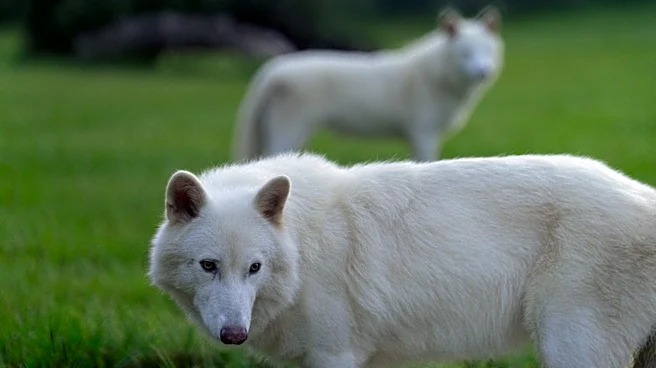
For their second birthday, Romulus and Remus, the two male dire wolves born in October 2024, got checkups and they are healthy, full-grown and apparently living their best lives.
The two male dire wolves now weigh more than 130 pounds each – Romulus, the larger weighs 134, while Remus weighs 132 – and measure nearly seven feet from nose to tail. Slightly smaller is sister Khaleesi, a female dire wolf named after the character in the Game of Thrones novels, which included dire wolves in the plots.
The update comes from Colossal Laboratories & Biosciences, the biotech company that made a splash by proclaiming in 2021 its plans to bring back the woolly mammoth, then surprised us with the existence of the dire
wolves in April 2025.
Colossal researchers edited the gray wolf genome to express specific traits of the dire wolf, a real-world predator that roamed North America for thousands of years before going extinct about 13,000 years ago. Fertilized dire wolf eggs were implanted into and born by surrogate dog mothers on Oct. 1, 2024. Born nearly four months after her brothers, Khaleesi weighed in at 102 pounds at her own recent checkup.

Two years after the birth of Romulus and Remus, Colossal are taking a victory lap. "You know, we really were waiting until they were full grown to be able to say, 'Did it work?' Did we actually make the edits that we needed to make them as big as dire wolves," Beth Shapiro, Colossal's chief science officer, told USA TODAY. "And because the boys fall right where we would expect them to based on the fossil record of dire wolves, we know that's a success."
De-extinction of dire wolves wasn't a given
The process of de-extinction, attempting to bring back an extinct species, has met with challenges in the past. A failed attempt to bring back the Pyrenean ibex, a type of wild goat, in 2009, resulted in a baby animal that died shortly after birth. Prior to that brought the 2003 cloning of a banteng, a wild bovine from the Indonesian island of Java. The lone surviving calf died in 2010, having lived half the expected life span of the extinct animal.
"There's typically been questions around what is the health impact to the animal," said Matt James, Colossal's chief animal officer. "So, for us to be able to say not only two years ago did we bring a species back from extinction, but two years on, we're really excited to say we've done deep dives … (and) from a health perspective, they're in great condition, great shape. … It's really incredible."
Colossal points to the healthy dire wolves as evidence its biogenetic engineering processes work. The company has multiple ongoing projects beyond the one to bring back the woolly mammoth including de-extinction projects for the dodo, the Tasmanian tiger, the giant moa, and an African antelope known as the bluebuck.
The advances also are expected to benefit Colossal's projects to preserve existing endangered species such the northern white rhinoceros and American red wolf. "I think the dire wolves provide us an amazing use case that we can demonstrate the long-term effects and consequences of genetic editing and cloning as a tool for conservation biology … and say genetic engineering, for the purposes of genetic rescue here, is a tool that we should be using," James said.
Artificial intelligence and machine learning advances in the dire wolf project have helped drive research on other Colossal projects. For instance, the "software pipeline" developed in the dire wolf project has been used to more easily identify the important individual genes found in bird genomes that must be turned on or off to create the dodo genome, Shapiro said.
For the record, critics argue that Colossal hasn't brought back dire wolves but rather genetically engineered gray wolves that look like what we think dire wolves looked like. "So what Colossal has produced is a grey wolf, but it has some dire wolf-like characteristics, like a larger skull and white fur," said Nic Rawlence, a paleogeneticist at Otago University in New Zealand told the BBC at the time. "It's a hybrid."
That's beside the point, Andrew Pask, chief biology officer at Colossal, told USA TODAY in a recent interview. "Even learning about why we want to bring a Tasmanian tiger or a mammoth back and understand that, they suddenly learn about the loss of biodiversity and breakdown of habitats and why you need all of the species," he said.

Remus, leader of the dire wolf pack
Allowed to roam their 2,000-acre preserve, the three dire wolves have learned to act like a pack since Khaleesi got to meet her brothers in August 2025. The trio have "formed a stable social unit," Colossal says in a health report issued Thursday, Oct. 15.
Remus may be the slightly smaller of the two male dire wolves, but he is the leader. "Romulus and Khaleesi defer to him and check in with him, and jostling is confined to feeding order," according to the report. "The pack hunts cooperatively, has caught rabbits and now pursues deer, and the fasting-and-gorging rhythm observed around carcass feeds is consistent with wild canid (the species including wolves and dogs) behavior."
Khaleesi, which was spayed during her recent checkup, was a happy accident. She has a male Y chromosome, but a gene on the Y chromosome that triggers male sex organ development (called SRY) did not turn on, Shapiro said. The development has been seen in cloned wolves and dogs – and in domestic dogs that breed naturally.
“To me, the most important thing is that our dire wolves are happy and healthy," said Colossal CEO Ben Lamm in a statement, referencing the "Jurassic Park" character played by Jeff Goldblum. "It is also fun that Khaleesi’s exam and spay confirms that she has normal female reproductive anatomy despite that she was not intended to be a female and that Colossal got an early ‘life finds a way’ moment with the SRY expression surprise which should make all the Ian Malcolm meme creators happy.”
Another windfall from the recent checkups? The team at Colossal, James said, has "a green light to then expand the dire wolf pack."

Mike Snider is a national trending news reporter for USA TODAY. You can follow him on Threads, Bluesky, X and email him at mikegsnider & @mikegsnider.bsky.social & @mikesnider & msnider@usatoday.com.
This article originally appeared on USA TODAY: Happy Birthday, dire wolves. Could it be time to grow the pack?