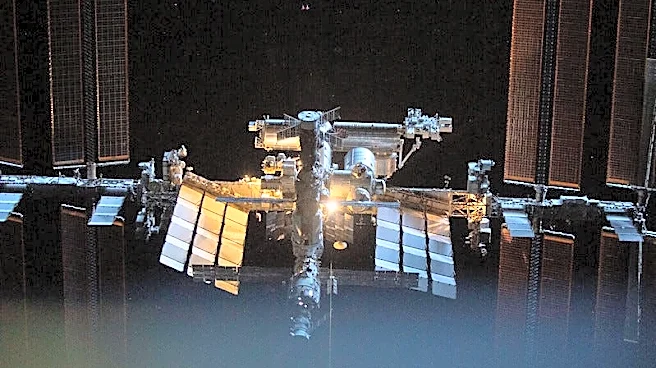






The International Space Station may be an iconic feature in Earth's orbit, but it's also getting old.
For years, plans have been underway to retire and deorbit the aging space station, which has increasingly been marred by air leaks and other issues. That means by the end of 2030, the ISS – where the world's astronauts have lived, worked and gazed upon the cosmos
for more than two decades – could be no more.But that hardly means NASA is abandoning its legacy of ensuring humans have a home to live and work long-term in space.
Even now, the U.S. space agency is laying the groundwork to ensure that government astronauts will have access to any number of private commercial space stations that could park themselves in low-Earth orbit in the years ahead.
And recently, NASA announced it is seeking proposals from aerospace companies interested in partnering with the agency to host government astronauts on its future stations.
"NASA is committed to maintaining a sustained American presence in low-Earth orbit long after the International Space Station retires,” NASA Administrator Jared Isaacman said in a statement.
Here's what to know about how NASA is already preparing for what comes after the International Space Station is retired.
What is the International Space Station?
The International Space Station has been stationed in low-Earth orbit for about 26 years, typically about 260 miles high, where it has been home to astronauts from all over the world. Throughout its lifespan, the station has served as a test bed for scientific research in microgravity and has in years past opened itself up to private commercial missions.
The orbital laboratory is operated through a global partnership of space agencies, including NASA, Roscosmos, the European Space Agency, the Japan Aerospace Exploration Agency and the Canadian Space Agency.
More than 290 spacefarers from 26 countries have visited the International Space Station, including 174 from the United States alone, according to NASA. While aboard the ISS, astronauts from all over the world not only help keep the aging station operational, but prepare for humans to venture deeper into space.
NASA taps SpaceX to deorbit ISS in years ahead
The United States has committed to supporting the International Space Station operations through at least 2030, after which the outpost will essentially be retired.
After deciding the the safest way to retire the ISS was through a controlled, targeted reentry ending in a crash landing into a remote ocean, NASA awarded SpaceX the contract to carry out the mission. That means tech mogul Elon Musk's company is tasked with providing the vehicle that will deorbit the space station by performing a propulsive maneuver to line up the reentry path into the desired uninhabited waters.
Many of the space station's modules and hardware are expected to burn up, melt away or vaporize upon reentry into Earth's atmosphere. The denser and heat-resistant components that may survive the plunge will splash down into the ocean, where they are expected to harmlessly sink to the ocean floor, according to NASA.
What comes after the International Space Station?
The station's successor will come from the private industry, as several companies are working on designs for next-generation space outposts.
Because NASA is focused on astronauts reaching the moon and Mars, the U.S. space agency has no plans to build and operate another space station of its own. Instead, NASA is planning to fund and contract with the commercial sector for human activities in low-Earth orbit.
NASA seeks plans for commercial space stations
NASA recently issued its final request for proposals for companies interested in partnerships with the agency to ensure government astronauts have a home at their space stations.
The proposals are due Dec. 8, with NASA planning to award contracts to at least two companies in spring 2027, according to a press release. Any company selected would need to be "prepared to invest in destinations that can serve NASA while developing additional customers and markets of their own," Isaacman said in his statement.
Concerns mount as SpaceX prepares to retire Dragon
Concerns have surfaced, though, about NASA's ability to continue sending astronauts to low-Earth orbit – a region closer to Earth's atmosphere – amid SpaceX's impending plans to retire its Dragon spacecraft around 2030. As of now, the Dragon is the only U.S. spacecraft capable of transporting astronauts to the space station.
NASA, though, is continuing to work with Boeing to certify the aerospace company's Starliner spacecraft, which underwent an infamously disastrous crewed test flight in 2024. Starliner, though, could make an uncrewed test flight by the end of 2026, followed by a mission with astronauts in 2028 if all goes well.
A major change of NASA's July draft of its "request for proposals" is the agency's vow that it will handle transportation of crews and cargo to commercial stations – at least initially. That would take some pressure off bidders, who would no longer be expected to make those arrangements themselves.
“We will continue to need a place to conduct research, develop technologies, train crews, and prepare for missions to the moon and Mars," Isaacman said in the statement. "Commercial space stations may provide that capability while creating new opportunities for American industry and allowing NASA to concentrate more of our resources on the near-impossible missions ahead.”
Contributing: Brooke Edwards, USA TODAY Network
Eric Lagatta is the Space Connect reporter for the USA TODAY Network. Reach him at elagatta@usatodayco.com
This article originally appeared on USA TODAY: NASA seeks private space stations to replace the aging ISS by 2030