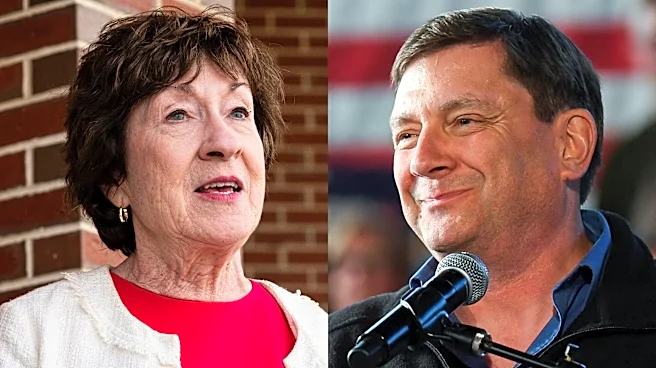



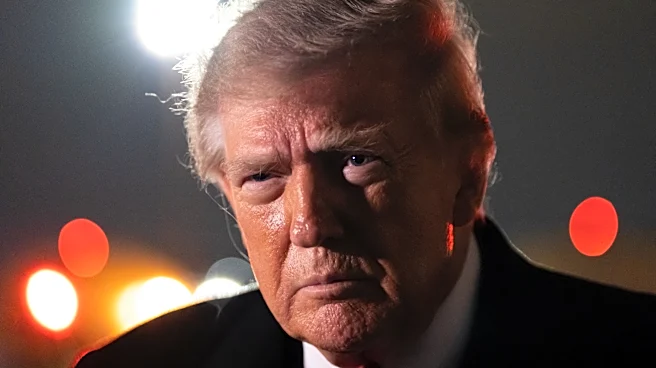


President Donald Trump, the Iran war and home heating oil took center stage in the third debate between five-term Sen. Susan Collins, R-Maine, and former state Senate President Troy Jackson, a Democrat, in the race for U.S. Senate.
The race has garnered national attention as Democrats see the seat as key to their hopes of flipping the U.S. Senate, which is currently held by Republicans 53-47. The seat is rated a “toss-up” by the Cook Political Report and other forecasters.
The debate was hosted by WABI and WGAM, stations that service the more central and northern, rural and conservative parts of the state – a key constituency for candidates to win over. Both Collins and Jackson are from Aroostook County, which is the northernmost part of the state bordering
Canada.
The candidates will face off one more time on Oct. 15. Here are three takeaways from the debate on Oct. 13.
Home heating oil is a major issue in Maine
Home heating oil has emerged as a major issue in Maine. According to the state, 52% of Maine households rely on heating oil to get them through the long winters, and an average of 20 residents die every year from hypothermia. The cost of the oil has jumped about 80% from last year, driven in part by the war in Iran.
Collins and Jackson clashed over who is more responsible for the high price of heating oil: Collins blamed Jackson and state leadership in general, while Jackson blamed the war in Iran.
Collins also heaped blame onto the Biden administration for cancelling projects like the Keystone Pipeline that she said would have expanded their supply of energy. Jackson said that the pipeline would have helped the U.S. ship oil overseas, not to Mainers.
Collins highlighted what she has done to help, including getting an earlier release of Low-Income Heating Assistance Program (LIHEAP) assistance. Jackson called it a “short-term Band-Aid.”

Iran War
The Iran war continued to dominate part of the discussion, with the candidates quibbling over how much Collins did or didn’t support it. Collins initially supported the war but has opposed it for months.
Collins said that she doesn’t think Trump had a good plan and should have anticipated the closure of the Strait of Hormuz, which is where a chunk of the world’s oil trade passes through. She said it’s important to make sure that Iran can’t make a nuclear weapon. She also said American troops need to be protected.
“My ideal end of this war would be an agreement by Iran that it would stop pursuing the enrichment of uranium for a nuclear weapon and the pursuit of long-range ballistic missiles,” Collins said.
Jackson argued that Collins could have stopped Trump from starting the war, then she opposed it when it was too late. Collins stressed that she has joined Democrats in voting against the war several times, but that they didn’t have the votes.
“Well, that sounds like then we probably ought to have Democrats in charge of the U.S. Senate so that we have the votes to stop this war,” Jackson replied.
Has Collins done enough?
Throughout the night, Collins highlighted specific policy achievements that she’s made during her time in the Senate. And repeatedly, Jackson responded that her efforts weren't enough.
Collins said she lifted tariffs on key items like concrete, road salt and pulp, but Jackson said Collins should have prevented the tariffs from being imposed in the first place.
Collins pointed out the $50 billion-dollar rural healthcare fund she successfully added to the One Big Beautiful Bill, but Jackson said that it won’t be enough to offset the negative healthcare impacts of the bill. Collins said she proposed and enacted reforms for ICE like body-worn cameras, but Jackson said that ICE should be disbanded.
Collins discussed a bipartisan housing bill she helped to pass that prevents private equity from buying up single-family homes, but Jackson rebutted that it doesn’t include apartment buildings, condos or mobile home parks.
Both arguments encapsulate the two candidates’ central platforms: Collins maintains she has the experience and knowledge needed to get things done for Maine, and Jackson argues that Collins has not done enough to stop the harm he thinks Trump has brought to Maine.
“Our Constitution guarantees that regardless of population, each state has two senators, but it does not guarantee that all 100 senators will have the same knowledge, experience, and clout,” Collins said in her closing statement. “When you live in a small state like Maine, who you send to Washington really matters. I have proven time and time again that I deliver for the state of Maine.”
Jackson leaned into the oft-cited argument against Collins: that despite stressing her moderation, she doesn’t stand up to Trump enough.
“Senator Collins wants credit for her power. I believe you have to be responsible for what you do with it,” Jackson said. “Senator Collins paid for the bullets at Donald Trump's command. Now she wants credit for not pulling the trigger. That's the choice on this stage: a senator who helps Donald Trump hurt Maine, then tells us how concerned she is, or somebody will stand up against him before another family in Maine has to pay the price.”
This article originally appeared on USA TODAY: Iran War and heating oil take center stage in Maine Senate debate