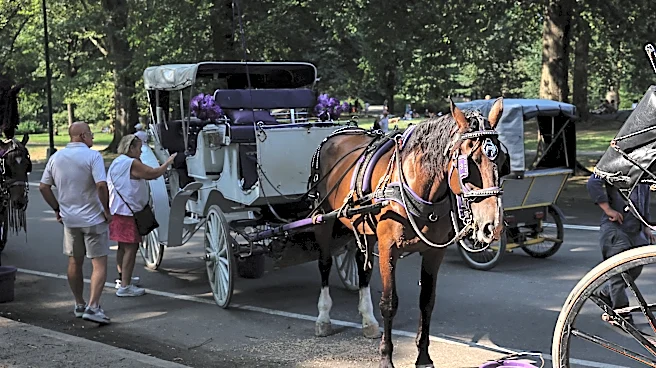









A tradition that has carried tourists through American cities for generations is disappearing from many of them.
Horse-drawn carriages are facing bans in a growing number of communities amid pushback from animal rights groups who argue horses should not be working in congested urban environments.
On Oct. 22, the New York City Council approved legislation that will phase out the practice within the next two years. Philadelphia formally banned horse-drawn carriages in June. Chicago, Salt Lake City and San Antonio have adopted similar restrictions.
Yet even as more cities move to prohibit the practice, horse-drawn carriage rides remain a fixture in some communities, including Charleston, South Carolina; Savannah, Georgia; and Nashville, Tennessee.
In New Orleans, mule-drawn carriages remain a hallmark of the city's French Quarter.

“It’s the best and most popular way to see the city,” said Tommy Doyle, who runs a horse carriage company in Charleston. “They’re not going anywhere.”
For decades, animal rights groups have pushed for an end to the horse-carriage industry, arguing that it subjects horses to harsh, unnatural conditions and physical exhaustion. Those who opposed the bans, including President Donald Trump, argue the rides are iconic features of cities like New York and the bans fail to protect workers whose livelihoods depend on the industry.
Here's what to know about the growing movement to ban horse-drawn carriage rides and the communities that continue to embrace them.

'They don't belong'
While efforts to ban horse carriages date back to the start of the tourism industry, official action to phase out the tradition is a recent trend.
Some of the first cities to do so were Key West and Palm Beach, Florida, which enacted bans in 1998. The efforts picked up steam over the last decade as lawmakers began siding with animal rights activists on the issue, leading to prohibitions in Salt Lake City, Chicago, San Antonio and Philadelphia.
Then on Oct. 22, New York City, the birthplace of the modern horse carriage industry, voted to phase out the practice within the next two years. Mayor Zohran Mamdani is expected to sign the legislation into law.
The vote followed a summer in which both a passenger and a carriage horse died in separate incidents that intensified scrutiny of the industry. In June, 18-year-old Indian tourist Romanch Mahajan died after he was thrown from a horse-drawn carriage. The same month, a horse named Deniz collapsed and died in Central Park while pulling a carriage with two passengers.

New York City Council Speaker Julie Menin described Mahajan's death as "the last straw" in the city's long-running effort to phase out this part of the tourism industry it helped start.
"Midtown Manhattan is not where horses belong. They don't belong in an area that attracts 42 million a year, pulling a 1,000-pound carriage in record-breaking heat," she said at a news conference. "We can all agree: The New York of the 1800s is not the New York of today."
Horse carriage drivers and others have pushed back on the ban and vowed to sue the city, saying the legislation does not adequately protect the industry's workers. Others, including Trump, say the measure ends an iconic New York tradition.
"The Horse-drawn Carriage in New York City is a quintessential New York experience," Trump wrote on Truth Social. "So sad that, for political reasons, we will see it go!"
From vital transportation to tourist attraction

Horse-drawn carriages date back to the 17th century, when European settlers brought wagons and horses to North America. By the mid-1800s, cities like New York and Philadelphia depended heavily on horses. They pulled omnibuses, fire engines, delivery wagons and private hansom cabs.
But by the 1920s, the rise of electric streetcars and gas-powered vehicles marked the end of horse carriages as an essential mode of transportation. Soon carriage rides transformed into a nostalgic pastime, offering visitors a slower way to experience the nation's rapidly modernizing cities.
Over the decades, the rides became a distinct part of the identity of New York, where ornate carriages and their top-hat wearing drivers have been featured in popular shows and movies, including "30 Rock," “Home Alone 2: Lost in New York” and "Sex and the City." They also became tourist staples in New Orleans and Charleston.
Still, they increasingly drew opposition from animal rights activists whose concerns date back to the late 19th century.
The American Society for the Prevention of Cruelty to Animals, one of the nation's leading animal welfare organizations, was created in 1866 after its founder witnessed the mistreatment of a carriage horse in New York. The nonprofit's first official seal depicted a driver beating a horse.
“It is part of our origin story,” Matt Bershadker, the group's president and CEO, told USA TODAY. He described the growing number of bans as a “recognition that having a thoughtful, sensitive, powerful animal pull a carriage through an urban environment is not appropriate.”
What cities still have horse-drawn carriage rides?
While some communities are phasing out the tradition, horse-drawn carriage rides remain popular in several cities that view them as an integral part of their tourism and cultural identity.
Charleston, South Carolina, for example, offers horse-drawn carriage tours through its historic district, one of the largest preserved historic areas in the country. Nashville, Tennessee; Savannah, Georgia; and Boston also permit carriage rides, but not without opposition.
"We're calling on Boston Mayor Michelle Wu and the Boston City Council to introduce and pass legislation banning horse-drawn carriages in Boston and make the city a leader in humane, modern tourism," reads a Change.org petition that has attracted about 630 signatures.
Several cities have adopted regulations in recent years requiring additional inspections, temperature checks and limits on operating hours. Some of those measures have met resistance from carriage operators.

In Savannah, which has 16 horse carriages in operation, city officials are battling carriage owners in court over a temperature restriction. In 2025, the city voted to lower the maximum operating temperature for carriage rides from 95 degrees to 85 degrees.
Two local companies sued, arguing the rule would cause "irreparable injury" by threatening their businesses. A judge has blocked enforcement of the regulation while the case proceeds, according to the Savannah Morning News, part of the USA TODAY Network.
Carriage operators say business is growing
Doyle, the general manager of Palmetto Carriage Works, oversees one of Charleston's largest horse-drawn carriage tour companies. He said the attraction is as “popular as ever.”
"Charleston is a carriage city," said Doyle, whose father started the business in 1976. He added that local officials work closely with operators to ensure horses are healthy and recieve proper care.
Cara Marshall, the owner of Carriage Tours of Savannah, also said business is booming.

"Despite a small group of protestors that reappear annually, we have seen increased growth year over year,” Marshall said in a statement. “Beyond the beauty of Savannah, this is directly attributed to the professional care of our horses, and a safety record that demonstrates Carriage Tours of Savannah’s commitment to an exceptional standard of care, operational excellence and transparency.”
Asked whether Charleston could see a ban similar to those enacted across the country, Doyle said he doesn't expect one anytime soon.
"It's not something I spend a lot of time thinking about," he said. "I continue to increase my herd size, and I have no intention of going out of business."
Animal activists hope for more bans

Bershadker said he hopes New York’s legislation “sets the tone for the rest of the country.”
“My hope would be that other communities look at New York, are inspired of what we’ve done here and take similar action,” he said.
But it could be some time before the New York ban, which was passed in a 40-7 vote, becomes enforceable. The legislation aims to wind down the city's horse-carriage industry by June 2028.
Meanwhile, city officials and animal rights groups are preparing for a legal showdown. The Transport Workers Union of America, which represents over 100 of the city's carriage workers, has vowed to file a lawsuit in an attempt to block the legislation from taking effect.
“Our work here is not done,” Bershadker said.
Christopher Cann is a national correspondent for USA TODAY. Reach him at ccann@usatoday.com.
This article originally appeared on USA TODAY: Horse-drawn carriage bans are growing. Which cities still allow them?