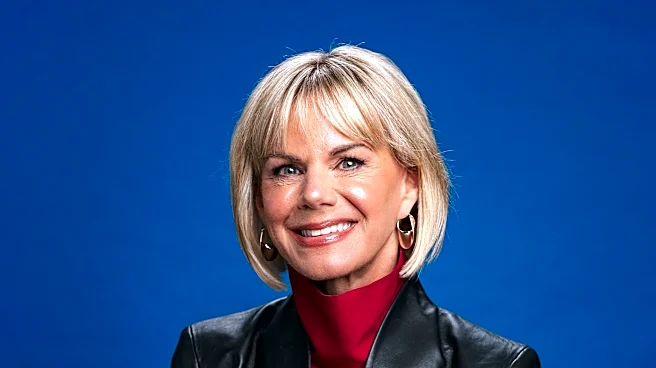




Every year, around the anniversary of her explosive lawsuit, Gretchen Carlson emails her lawyers.
“I say, ‘I can’t believe we did this,’” she says. “And they always write back, ‘That was the greatest joy of my career helping you.’”
It’s been ten years since she took down Roger Ailes, then the powerful CEO of Fox News, and she still tears up as she recounts those messages. Even though her lawsuit, which accused Ailes of sexual harassment and of firing her and sabotaging her career after she rejected his advances, was a major catalyst of the #MeToo movement. Even though she’s helped countless women since. Even though she's learned not to care what anyone thinks about her. The anniversary is emotional, and lonely.
“It's hard to explain, but it's really
hard to see that milestone,” says Carlson. “I have absolutely no regrets about anything. But on that actual day, it's a very lonely, singular experience. Because only you can understand what that felt like. Other people can be empathetic, they can love you and they can care for you, but you still had to do it by yourself.”
She’s spent past anniversaries with friends and family, her husband, Casey Close, and their two children, Christian and Kaia. Last year her mom said, “Why are you so emotional? Look at everything you’ve done!" Carlson feels proud, and yet loneliness still seeps in. “I’m not going to lie and say it’s easy as the anniversary approaches and that it’s all rosy,” she says. “It’s complicated.”
The memories run that bone deep.

The 5-year-old who became the whistleblower
Standing up for herself was something Carlson learned when she was very young.
"I was a fighter as a little kid,” says Carlson. On her first day of kindergarten, she says, the teacher divided the class into kids who could read and kids who could not. Carlson was slotted in the latter group. “Three times that day, I went up to my teacher's desk and I said, ‘But I know how to read.’ And she was very nice to me and said, ‘Just go back down and sit down, Gretchen.’"
Carlson wouldn’t be put in the corner. She ran home from school and told her mom, who helped advocate for her to be in the reading group.
“Imagine if I hadn't had that little fire in my belly as a little kid to go up and fight for myself,” she says. Some of it was innate, she believes. “I also had parents who told me every single night when we said our prayers and went to bed that I could be anything I wanted to be, but I was going to have to work really hard in life. And I believed that.”
That memory bubbled before she filed her lawsuit. “I thought about what I did as a five-year-old before I had to get courage on such a higher level,” she says. “If I hadn't done that for myself at five, it could have affected my entire educational trajectory. I would've just said, ‘Oh, well, whatever the teacher says is what's right.’ It really set me on a path of, I am going to stand up for myself, and when I do, things can change. And I felt like I owed it to that little girl to follow through on what was happening to me at Fox.”
Just like that day in kindergarten, Carlson, now 60, sought her parents’ support before filing her lawsuit. The “Minnesota nice” family didn’t like to make waves. Six months before she filed, her parents called. “It was a very emotional conversation and they said that they agreed that it was maybe something I was going to have to pursue,” she says. “That was really important to me.”

Once she filed the suit, she had no idea what to expect.
“I thought that I was going to be just catatonic and doing nothing. But immediately I started hearing from other women across our country and the world. And I realized that number one, I was not alone and number two, I had to do something,” she says. “This had all been going on, in secrecy, and [women] were being given a false impression that we had fixed all these things in the workplace and we hadn't.”
She says she heard from women who had worked with Ailes as far back as the ’60s, some of whom had never told their husbands they had been abused.
As the world swirled, she planned. Ailes was fired within two weeks, and Carlson reached a resolution with Fox in two short months.
And soon, she headed to Washington.
Giving workers the right to speak out
Part of Carlson's resolution with Fox included signing a non-disclosure agreement. “At the time, you're in a fog when you go through something like this, and I was very much reliant on my lawyers who said, ‘Well, this is just the way that it works,’” she says.
Over three different conversations, she’s very careful about what she can and can’t say. She will neither confirm or deny rumors of a $20 million settlement—she won’t even acknowledge the question, but pivots to say, "The most important thing that happened was that I got an apology. I realized very early on from speaking to so many thousands of survivors that that's really the most important thing,” she says. “It's a validation that you're not crazy. You can move on because you did the right thing.”
What she learned through the process is the majority of American workers are similarly gagged at work the moment they start a job. “Most people sign contracts or agree to handbooks and have no earthly idea that they are signing away their rights,” she says.

When you're starting a new job, a forced arbitration clause could be in the fine print of any contract or documents. "It states that you're agreeing that will arbitrate any claim or dispute you have with the company," says Alex Colvin, dean of the Industrial and Labor Relations school at Cornell University, whose research has focused on employment dispute resolution.
In other words, you can't sue them in court, says Colvin. "Forced arbitration means that if you don't agree to this, they won't give you the job." It also can require any case to be handled individually, preventing large, class-action lawsuits.
Twenty to 25 years ago, Colvin says, only 10 to 20 percent of companies had such clauses. While some companies, like Microsoft, choose to forgo such policies, more and more are implementing them. The Economic Policy Institute reported that in 2017, 55 percent of American workers were subject to mandatory arbitration. Some projections estimate the number today is more than 80 percent.
Carlson co-founded Lift Our Voices to change that. After many visits to Capitol Hill, she forged bipartisan support including Senators Kirsten Gillibrand (D-NY), Lindsay Graham (R-SC), Josh Hawley (R-MO) and Jon Ossoff (D-GA), and in 2022 Congress passed the Enforced Arbitration of Sexual Assault and Sexual Harassment Act, outlawing forced arbitration in cases with sexual harassment or assault.
"She raised the issue to a prominence that otherwise it would not have had, and really made forced arbitration a central issue of the #MeToo movement," says Colvin. "More importantly, in a practical matter, she was an incredibly important political policy lobbyist." The passage of the legislation, he adds, "was very largely to her credit. She's been enormously influential."
Next on Carlson's list is to pass similar legislation that would prevent arbitration in cases of age discrimination.
Still bound by an NDA, “now I spend most of my day trying to teach lawyers, ‘No, that's not the way that it has to work anymore. There are new laws that have been passed and I want to educate you that you don't have to automatically silence people,'" she says.

The progress of #MeToo
Carlson is often asked if the movement she helped inspire has fizzled out or failed. Bill Cosby was released. Louis C.K. is back on stage and touring. Time’s Up has shut down. She doesn’t believe that narrative.
“Harvey Weinstein would’ve never been convicted of one charge without MeToo. Bill Cobsy would’ve never had a jury of his peers believe women—he was let out on a technicality, not because people thought he was innocent,” she says. “Is any of it perfect? No...we’re still evolving, but how we treat the people who have the courage to come forward [has changed vastly]. Changing culture takes decades. We’ve made massive progress in a short period of time.”
Asking if #MeToo is dead or when another offender will make a comeback, she says, is the wrong question.
“Why aren’t we asking, ‘Where are all those women?’ Where are all those women that were on Bill O’Reilly’s show who aren’t on TV any more? Where are all the women who worked at Walmart who had the courage to come forward? Where are all the members of our military or police officers or firefighters who had the courage to come forward and aren't doing their chosen profession anymore?” she says. “That's the question we should be asking—where are all of these courageous people who did the right thing?”
Those women deserve the job, the platform, the second chance, she says, “America is such a winning nation, and we root for the underdog and the person who works hard and who tells the truth. It’s the American dream. And yet we seem to penalize still people who have that courage.”
Legacy post script
Her mission to change both the rules and the culture faces headwinds right now. President Donald Trump has publicly disparaged women and female journalists.
“I'm extremely worried about the bro culture that has been ignited under President Trump,” she says. “It sends a devastating message to women, but almost more importantly, what kind of message does that send to our young boys? Because they are watching this behavior and thinking they can treat women that way.”

It inspires her to keep working, even though she hopes her latest job will be a short one. "I hope Lift Our Voices is out of business [in ten years] because we have been able to pass laws to get rid of forced arbitration and non-disclosure agreements for everyone. And that Americancompanies have realized that the train has left the station and they just need to be more transparent instead of putting so much money into covering stuff up.”
Carlson knows any future obituary about her will likely begin with, the broadcast journalist who took down Roger Ailes. “I’m very happy with that being my legacy,” she says, “As long as the caveat is: and went to Capitol Hill and passed these laws to help other innocent people."
Wendy Naugle is the executive editor of entertainment for USA TODAY. You can follow her on Instagram @wendy_naugle.
This article originally appeared on USA TODAY: Gretchen Carlson beat Roger Ailes, took on Congress, and keeps winning