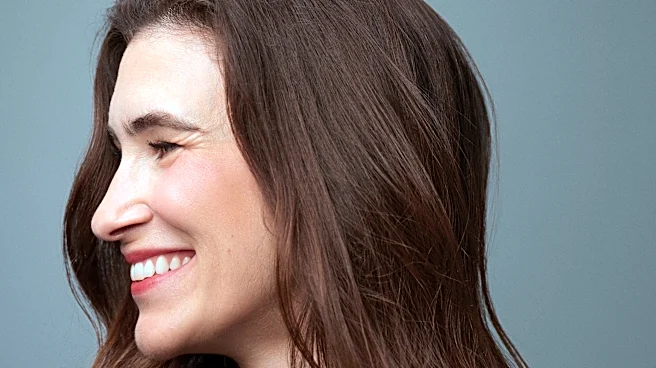




When bestselling author Katherine Rundell meets young readers, they sometimes play it cool.
They know fantasy books like her “Impossible Creatures,” set on magical hidden islands with dragons and sphinxes, are fiction. But they lean in anyway, with a glint in their eyes, and ask, “Just to check, though, is any of it real?”
It’s a rewarding comment for the author, 39, who crafted a world real enough to spark that kind of wonder. Speaking to USA TODAY with the soothing lilt of a Miss Honey, Rundell is protective of her young readers and their imaginations. In a recent essay in The Guardian, she argued that artificial intelligence “risks becoming an iron curtain that comes down between a young person and their potential for thinking.”
Could fantasy
books be the antidote? Rundell is the first author since J.K. Rowling to simultaneously top the children’s book charts in the UK and U.S. Queen Camilla will gift every Year 6 student in the UK a copy of “Impossible Creatures” for Christmas this year. Walt Disney Studios has snatched up the film rights for a whopping seven figures. And a recent review said the series’ next installment, “The Neverfear” (out now from Knopf Books for Young Readers) “would make JRR Tolkien proud.”

“I don't think the world is going to become an easier place to be in the next few years. I think it's going to get harder … So I would love to write a book that has in it peril, danger, but also has in it a sense that even amid peril and danger and fear, it is worth finding reasons to rejoice,” she tells USA TODAY. “There is a reason that the book begins and ends with a feast, because I wanted the idea that there is always cause for hope. There is always a reason to come together and celebrate love, celebrate humanity.”
This interview has been edited for clarity and length.
Question: Why are you drawn to writing stories for young people?
Answer: I loved reading children's fiction as a child. It was incredibly important to me, and I think it shaped my imagination by showing what was possible. So reading Pippi Longstocking and the Moomins and Paddington, it gave me this sense of a world that is lit by strangeness, by idiosyncrasy, by the dexterity of language, by intelligence.
Then when I was 10, (my older sister) was 16, she died, and it was a great loss and a great sorrow. I was surrounded by the love of family and friends, and I have never known love so outpoured. It was an extraordinary thing, but I also felt an outpouring of love from the books I read. I think sometimes we forget that for children, particularly children in difficult moments, a book can be a form of love.
There's a wonderful British writer called Joan Aiken who wrote “The Wolves of Willoughby Chase,” and she wrote this fabulous book about being a children's writer. She said when you write for a child, you are closer to them than when you write for an adult. You are cheek-to-cheek with them. You are telling the story in their ear, and you have a great duty of care to them because you might be the first book they ever read all through. Do not let them down. Their first taste of books must be a good one. You therefore owe them. In the same way, I often think children deserve the very best literature of all literature.
They are in many ways so hungry for the world, hungry for information, hungry for experience, hungry for clarity. I think to give the hungry bad food, to give them anything that is shoddy or cheap or gimcrack would be so dishonest and wrong. I think it is children who deserve the best food, it's children who deserve feasting.
Your readership is growing at a time when literacy rates are declining. Do you feel a responsibility to keep kids reading?
I do think that for every single children's writer, we have this extraordinary moment where we have an opportunity and a duty and a real challenge.
The opportunity is that there are so many children who we might be able to reach, that we are a world in which information passes more swiftly than it ever has in history. But also a great, great challenge because children's imaginations are among the toughest, the funniest, the swiftest, but they are also vulnerable and they are vulnerable to being seized by companies which put profit before the childhood experience or even childhood safety. I have experience of seeing the ways that social media, when used by young people, can erode their sense of self-worth, it can erode their attention span, it can erode their sense of being safe and unsurveilled in the world. I think that now we're in a position where AI risks doing infinite damage to a child's intellectual freedom.
It reminds me of your recent Guardian essay when you asked, “Is that what we dream of for our kids – an efficient childhood?”
Efficiency is valuable in some contexts, but we do not want children to sing an efficient song, to draw an efficient picture, to love an efficient love. That is insane.
A world in which everything is instrumentalized is a world in which there is no space for art. There is no space for a child drawing because someone else could do it better, the computer could do it better. But the world that I want to live in is one in which a child who has a capacity or a talent or even more urgently just a delight in their own creativity, whether that takes the place in the written word or in drawing or in dance or in football or in any form of created work, because we are creative beings and the idea that AI could take that from us and from our children in particular, that makes me very angry.
Up against AI and iPads, how do you keep kids engaged in your books?
I think we do need to meet kids where they are.
I was a kid 30 years ago, and so I need to not write for the kids of 30 years ago. I need to write for the kids of today. And that does mean, for instance, maybe shorter chapters, maybe cliffhangers. I think one of the great ways that you can pull a child into a story is a joke, and I think a good joke honors everyone.

What are you most excited for them to read in ‘The Neverfear’?
Christopher, my protagonist, has been going over the three books through a transformation. So in Book 1, animals in our world – he lives in London – follow him, but he doesn't know why and no one knows why. And then in Book 2, that attraction that the creatures have to him in the magical world of Gilmouria becomes stronger. And in Book 3, it becomes a form of communication without words.
I think every kid longs to have a connection with, to deeply know, living things. I think almost every kid, if you ask, "What do you love?" Animals will be so high on the list. For them, the discovery of the living world is still unfolding. It is an extraordinary thing.
How do you feel about your books being compared to Harry Potter?
I think at any point when people suggest that the series might have the same impact that Potter had, I would, of course, be delighted. I think that particular moment of impact will never be repeated in part because of the changing ecosystem, the sense that we no longer have a monoculture, the ways that young people do just read much less. I mean, the thing that I would most long for would be if the book could reach as wide a range of people as possible. I would love it to reach people who didn't think that they would read fantasy. That would be a great joy.
Disney is adapting this into a film series. Do you have any updates on it?
It has been absolutely a huge pleasure, and it's been thrilling. Currently, we're in the process of script development. I'm writing the script. I've been working with the Disney team, and it has been wonderful. It's such a fascinating challenge to take something from one form into another.
Clare Mulroy is USA TODAY’s Books Reporter, where she covers buzzy releases, chats with authors and dives into the culture of reading. Find heron Instagram, subscribe to our weeklyBooks newsletter or tell her what you’re reading atcmulroy@usatoday.com.
This article originally appeared on USA TODAY: Could this British fantasy author be the next J.K. Rowling?