









Want to start a conversation with Teller, the famously silent half of the comedy-magic duo Penn & Teller?
Ask him about Harry Houdini.
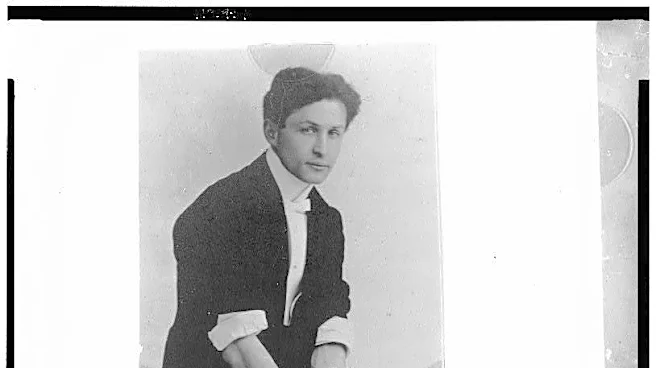
Houdini, the legendary magician, illusionist and escape artist who died 100 years ago, "was the biggest star in the world in his day," Teller said. "He was the Rolling Stones at their height. He was Brad Pitt. He was everybody all rolled into one."
A century after his death, Houdini remains an inescapable figure in American culture. He died at 52 on Halloween — Oct. 31, 1926 — and is being remembered with tributes, exhibits and séances across the United States this year.
The séances are eerily at odds with Houdini's late-career crusade to expose fraudulent mediums who claimed to communicate with the dead. Still,
his escapes from straitjackets, handcuffs, and other devices are what people remember most.
In popular culture, to "pull a Houdini" means to escape or disappear. Grammy-winning singer Dua Lipa used it in a refrain, "Catch me or I go Houdini," in her 2023 song "Houdini."
Even today, "if you walk down the street, stop someone and say, 'Name a magician,' the first name they'll say is Houdini," Teller said.
Teller is a Houdini enthusiast and collector of rare Houdini artifacts. USA TODAY consulted him and others to ask why the escape artist remains so popular today.
One of Houdini's best-known escapes: The straitjacket
Can't see our graphics? Click here to reload the page.
"You can get seriously hurt trying to get out of a straitjacket," said Thomas Ewing, national historian of the Society of American Magicians. Houdini himself "was often injured when getting out of these straitjackets. He suffered from a kidney injury for many years from a strap around his midsection."
Houdini was president of SAM from 1917 until his death in 1926.
A century later, why do people still remember Houdini?
Images of his famous performances are burned into collective memory:
- Shackled with handcuffs and chains in a police cell.
- Squirming out of a straitjacket while dangling by rope above a city street.
- Suspended upside-down in his water torture cell.
Songs, movies and scores of books underscore Houdini's long-lasting popularity. "There's even dozens of children's books about young Houdini and his escapes," Ewing said.

Why was the public drawn to Houdini?
"Houdini was about escape, and escape is such a powerful idea," said Joe Posnanski, author of "The Life and Afterlife of Harry Houdini."
His life and career "is the story of a man who cannot be confined or locked up," Ewing said. "It's life over death. That's what drew people to the theater."
When Houdini began performing, most magicians performed with assistants or audience members onstage. In contrast, "Houdini himself was the prime focus of his acts," said George Schwartz, curator-at-large at the Peabody Essex Museum in Salem, Massachusetts. The museum is presenting a Houdini exhibit this year.
"He was bound, chained or confined, and he escaped situations that seemed inescapable," Schwartz said. "That profoundly shaped people's conceptions of who he was, whether they had seen Houdini in person or had only read or heard about his feats."

Public performances captured public attention
Most significantly, Houdini didn't confine himself to theater stages.
"He was a publicity hound," Teller said. "When you think of Houdini escaping from a straitjacket, you don't think of him doing it in his living room.
"He's doing it hanging upside down by his ankles from the outside of a newspaper building, so the newspaper will get the best possible photo," he said. "And underneath, there's thousands of people. Houdini captures your imagination because he took magic out into the real world."
In doing this, "he’s become part of the language," said John Cox, who authors Wild About Harry, an authority website about Houdini. "His very name has come to symbolize all things mysterious, and the idea of freedom and self-liberation."
Performers themselves agree. "You really can't study magic without studying Houdini," said Kristen Johnson, an escape artist and magician known as Lady Houdini.
Modern-day magicians have presented their interpretations of Houdini acts, including escapes from water torture cells. Doug Henning performed one in 1975, and David Copperfield did his own version in 1984.
Johnson has escaped water cells, straitjackets and other Houdini-like devices. She's done them onstage without a curtain as the audience watched.
"I've had situations in the water cell that have not gone according to plan," Johnson said. In times of difficult escapes, she stays calm by thinking, "What's the most logical thing to do? What would Harry do?"
Where did Houdini start?
Houdini was born Erik Weisz on March 24, 1871, in Budapest, Hungary. He moved to the United States with his father, a rabbi, at age 4. Immigration officials changed Weisz to Weiss. As a young man, he was known as Ehrich Weiss.
The entire family later settled in Appleton, Wisconsin, and endured long-lasting financial hardship when Rabbi Weiss lost his position at the Zion Reform synagogue.
"Houdini grew up in poverty," said Eric Colleary, author of "Houdini's Library" and the Cline curator of theatre & performing arts at the Harry Ransom Center at the University of Texas at Austin. The center is offering a special exhibit titled Houdini’s Library. "He reinvented himself and became one of the most famous performers in the world."
Ehrich became a trapeze artist at age 9, and called himself "Ehrich, the Prince of the Air." He began performing magic acts at 17 and took the name "Houdini" in homage to Jean-Eugène Robert-Houdin, the French magician who's considered the father of modern conjuring.
He adopted "Harry" as his first name, probably because it sounded similar to his childhood nickname, "Ehrie," derived from Ehrich, according to wildaboutharry.com.
Houdini married Wilhelmina Beatrice Rahner, known as "Bess," on June 22, 1894. She became his stage partner, replacing his younger brother Theo.
"The Houdinis" performed magic and other acts in vaudeville shows across the country.
By 1895, their biggest act was called the Metamorphosis. Houdini is tied, put in a sack that's tied shut, and placed inside a locked trunk.
Audience members examined the trunk, and Bess pulled a curtain around it. Seconds later, Houdini emerged from behind the curtain and Bess was found inside the trunk, restrained the way Houdini was.
The Metamorphosis "was an instantaneous switch that looked absolutely miraculous," Teller said. "It really looked like two people had just suddenly dreamed their way into each other's positions instantaneously. It's such a beautiful, practical trick that's so full of meaning."
Houdini began performing handcuff escapes in 1895. He was discovered by Martin Beck, a vaudeville manager, who after convincing him to focus his stage acts on escapes, booked him on the Orpheum circuit as the Handcuff King.
"He never fully stopped being a magician, but he found as his career went on that he could get more jobs and more attention as an escape artist," Posnanski said.
Houdini’s fame grew from there. He and Bess traveled to London in 1900 and performed at the Alhambra Theatre on July 2. After a successful series of shows in Europe, he returned to the United States as a celebrity in 1905.
Over the next two decades, Houdini constantly introduced new acts to attract audiences and to stay ahead of imitators who copied his escapes.
"Nobody has ever been better at self-promotion than Houdini," Posnanski said. "He was a genius at making news, capturing attention and making people think about him."
You can't even escape Houdini's name while shopping. It shows up on products you wouldn't expect, like ice-cube trays, sportswear. and special-effects software.
His best-known escapes — from multiple handcuffs and shackles, straitjackets and large containers — became his signature performances.
Houdini "helped define modern media and marketing," Colleary said. "He staged free outdoor escapes that drew enormous crowds, challenged local police to lock him up and made sure the newspapers were there."
Those escapes included getting out of straitjackets while cranes suspended him over city streets and trunks submerged in water.
Many people came to see "if they were at the show in which Houdini was finally going to fail," Ewing said.
Houdini was extremely athletic and was about 5 feet, 5 inches tall, according to measurements the Smithsonian made in 1926.
Containers such as packing crates, the milk can, and the water torture cell incorporated concealed escape mechanisms. But Houdini also relied on his knowledge of locks, his physical strength, stamina, and exhaustive practice to free himself.
While Houdini found success with the escapes, magic remained part of his act.
"Houdini would work magic into his act as a warm-up throughout his career," Cox said. "Near the end, he created a three-act show with an all-magic first act. "Magic was always there. But people came to see the escapes!"
In the latter part of his career, Houdini added exposing fraudulent mediums.
Houdini's death, in Detroit, was attributed to diffuse peritonitis, the result of a burst appendix. He did not die during his water torture cell escape act as depicted by actor Tony Curtis in the popular 1953 Paramount film "Houdini."

Houdini exposed fraudulent mediums and asked Congress to stop them
Spiritualism is a movement that believes a person's consciousness exists after death and can be contacted by the living, according to the Encyclopaedia Britannica. It surged in popularity after World War I and the influenza pandemic of 1918-1920, according to history.com.
Houdini was devastated by the death of his mother in 1913 and made attempts through the years to communicate with her spirit. After discovering deception from mediums, he began publicly exposing frauds who exploited the grief of families.
"Houdini was very upset by this," Teller said. "He saw magic tricks being used to take advantage of people who were in desperately sad shape. It was a horrible racket."
He would attend séances in disguise, "catch mediums red-handed in the middle of their act and declare 'I am Houdini, and you are a fraud!'" Teller said. In his later theater shows, Houdini would use the last part of the performance to demonstrate how mediums could fool hopeful families.
Houdini also testified before a congressional subcommittee on Feb. 26, 1926, in favor of legislation against paid fortune-telling and communication with the dead.
"This thing they call 'spiritualism,' wherein a medium intercommunicates with the dead, is a fraud from start to finish," he told the committee.
While people know Houdini from his magic acts and escapes, "it's surprising how many are aware of his spirit-debunking," Cox said. "That was a relatively short period of time at the end of his life and career. But it is now very much part of his overall identity."
After Houdini died, Bess held annual séances for 10 years to contact him, using a special code they shared. The séances were unsuccessful, and Bess ended them.
Fans of Houdini conduct séances on every anniversary of his death. Special ones are being held this year.
Six things you may not know about Houdini
1. He did daring escapes but reportedly disliked driving a car. He said he was too easily distracted to concentrate on the road, according to wildaboutharry.com.
2. His younger brother Theodore, also known as Dash, performed with him until Bess became part of his act. Dash continued on his own as a magician and escape artist under the name "Hardeen." The brothers maintained a staged professional rivalry, according to wildaboutharry.com.
3. For a brief period, he was a pioneering aviator and made one of Australia’s first controlled, powered flights in 1910, according to museumsvictoria.com.
4. He appeared in several silent films, including two adventure serials and three features, and formed his own movie-production company, according to PBS American Experience.
5. He was a friend of Sir Arthur Conan Doyle, creator of Sherlock Holmes, though they later parted over disagreements on spiritualism and communication with the dead, according to PBS American Experience.
6. He was an avid researcher on magic, escape artists, the occult and spiritualism. He collected thousands of books, pamphlets, manuscripts, posters and other items, many of which were given to the Library of Congress. Others went to the Harry Ransom Center at the University of Texas in Austin.

Houdini’s private library could've filled a Barnes & Noble
"Most people don't realize Houdini was a serious author and historian," Colleary said. "He built one of the greatest private libraries on magic, spiritualism and theater history. He collected material from performers and booksellers around the world."
In the Library of Congress, "there are more than 4,000 items in the Houdini Collection," said Amanda Zimmerman, reference librarian in the Rare Book and Special Collections Division. Houdini's estate bequeathed the collection in 1927.
The Library of Congress collection holds "many books on magic, but much of it contains works Houdini collected in his 30-year study of spiritualism and related topics," Zimmerman said. That includes "religion, theosophy, occultism, parapsychology, clairvoyance, mesmerism and others."
Library patrons of all kinds request material from the collection, Zimmerman said, from the general public "to scholars working on very specific subject research. We also see a lot of interest in the collection from current, active magicians.
"I’ve found magicians tend to be the best scholars on the history of magic," Zimmerman said. "If you look at histories, you will often find the author is, or was at some point, a performer of magic."
While Houdini's books on magic and spiritualism went to the Library of Congress, "everything else in his large library was left to Bess to do with as she chose," Colleary said. More than 25 crates ended up at the University of Texas in Austin in 1958.
You can watch Penn & Teller examine items from the Houdini collection at the Library of Congress in October 1990.
Exhibits mark the 100th anniversary of Houdini's death
Tickets may be required for some of these events.
- Smithsonian: The Great Harry Houdini: Life, Death, and the Afterlife, 6:45 to 8:15 p.m. ET Nov. 9 online seminar.
- Appleton, Wisconsin: AKA Houdini, 10 a.m. to 4 p.m. daily at the History Museum at the Castle.
- Milwaukee, Wisconsin: 2026 Houdini Club Convention, Oct. 30-31.
- Austin, Texas: Houdini's Library through Jan. 24 at the Harry Ransom Center.
- Salem, Massachusetts: Peabody Essex Museum exhibit through Nov. 2 focuses on Houdini's 1906 visit to Salem.
- Scranton, Pennsylvania: The Houdini Museum, open year-round. Call for dates and times.
- Amarillo, Texas: Amarillo Magic Company, Oct. 31 one-day Houdini show.
- Budapest, Hungary: HOUDINI100 Grand Centenarium through Nov. 1.
Séances will try to contact Houdini
A few of the scheduled séances that will try to contact Houdini in the afterlife. Tickets are required.
- Marshall, Michigan: The American Museum of Magic, noon ET Oct. 31.
- Detroit: Detroit Historical Society, 6 p.m. ET Oct. 31.
- Alton, Illinois: American Oddities Museum, 10 p.m. CT Oct. 31.
- New York City: The 100-Year Houdini Séance, three séances are scheduled Oct. 31 at Houdini’s former residence at 278 West 113th St.

Movies celebrated Houdini and helped us remember him
Productions about Houdini include:
- "Houdini" | 1953: Tony Curtis as Houdini, Janet Leigh as Bess. (Film)
- "The Great Houdinis" | 1976: Paul Michael Glaser as Houdini, Sally Struthers as Bess. (TV)
- "Young Harry Houdini" | 1987: Wil Wheaton as young Ehrich Weiss. (TV)
- "Houdini" | 1998: Johnathon Schaech as Houdini. (TV)
- "Death Defying Acts" | 2008: Guy Pearce as Houdini, Catherine Zeta-Jones as a Scottish psychic. (Film)
- "Houdini" | 2014: Adrien Brody as Houdini, Kristen Connolly as Bess. (TV miniseries)
The 1953 film has been criticized for a number of historical inaccuracies. "The Tony Curtis movie was fantasy in many ways, but it's still a very good movie," Ewing said.
Want to know more?
- Wild About Harry by John Cox is an authoritative Houdini research site.
- Society of American Magicians, founded in New York City in 1902, is recognized as the world’s oldest magic society.
- The Houdinarian Society is a site focused on Houdini’s "legendary illusions and daring escapes."
Books on Houdini include:
- "Houdini's Escapes" by Walter B. Gibson (1930).
- "The Great Houdini" by Beryl Williams and Samuel Epstein (1950).
- "The Secrets of Houdini" by J.C. Cannell (1989).
- "The Life and Many Deaths of Harry Houdini" by Ruth Brandon (1993).
- "Houdini!!! The Career of Ehrich Weiss" by Kenneth Silverman (1996).
- "The Secret Life of Houdini" by William Kalush and Larry Sloman (2006).
- "The Life and Afterlife of Harry Houdini" by Joe Posnanski (2019).
- "Houdini, The Elusive American" by Adam Begley (2020).
- "Houdini's Library: Inside the Spellbinding Collections of the Great Illusionist" by Eric Colleary (2026).
- "The Man Who Died Twice" by Larrain Gillespie (2026).
The latest book, “Houdini: The Man Who Died Twice,” by Larryn Gillespie, a retired urologic surgeon, focuses on the circumstances of Houdini’s death. The author "treats it as a cold case that hasn’t been solved...she may have opened a new chapter on this," said Teller, who is reading the book.

Houdini's grave has been vandalized
Houdini is buried in the Houdini-Weiss family plot at Machpelah Cemetery in the borough of Queens in New York City. He unveiled it in 1916.
"It's not a big cemetery, but it's the one Houdini chose for himself and his family," Ewing said. "It's needed maintenance over the years, which has been done. But it's still in need of repair."
The Society of American Magicians annually conducts a Broken Wand Ceremony at the site to honor Houdini and note the deaths of other magicians. It also accepts contributions to help maintain the gravesite.
The busts of Houdini atop the exedra — the curved wall with benches — have been vandalized and stolen over the years. In 2011 "a replacement bust was put there by Dorothy Dietrich from the Houdini Museum in Scranton, Pennsylvania," Ewing said.
What was Houdini's greatest act?
Posnanski and Ewing say Houdini is best known for his escapes, though which ones are "probably a matter of opinion," Schwartz says.
"Some might point to his straitjacket escapes while suspended upside down from a tall building in a city," Schwartz said. "Others might say his water torture cell escape, since it's been popularized in film adaptations of Houdini’s life."
Teller offers one last thought.
"He's most remembered as the Elusive American, the guy who can get out of everything," Teller said. "The idea of self-liberation is very attractive and being the great self-liberator is the greatest trick of his career."
Would Houdini be satisfied with his place in history?
"I'm certain he would," Teller said. "The energy and images he put into the world and the joyful celebration of liberty he put into America have burned for all these years. I think that would probably tickle him to death."
Source: USA TODAY Network reporting and research; Reuters; wildabouthoudini.com; Harry Ransom Center at the University of Texas at Austin; Society of American Magicians; seancehoudini.com; The Houdinarian Society; Library of Congress; centerforinquiry.org; Smithsonian magazine; scientificamerican.com; Eileen J. Garrett Parapsychology Foundation, University of Maryland, Baltimore County; National Geographic
Contributing: Ramon Padilla
Special thanks to: Teller of Penn & Teller; John Cox of wildaboutharry.com; Thomas Ewing of the Society of American Magicians.
This article originally appeared on USA TODAY: 100 years after his death, we can't escape Houdini. Teller reveals why