






Are we alone in the universe? Could any other worlds beyond our solar system support life? What is the nature of enigmatic dark energy and how is it shaping the cosmos?
These are just some of the wide-ranging questions that NASA's next great cosmic observatory will seek to answer when it reaches space in the coming days. According to the U.S. space agency, the Nancy Grace Roman Space Telescope is expected to transform humanity's understanding of the cosmos as it scans massive swaths of the sky to shine a light on dark corners of the universe.
In the process, the Roman telescope will investigate the strange force known as dark energy accelerating the universe's expansion, observe the formation of galaxies and uncover far-away planets that have
eluded detection.
And it all begins potentially as early as this weekend with a rocket launch from Florida's iconic Kennedy Space Center.
Here's everything to know about NASA'sNancy Grace Roman Space Telescope, its impending launch and its mission to observe the universe like never before.
What is NASA's Nancy Grace Roman Space Telescope?
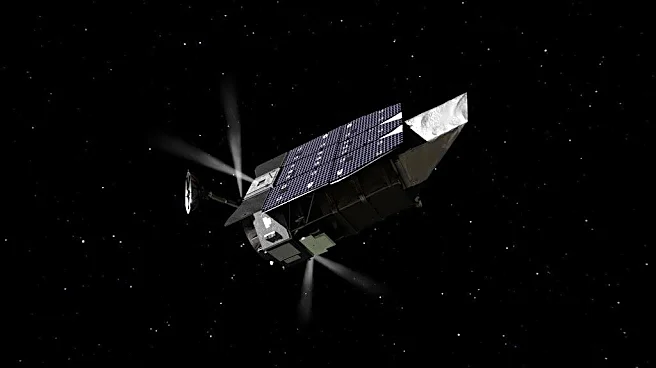
TheNancy Grace Roman Space Telescope represents NASA's next flagship astrophysics mission. Managed by NASA’s Goddard Space Flight Center in Greenbelt, Maryland, the observatory is designed to explore the outer solar system and beyond – prying into the previously unobservable far reaches of the universe to study dark energy and search for exoplanets.
When is the Nancy Grace Roman Space Telescope due to launch?
NASA is working toward an Aug. 30 launch of the Nancy Grace Roman Space Telescope, with liftoff taking place no earlier than 7:26 a.m. ET, according to the agency.
Where will the Nancy Grace Roman Space Telescope launch take place?
The telescope will get off the ground and be propelled into space from the historic Launch Complex 39A – the site of many Apollo moon mission launches – at NASA’s Kennedy Space Center near Cape Canaveral, Florida.
How will the observatory get to space? SpaceX Falcon Heavy to provide liftoff
The telescope will hitch a ride atop SpaceX's Falcon Heavy rocket, which will provide the initial burst of thrust to help it reach space.
The 230-foot-tall Falcon Heavy rocket is similar to SpaceX's well-known Falcon 9, except it is composed of not one, but three reusable core boosters from SpaceX's Falcon 9 – each powered by nine engines in the company's Merlin family. The design, classifying Falcon Heavy as a super-heavy launch vehicle, means the rocket is capable of transporting much bigger payloads to orbit.
Who was Nancy Grace Roman?
The telescope is named for Nancy Grace Roman, an American astronomer born in Nashville, Tennessee. The first female executive at NASA, Roman served as NASA's first chief of astronomy until her retirement in 1979.
Roman, who died in 2018 at the age of 93, came to be known as the "mother of Hubble" due to her role in planning the iconic space telescope, according to NASA.
What will the Nancy Grace Roman Space Telescope do?
Roman's primary objectives include revealing hundreds of more than a billion galaxies and studying the nature of dark matter and dark energy, according to NASA. The observatory will also aim to find and study thousands of new exoplanets – or worlds beyond the solar system.
How big is the telescope? How is it built?
Spanning 42 feet long and more than 14 feet wide, the Nancy Grace Roman Space Telescope is outfitted with two primary instruments:
- a wide multi-band 300-megapixel near-infrared camera known as the Wide Field Instrument that will allow scientists to look very far back in cosmic time and survey exoplanets;
- and the most powerful coronagraph to date, designed to reduce the glare from distant stars so it can photograph distant worlds that are could be nearly billion times fainter than their host star, as well as the debris disks orbiting them.
What makes the Roman telescope different from Hubble, Webb?
NASA envisions that the Roman telescope will be a complement to both the Hubble and James Webb observatories, exploring the same mysteries of the universe in different ways for a more complete picture.
The Roman telescope's field of view is 100 times wider than Hubble's, meaning every image it captures and beams back to Earth is equivalent in scope to 100 photos from its predecessor.
What orbit will the Nancy Grace Roman Space Telescope be in?
The telescope will make its observations while about 930,000 miles from Earth, facing in a direction opposite the sun. At this spot in space, known as the second sun-Earth Lagrange point (or L2,) gravitational forces balance to keep objects in steady orbits, according to NASA.
How long will the telescope be in space?
The Nancy Grace Roman Space Telescope's primary mission is expected to last five years, though NASA designed it for a five-year extension.
Eric Lagatta is the Space Connect reporter for the USA TODAY Network. Reach him at elagatta@usatodayco.com
This article originally appeared on USA TODAY: NASA's next great telescope launches this weekend. What to know about it