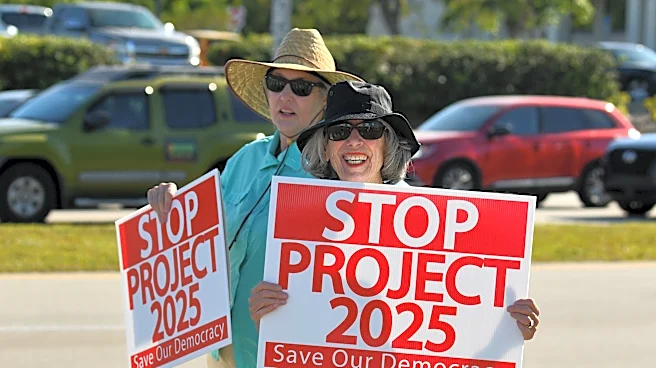



Two years ago, as Donald Trump and Kamala Harris were nearing the finish line in the 2024 presidential election, one controversial topic kept coming up during their debates and rallies.
Project 2025.
Harris warned that Project 2025, a 920-page plan to transform the federal government produced by the hard-right Heritage Foundation, would "take our country backward" and "weaken the middle class."
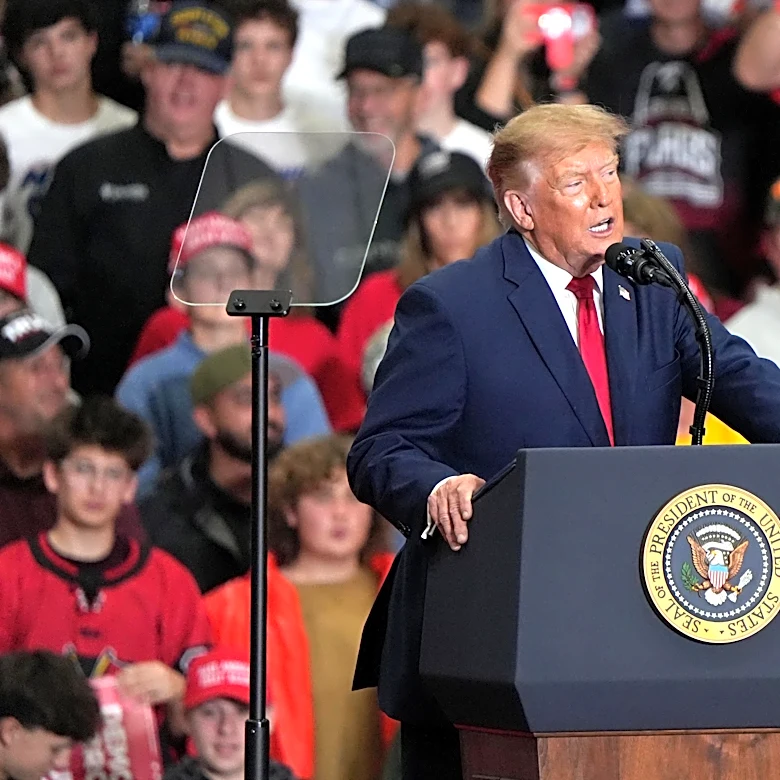
Trump, knowing that polls in 2024 showed a majority of voters did not like Project 2025's projected goals, insisted he had nothing to do with it and even called the plan's authors part of "the radical right."
Guess what happened next.
Trump won a second term as president, hired the people who wrote Project 2025 to run his administration and let them get to work
implementing it.

Project 2025 doesn't make as many headlines these days. But the impacts have been felt across the government.
Federal agencies slashed staffing, but then had to rehire some employees. Militarized mass deportations caused havoc in American cities. Trump's team hunted down any reference to "diversity, equity and inclusion" and halted programs addressing LGBTQ+ issues. Energy sector regulations were disabled. Disaster planning funds were washed away.
It's time to remember Project 2025, to look at the context of what it has meant in the first 21 months of Trump's second term. Just ahead of the Nov. 3 midterm elections, it's time to decide whether this is what you want from your government.
Ways Project 2025 was enacted in two years of Republican reign

Project 2025 was a blueprint, but Trump rarely sticks directly to any plan. Consider FEMA, the Federal Emergency Management Agency. Project 2025 proposed pushing more disaster response responsibility onto the states. But Trump had another idea – using FEMA funding as political leverage in blue states.
"One of the most surprising features of this administration has been the outright, unabashed politicization of emergency aid," said William Galston, a senior fellow at The Brookings Institution, a nonpartisan research think tank. "That used to be one of the few remaining areas of genuine neutrality."
Galston and Elaine Kamarck, another Brookings senior fellow, told me Project 2025 allowed Trump's second term to get off to a very quick start but also caused friction as an eagerness to slash federal programs and employment prompted concerns from Cabinet secretaries who saw their agencies and staff impacted.
And they question whether much of what Trump has accomplished with Project 2025 has staying power, because so much of it was implemented by executive orders that the next president can eliminate.
"They're more than happy to have people believe that an executive order is akin to a bold and revolutionary bill signing of something that came out of Congress," Kamarck told me of Trump's team. "And it's just not true."
But the damage of Project 2025 can be lasting, and a political danger for future presidents. One place to look for that is FEMA. Workforce reductions at FEMA and cuts to state grant programs landed just ahead of an unusually calm hurricane season in the Atlantic Ocean.
George W. Bush took sustained criticism in his second term as president for his administration's disaster preparedness and bumbling response in 2005 to Hurricane Katrina, which killed nearly 2,000 people.
Trump should know – the next storm is always out there, somewhere.
"They're just lucky that it hasn't come to bite them in the (expletive). But it will," Kamarck said. "There's no doubt that sometime in the next two to four years there will be some kind of Katrina-level disaster."
Galston told me the next president will need to rebuild FEMA for when that disaster hits because they will take the blame for a bad federal response, even if Trump is the reason the resources and staffing are no longer available.
Project 2025 proposed, and the so-called Department of Government Efficiency under Elon Musk accomplished, massive cuts to the federal workforce with voluntary incentives to quit. But Kamarck told me we won't really know the scale of the cuts until 2029, because so many of those eliminated positions are now being restored.
DOGE is now a sad joke, a short-term chaos agent that ludicrously claimed to have found $215 billion in savings in federal spending. The Government Accountability Office in August reported that much of that was exaggerated or unproven. Musk in December said that DOGE had been "somewhat successful," but that he would not do it again if he had the chance.
And the cleanup for that chaos continues.
"Nobody quite knows yet how many people they will need to hire back and whether or not people will want to come back to the federal workforce because of the trauma that DOGE inflicted on them," Kamarck said.
Attacking DEI became a staple of Trump's agenda

Project 2025 also exploited political culture war issues to attack at the federal level programs as varied as diversity, equity and inclusion (DEI) in hiring to reliance on fossil fuels versus renewable energies.
Kamarck told me the federal government purge of DEI programs has been largely effective, including overreaching efforts that impacted programs that studied breast cancer and ovarian cancer.
But Trump also used the power of the federal government to attack DEI programs at universities. Galston told me some universities just changed how they labeled some programs and job descriptions, as DEI has "gone into hiding" on campus.
Project 2025's aspirations to stamp out DEI programs, which the plan called "profoundly unserious," were a major focus for Trump's secretary of Defense, Pete Hegseth, even as America's military engaged in short-term hostilities with Venezuela and a prolonged war with Iran.
The result: Hegseth has forced out high-ranking officers or rejected their promotions, including several Black and female officers.
Hegseth wants to be called the "secretary of War." But he's too stuck on his worries about being "woke" to be much use in war.
Conservatives want big government. They just want to control it

For fossil fuels, Kamarck called the Trump administration's recent move to roll back mileage standards for new cars "was a biggie, and has been around for a while" on the list of conservative goals.
That also helps drive political division. "Over the past generation, energy has become more than an economic issue. It's become a cultural issue," Galston said. "Either you're for fossil fuels or you're against them."
James Goodwin, a policy director at the Center for Progressive Reform, a nonprofit research organization, has tracked Project 2025's implementation and estimated that by February, about 53% of the plan had been initiated or enacted.
He found tension in the plan between the administrative-law overhaul envisioned when Project 2025 was written in 2023 and what happened when Trump took office and unleashed the federal government, people like Musk and his DOGE acolytes.
It can be difficult to track more Project 2025 progress, Goodwin said, as normal federal procedures are not followed, especially if the Republican-controlled Congress does little to provide oversight for implementation.
Goodwin cites the destruction of the U.S. Agency for International Development, a humanitarian program known as USAID, as a Project 2025 target that didn't go as Project 2025 projected. The plan had been to exert more presidential control over the agency, and to eliminate emphasis on DEI and climate change issues, while empowering "faith-based" organizations to run programs abroad.
"Instead, they just got rid of the whole thing," he told me, calling that "a trial balloon" for sweeping changes that upended how federal agencies are managed because Trump felt "zero pushback" to stop it.
Goodwin said that's not a problem for the Project 2025 authors because, in his opinion, this was never about the granular details of federal programs. Project 2025 moved on from the conservative ideal of a smaller government, shifting to a larger government as long as the people writing the plan hold the power.
"It was about a new way of thinking about government," Goodwin said. "It is a full-throated endorsement of a very specific kind of big government that is distinctly conservative."
2026 midterms could be Project 2025's epilogue

Remember what Trump said during a 2024 presidential debate with Harris about Project 2025: "I have nothing to do with Project 2025. That's out there. I haven't read it. I don't want to read it, purposely. I'm not going to read it. This was a group of people that got together, they came up with some ideas. I guess some good, some bad. But it makes no difference."
There are only two parts of that statement that sound remotely true – Trump didn't want to read the plan, and so he didn't. The rest is standard Trump distancing from terrible ideas he quickly embraced. It made a difference.
The 2026 midterm elections will determine if Republicans remain in control of Congress and continue to abet Trump's efforts to twist and transmogrify our federal government. The midterm polling shows a growing blue wave in support of Democrats winning control of Congress, which suggests Americans have seen enough of that.
That should be Project 2025's epilogue, and voters should keep that in mind when they cast their ballots.
Follow USA TODAY columnist Chris Brennan on Bluesky, @bychrisbrennan.bsky.social, and on X, @ByChrisBrennan. Sign up for his weekly newsletter, Translating Politics, here.
This article originally appeared on USA TODAY: How Project 2025 became the blueprint for Republicans' failure | Opinion