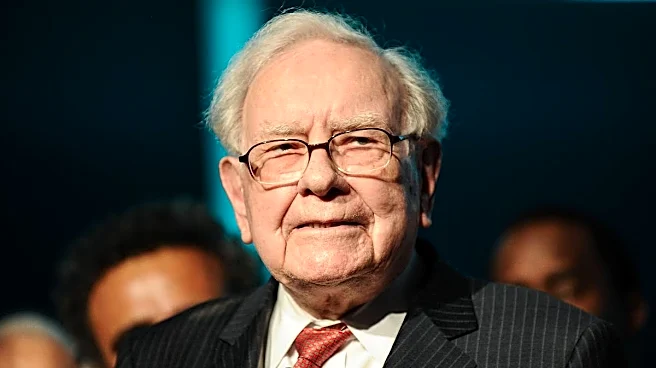






Warren Buffett, a near-mythic figure in the American investing world, is stepping down as chairman of the company he built, Berkshire Hathaway.
Buffett will become chairman emeritus, effective immediately, the company announced on Sept. 18. His son, Howard Buffett, 71, replaces him as chairman.
Warren Buffett is 96. That his departure from the day-to-day business world is big news speaks to his gravitas within it.
Buffett is the 10th-wealthiest American and the nation’s wealthiest nonagenarian, according to Forbes, with an estimated wealth of $144 billion. He’s widely regarded as one of the shrewdest investors in Wall Street history. He’s also co-founder of the Giving Pledge, a challenge to the ultra-wealthy to give at least half their wealth to charity.

Buffett built a failing textile company into a $1.1 trillion colossus
Over six decades, Buffett transformed Berkshire Hathaway from a failing textile company into a $1.1 trillion conglomerate while building an investment philosophy that influenced generations of investors and executives, making him one of the most consequential figures in modern corporate America.
His departure has played out in stages: Nine months ago, he handed the CEO reins to longtime lieutenant Greg Abel.
“Serving as your Chairman has been the privilege of a lifetime, and I have never taken your trust for granted,” Buffett wrote in a Sept. 18 letter to shareholders.
“Father Time always wins. He has, however, been generous with me. He has given me the opportunity to see Berkshire reach a point where I am more confident than ever about what lies ahead. The company is in excellent hands, and I look forward to remaining a shareholder alongside you.”
Buffett is one of the world’s oldest billionaires. His eventual departure from Berkshire Hathaway was long anticipated.
“It was always a matter of when, not if. Buffett has made a graceful exit,” said Brian Jacobsen, chief economic strategist at Annex Wealth Management. “Berkshire has had years to prepare for this transition, so this feels more like the completion of a carefully planned succession than a sudden changing of the guard.”
Wall Street is already feeling Buffett's absence
That doesn’t mean Wall Street is pleased to see him go.
Berkshire operates businesses such as the insurance giant GEICO and the Burlington Northern Santa Fe Corporation, which operates a massive freight railroad network, along with Dairy Queen ice cream and grizzled brands such as the World Book Encyclopedia.
The conglomerate also holds a massive and closely watched investment portfolio, with large stakes in such companies as American Express, Bank of America, Coca-Cola, Apple and the New York Times.
Between 1965, when Buffett took over, and 2023, Berkshire stock reaped a compounded average annual return of 19.8%, according to an analysis by Motley Fool. That compares to 10.2% for the S&P 500 as a whole.
But Berkshire stock has struggled since Buffett began to step back. Its stock is up just 0.7% this year, as of late morning on Sept. 18, compared with an 11% gain for the S&P.
“Warren Buffett is arguably the greatest investor of all time, with generations benefiting from his investment acumen,” Abel wrote in a 2025 letter to shareholders. He added, “Warren is obviously a very hard act to follow.”

Buffett shaped generations of corporate leaders
Over the decades, Buffett's philosophy of taking the long view when making decisions and focused capital distribution has guided business leaders and everyday investors alike.
“The culture Warren built and the values he championed will remain at the heart of Berkshire, and Howard will be their guardian,” Abel said in a Sept. 18 statement.
CEOs have looked to Buffett as a sounding board on everything from acquisitions and succession, to getting through periods of market turmoil, while his annual shareholder meetings became a heralded destination for those seeking an investment road map.
“As Chairman Emeritus, Mr. Buffett will remain a member of the Board of Directors and will continue to offer his valued judgment and perspective,” Berkshire said in its statement.
Chairman emeritus is typically an honorary title given to a retired board leader or company founder to recognize past service and lasting impact.
Buffett first announced plans to step away from the conglomerate in May 2025, surprising shareholders and analysts despite his age. After decades at the helm, he had become synonymous with the company, making his succession one of the most closely watched in corporate America.
Unlike his father, Howard Buffett will not have a management role as chairman, and his main responsibility would be to preserve Berkshire's culture.
That culture includes letting Berkshire's operating businesses handle their day-to-day affairs without interference from upper management, though Abel is widely seen as more keen than Warren Buffett to address performance shortfalls.
Howard Buffett had his own definition of Berkshire's culture.
“It's not rocket science,” he told the Wall Street Journal in January 2025. “The culture is to keep things simple, to do what you need to do but don't do a lot of things you don't need to do, treat people fairly, respect your managers, respect your shareholders. Tell them the bad news upfront, be honest.”
Reuters contributed to this report
This article originally appeared on USA TODAY: Greatest investor ever? Warren Buffett's legacy at Berkshire Hathaway