



Spooky season is in full swing and places around the country are celebrating their haunted history this October.
In Georgia, many scare-seekers may assume the city of Savannah is their best bet at glancing a ghost or peeping a poltergeist. Ghost tours and haunted pub crawls bring visitors to spots around the city each year, stopping at burial grounds, paranormal hot-spots and historical haunted hotels.
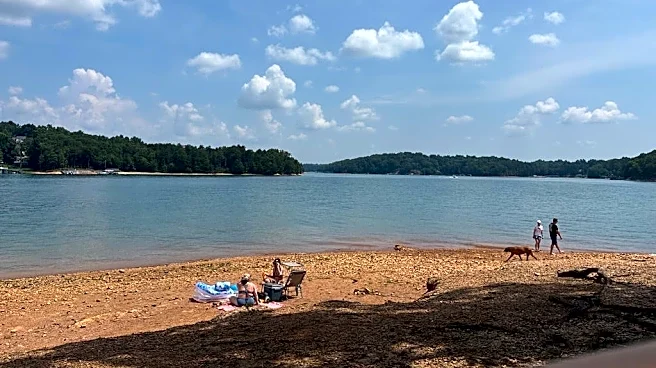
But in the northern part of the state, there is a different landmark that takes the title of Georgia's most haunted — Lake Lanier.
The roughly 38,000-acre federal reservoir may seem like nothing more than the water source for the greater Atlanta metro and a fun spot for boating in the summer. This year, it was even voted as the best lake to see fall
foliage from the water.
It's history, however, is much darker. Here's why Lake Lanier is considered one of the most haunted lakes in America.
Creation of Lake Lanier floods town
Lake Lanier was artificially created in the 1950s by the U.S. Army Corps of Engineers and was named after Civil War Confederate soldier and poet Sidney Lanier. The site was selected between Forsyth and Hall Counties, a heavily affluent area north of Atlanta.
But the space in the middle was already occupied. The city of Oscarville was established in the 1800s and was home to a thriving Black farming community before the death of an 18-year-old white woman in 1912. Her attack led to two young Black men being wrongfully convicted by all-white juries and hanged.Mobs of white people set the town on fire in the trial's aftermath, and many of the residents were forced out of the county.
The town's structures weren't removed, and when the Army Corps decided to flood the land for the reservoir, the remnants of the once thriving community were also thrust underwater.
The infrastructure for the reservoir, including the dam, where built over a period of about seven years, and the "full pool" was reached in August 1958. The evidence of the racial cleansing of Oscarville and forced expulsion of the Black community from Forsyth County remained at the bottom of the lake.
This is where the urban legends and ghost stories begin.
Do bodies float up from the bottom of Lake Lanier?
There have been plenty of stories of a woman in a blue dress reaching out for swimmers from the depths, or paranormal enthusiasts seeing suspicious things while diving around the wrecks of Oscarville.
But the story that bodies started to float up from the town's cemeteries is untrue. Graves that were marked were relocated prior to the flooding, and there have not been reports of caskets from the Oscarville era floating up to the surface.
That doesn't mean no historical human remains have been found.
“The technological capability to identify and verify unmarked burial sites through subsurface scanning or other means was far less robust 70 years ago,” Cesar Yabor, a spokesperson for the Corps told CNN in a 2020 interview. “While the Corps made every effort at the time to locate unmarked burials, the limited capabilities of the time make it probable that unanticipated finds of human remains are possible, whether from the antebellum and Civil War periods or of Native American origin from pre-colonial and ancient times.”
Hundreds of deaths on the lake continue
Lake Lanier maintains its haunted reputation, or possibly cursed reputation, as it remains one of the most deadly lakes in the country.
There have been as many as 700 deaths on the lake since it's creation, with 200 or so of those deaths occurring between 1994 and 2002.
Compared to deaths in the Great Lakes, this may seem like a relatively small number (1,501 people have drowned in the Great Lakes since 2010, as of Sept. 28), but Lake Lanier is a fraction of the size of just one Great Lake, let alone all of them.
The woman of the lake rumors began after the body of a woman with no hands wearing a blue dress was found by a fisherman in 1959, a year after two women had gone missing after leaving nearby Dawsonville, Georgia. She was too decomposed to identify, but when the vehicle of one of the women was found by bridge workers with bones inside in 1990, the earlier remains were believed to be that of the second missing woman.
In December 1964, Lake Lanier saw it's deadliest day. A vehicle carrying 11 people drove off a bridge on Christmas Day, leading to the death of five children and two adults.
But there have been many modern deaths, from drownings to boating accidents to a freak electrocution.
What is important to remember is that more than 11 million people visit the lake every year, and the water itself is not dangerous. Everyone who visits the lake should practice safe swimming and boating techniques, and should be wary of potential dangers of swimming and boating on the lake.
Some call for Lake Lanier to be drained
Lake Lanier, and the surrounding watershed, provides water for the entire Atlanta metro area and some of the neighboring counties, but with the history of deaths on the lake some have called for it to be drained.
In 2012, the son of Usher's ex-wife Tameka Foster died in a boating accident on Lake Lanier. Kile Glover was 11 years old when he was run over by a personal watercraft and died two weeks later.
Foster raised 2,500 signatures in 2023 to "drain, clean and restore" Lake Lanier to remove hazardous debris and other obstructions that may lead to boating accidents. The effort has not moved forward.
Irene Wright is the Atlanta Connect reporter with USA Today’s Deep South Connect team. Find her on X @IreneEWright or email her at ismith@usatodayco.com.
This article originally appeared on USA TODAY: This Georgia lake is considered one of America's most haunted. Why?