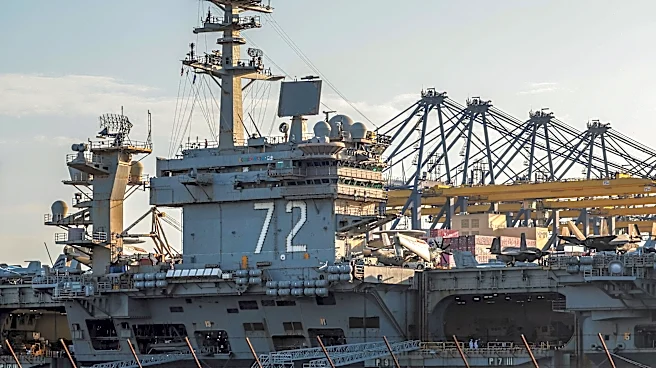








SAN DIEGO – The U.S.S. Abraham Lincoln aircraft carrier will return home to San Diego on Oct. 8, after a grueling, 321-day marathon deployment that saw its crew brave deteriorating conditions while operating in an active combat zone for months.
The lengthy deployment took a toll on the crew, which experienced mental health challenges, poor living conditions, and reduced meal options during a record-setting amount of time at sea without a port stop.
Eight sailors attempted suicide during the Lincoln’s deployment, according to acting Navy Secretary Hung Cao. No sailors on the Lincoln died by suicide.

Defense Secretary Pete Hegseth visited the Lincoln ahead of its return to San Diego on Oct. 7, where he awarded the crew with the Presidential Unit
Citation for extraordinary heroism — the highest unit-level decoration awarded by the United States Military.
"You have changed the arc of history," Hegseth said. "Ensuring that crazy people, theocrats, never get a nuclear weapon changes the arc of history."
Hegseth praised the Lincoln's crew of roughly 5,000 while delivering remarks onboard the aircraft carrier, acknowledging they had endured an historically lengthy deployment and rattling off statistics he said spoke to the professionalism and bravery of the men and women on board.
"You sunk 59 of them — 59 vessels of the Iranian Navy," Hegseth said. "They had a modern Navy before this conflict started, and then they had to deal with the USS Abraham Lincoln."
The Lincoln departed its home port of San Diego on Nov. 21, 2025, more than three months before the start of the U.S.-Israeli war on Iran. The aircraft carrier spent more than 200 days in a war zone, helping to conduct airstrikes against Iranian targets and enforce the United States blockade of the Strait of Hormuz.
Poor conditions on the Lincoln
The conditions onboard the Lincoln began to deteriorate as the U.S. military struggled to resupply the aircraft carrier following an Iranian missile and drone attack that destroyed the Navy’s base in Bahrain, which served as a major logistics hub.
President Donald Trump and Hegseth initially downplayed the reports of poor conditions on the Lincoln, prompting outrage from members of Congress.
Trump said in August that the Lincoln’s deployment was “not nearly long enough” in response to a question about the aircraft carrier.
Sen. Kirsten Gillibrand, D-New York, pushed the Navy’s leadership for more information about the conditions on the Lincoln. In a reply on Sept. 22, Cao revealed that eight sailors on the Lincoln had attempted suicide, one sailor had gone overboard, and another attempted to go overboard.
The sailor that went overboard was “quickly recovered,” Cao wrote.
The Navy also acknowledged that the resupply issues forced the Lincoln to reduce the number of main entrée options served to sailors from two to one.
“This measure was implemented to optimize endurance and ensure sustained time on station," Cao wrote. “Four meals were served daily, and all meals provided were nutritionally balanced, with adequate calories per day made available to every Sailor.”
On Sept. 2, the Lincoln made its first port stop in months in Pattaya, Thailand. The city, a popular tourist destination in Thailand, offered thousands of sailors their first opportunity for rest and relaxation on land after months at sea.
This article originally appeared on USA TODAY: The USS Lincoln is returning home as lengthy deployment ends