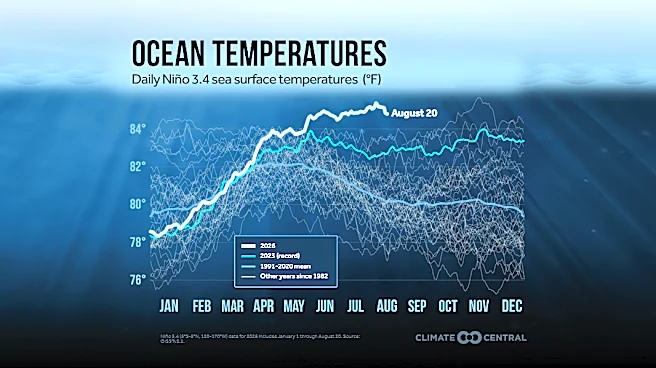



With sharks on the move, sea surface temperatures skyrocketing and one tropical system after another in the eastern Pacific, signs of a potentially historic El Niño seem to be popping up all over.
This climate powerhouse is expected to reach unprecedented strength later in 2026, inspiring a flurry of colorful, descriptive terms across social media posts, blogs and even news stories. "Monster," "mega," "mind-blowing," and even "flamethrower" have appeared in posts and headlines to describe this strengthening El Niño.
Grasping for a catchy description seems only natural. We name fires and hurricanes. We’ve debated naming winter storms. The intense 2015-2016 El Niño was widely dubbed Godzilla, as people struggled to compare it to the very strong
El Niño in 1997-1998. That nickname even later emerged in scientific papers.
And yet, scientists have consistently said the apropriate term for this El Niño is simply "very strong."
The description comes from an official classification from the National Oceanic and Atmospheric Administration. It is based on the three-month average that categorizes El Niño as weak, moderate, strong or very strong.
Even so, "very strong" just doesn't have quite the same cache as a "Cat 5 hurricane" or an "EF-5" tornado.
That leaves meteorologists, social media users and journalists reaching for adjectives to describe this El Niño. “Super” is the description most often being used, but that's prompted reminders from science communicators who say at the very least it shouldn't be "Super" with a capital S because it's not an official NOAA term.
Humans tend to want to name and compare historic weather events, said Adam Rainear, an associate professor of communication and media at West Chester University of Pennsylvania. It makes it easier to understand and compare events.

As the Pacific heats up this summer, the term "super" has grown on some of the scientists who were uneasy with the word earlier in the summer.
“Especially if this event meets or exceeds the peak levels seen in previous El Niño years, maybe we will need language to differentiate it,” said Emily Becker, a research professor at the University of Miami's Rosenstiel School.
Climate scientist Michael Mann was not a fan of using the word super before El Niño arrived. “Now that the event has materialized, it’s fair to characterize it in those terms,” said Mann, director of the Penn Center for Science, Sustainability & the Media at the University of Pennsylvania. “It does look like it will potentially be the largest El Niño event on record."
Because such strong events are still unusual, "we don't have a lot of comparisons for this situation," Rainear said. "We've only had a few really extreme El Niños that we can point to. Without a tangible way to create your comparison, how do you know if this El Niño is any worse?”
Ultimately, what’s in a name doesn’t seem to have a big role in the public risk perception, he said. That’s evident in NOAA's hurricane messaging, when forecasts warn those in harm's way to pay less attention to the category and more attention to the potential impacts of each particular storm. NOAA takes its public safety messaging very seriously, working with sociologists on how to convey messages. It's one reason the National Hurricane Center has retooled its forecast cone graphic and other products.
Michael McPhaden, a recently retired NOAA senior scientist who studied El Niño for more than 40 years, said he doesn't "think we need to make a new category for this event."
"There have been three what we would call extreme El Niño events in the past 50 years," in 1982-83, 1997-98 and 2015-16, he said. "This event we'll get to in 2026-27 will rival those, if not exceed those, in magnitude."
If the current El Niño turns out as big as scientists think it will be, he said, “we will have had three major El Niños in the course of a decade, not something we've seen in the previous 150 years in the historical instrumental record.”

Dinah Voyles Pulver, a national correspondent for USA TODAY, covers violent weather, climate and the environment, among other news. Reach her at dpulver@usatoday.com.
This article originally appeared on USA TODAY: Unprecedented El Niño has earned this perplexing label