








Years ago, I was attending a seminar for new university presidents where our conversation turned to the greatest challenges we expected to face. The discussion soon became a catalogue of conflicts: controversial speakers, offensive faculty remarks and when a president should intervene in crises. After listening for several minutes, I posed a different pair of questions.
“What is the purpose of our universities? Why do they exist?”
The room fell silent.
That silence has stayed with me. It revealed a challenge deeper than any controversy of the moment. The crisis facing American higher education today is not merely ideological; it is teleological – a crisis of purpose.
The “call to action” recently issued by Secretary of Education Linda McMahon provides
universities an opportunity to recover that purpose.
Reflecting on what universities offer society
The erosion of public trust in higher education and the troubling decline in the share of Americans enrolled in postsecondary education reflect a system in need of serious reevaluation. The secretary’s call for transparency offers a way for the public to better understand how universities approach matters such as admissions, research, affordability, academic rigor and artificial intelligence.
However, none of these questions can be addressed apart from the deeper question of purpose. Before a university can define the practices that govern how it operates, it must answer why it exists.
Purpose is not a slogan to be placed on a website. It is the foundation from which institutional decisions should flow.
A university committed to forming thoughtful and responsible graduates will shape admissions around the community it seeks to build, insist on academic rigor because it respects students’ potential, pursue research that expands knowledge and serves humanity, address its affordability as part of its public responsibility, and approach artificial intelligence by asking not only what technology can do, but also what kind of human beings education is meant to form.
A return to universities' historical purpose
At its best, a university is one of civilization’s great achievements: an intergenerational community devoted to the shared pursuit of truth. In such a community, students learn to examine arguments carefully, listen seriously to those with whom they disagree and follow evidence wherever it leads.
A letter of admission to a great university should represent more than acceptance. It should be an invitation into one of humanity’s great conversations, stretching from the accumulated wisdom of the past toward discoveries yet to come.
There, students encounter Plato and Shakespeare, Maimonides and Madison, Newton and Einstein as living conversation partners whose ideas they can study, challenge and carry forward with insights of their own.
When universities lose sight of that purpose, they inevitably look for substitutes. Too many have come to measure success primarily by rankings, enrollment targets and institutional prestige rather than by the formation of thoughtful, capable and responsible graduates.
In some places, the pursuit of truth has become entangled with advocacy, while consumerism has redefined education as a product, a degree as a purchase, and students as customers.
That is why a return to the university’s original vision is so urgent now. In an isolating and rapidly evolving technological age, the next generation is searching for meaning and belonging, in addition to career paths toward a secure future. Few institutions are better positioned to meet those needs than universities that understand education as the formation of the whole person.
The rise of artificial intelligence only reinforces that responsibility. Information has become almost limitless. Wisdom has not.
AI can answer questions with astonishing speed. It cannot teach a young person which questions are worth asking.
It cannot cultivate judgment, courage, empathy, resilience or purpose. Those qualities emerge through relationships – with teachers, classmates, mentors, great books, scientific inquiry and the shared life of a university community.

At my school, Yeshiva University, this means aligning our priorities and practices with our values-based mission: to educate with excellence, prepare students for professional lives of consequence, and foster research that advances science, technology, medicine and the broader human good.
Our mission is rooted in a Jewish intellectual heritage deeply consonant with academia's highest ideals: the primacy of reasoned argument, the pursuit of truth and the conviction that education should shape both intellect and character.
Self-reflection can serve a meaningful purpose
That is how I understand Secretary McMahon’s call to action – not as an invitation for every institution to become the same, but as a summons for each to articulate, in its own words, the educational community it seeks to build.
America’s colleges and universities have never shared a single mission, nor should they. Major private and public universities, liberal arts colleges, community colleges, historically Black colleges and universities, and faith-based colleges and universities all bring distinctive missions and traditions to our national life.
Yet beneath those differences lies an older understanding of the university as a community rooted in wisdom, devoted to discovery and seeking not only to expand what students know, but also to shape who they become.
As the new academic year begins, each institution has the opportunity to set out publicly the kind of graduates it hopes to form, the values it seeks to cultivate and the contribution it aspires to make to society.
This does not mean returning nostalgically to some imagined past. It means recovering the enduring purposes of the university and applying them with confidence to the challenges of the present. The strongest institutions will rise to this moment by articulating the convictions that gave them life and demonstrating how those convictions shape who they are today.
Americans have not stopped believing in higher education. They are asking universities to once again believe in themselves.

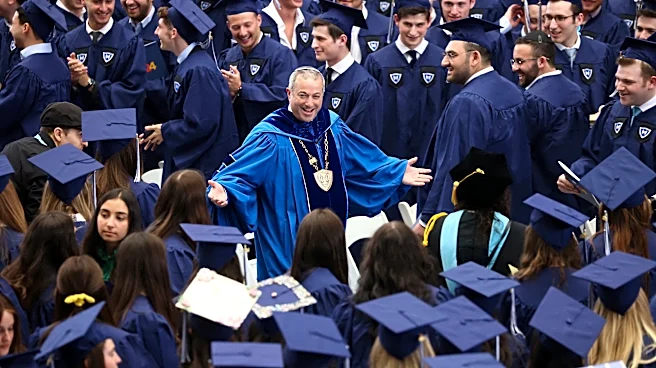
Rabbi Ari Berman is the president of Yeshiva University.
This article originally appeared on USA TODAY: Colleges have lost sight of their goals. That's the real crisis. | Opinion