



As some school districts across the country limit the use of artificial intelligence in the classroom, teachers have mixed thoughts about the technology.
On Sept. 2, New York City Mayor Zohran Mamdani passed a one-year moratorium that bans the use of student-facing generative AI for students 2K (early childhood) through eighth grade for the 2026-2027 school year. Since the news broke, some teachers have taken to social media to express their thoughts.
Janet Elias is a teacher and technology specialist at Robert F. Wagner Jr. Secondary School for Arts and Technology in Queens, New York. In a TikTok video shared Sept. 2, Elias said she agreed that students before middle school should not be introduced to AI.
"I absolutely support our youngest students
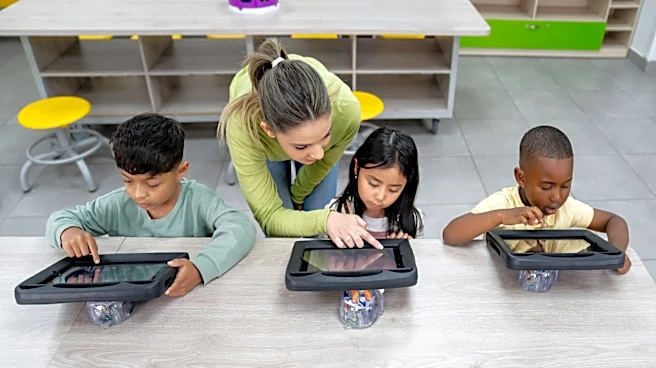
... 2K all the way to 5th grade should not be using any devices at all, that's just my stance on it. They need to be using Crayons and pencils and writing and reading. They don't need tablets. They don't need iPads. They don't need Chromebooks," Elias said in her video.
However, Elias, who said she has taught technology for 22 years, doesn't think the moratorium should affect middle schoolers.
"I wrote a whole curriculum for my middle school students in order to teach them AI and those students are probably very happy they had me because they understand how AI works," she said in her video. Elias said she taught middle schoolers about machine learning, large language models, misinformation, bias, plagiarism, AI privacy and ethical use of AI.
"They even learned how to train their own AI model," Elias continued. "Those are not lessons in cheating. Those are lessons in critical thinking."
'AI has its place.'
Mandy Traub is a fourth grade teacher at Rolla Public Schools in Rolla, Missouri. She understands where entities looking to ban generative AI in the classroom are coming from. But she told USA TODAY, "AI has its place."
This year, Rolla Public Schools is utilizing McGraw Hill's ALEKS, an AI-powered math and science assessment program. Traub said the 2026-2027 school year will be the first year the district is using the program but other similar ones have been used in the past.
The idea, Traub said, is students log onto ALEKS for about 10 minutes, two or three times a week. Different than general classroom instruction, ALEKS provides students with tailored assignments that hone in on problem areas.
Traub said she thinks it's important to distinguish the difference between teacher and student generative AI use because she utilizes the technology "like crazy." Generative AI can be used to create permission slip forms and lists of spelling test words, she said. More recently, Traub used AI to code a website that allows teachers across the district to digitally log their students' lunch selections, which she said used to be a lengthy morning process.
Teacher union voices concern over ban
In addition to the ban on generative AI use, the moratorium implements twice-yearly AI critical thinking modules for high schoolers, limited AI pilots for a small number of high school classrooms and age-appropriate screen time restrictions for students, according to a news release.
Students in second grade and below will have restricted 1-1 screentime; students in third through fifth grade will have a recommended cap of 30 minutes per day; and middle schoolers will be limited to 45 minutes per day, the news release outlines.
In a statement shared Sept. 2, NYC public schools labor union United Federation of Teachers President Michael Mulgrew said the screen time restrictions "makes sense."
"The AI policy, however, leaves many questions unanswered," Mulgrew said. "Missing are details about how the Department of Education will be more aggressive in demanding the products it purchases have AI safeguards. If we are going to be serious, let's start at the source, rather than expect school communities or individual educators to figure out after the fact if what their school uses fits the new policy."
More school districts implement AI bans
Similar restrictions are in place at the Los Angeles Unified School District (LAUSD).
Generative AI is not available to LAUSD students who are under 13, according to the district's Guidelines for Student Screen Time Policy. And for students who do have access, the technology must "support clearly defined education purposes with teacher direction and guidance," the policy outlines.
In a statement shared with USA TODAY on Sept. 3, the labor union United Teachers Los Angeles said nothing can replace the relationship between educators and students, and children need the opportunity to develop relationships with their peers during the school day, rather than "rely on chatbots for social interaction."
"However, for LAUSD’s AI policy to be effective, as with the district’s recent screen-time restrictions, collaboration will be essential," the statement continues. "Educators care deeply about the future of our students, and we look forward to working with LAUSD, school staff and parents to implement these changes in ways that support both student well-being and academic success."
Though Chicago Public Schools has not enforced an AI ban, 24 of 42 school board candidates running in the upcoming November election, have signed a pledge to enact a three-year moratorium pausing the use of generative AI in schools. The pledge, created by Illinois Families for Public Schools, would pause the use of current AI in the classroom and ask the board to create a clear policy for its use moving forward.
"Nurturing all children’s agency, knowledge, and creativity is paramount to their educational development, and learning is fundamentally a social, relational activity. No advance in technology can or should replace the interaction with peers and professional educators in our schools," the pledge states.
Greta Cross is a national trending reporter at USA TODAY. Story idea? Email her at gcross@usatoday.com.
This article originally appeared on USA TODAY: AI ban for students? Not all teachers agree